
Logo

American Heart Association

  23
  0


Final ID: MP1686

Multi-View Deep Learning for Automated Quantification of Mitral Stenosis

Abstract Body (Do not enter title and authors here): Background: Accurate assessment of mitral stenosis (MS) severity is critical to guide timely clinical management. Current evaluation relies on expert interpretation of B-mode and Doppler echocardiography, requiring integration of multiple views and skilled Doppler imaging. This study aimed to develop and validate a deep learning model for automated MS severity assessment using multi-view B-mode and color Doppler echocardiographic videos.
Methods: We developed a two-stage framework for automated MS assessment. First, four video-based convolutional neural networks were trained to classify MS severity from distinct echocardiographic views: B-mode [parasternal long-axis (PLAX), apical three-chamber and five-chamber (AP)] and color Doppler [PLAX-color, and AP-color]. Next, outputs from the four models were integrated using a machine learning ensemble (HistGradientBoostingClassifier) to produce a study-level MS severity classification. Performance was assessed using area under the receiver operating characteristic curve (AUC) on held-out test set from Kaiser Permanente (KP) and Stanford Health Care (SHC).
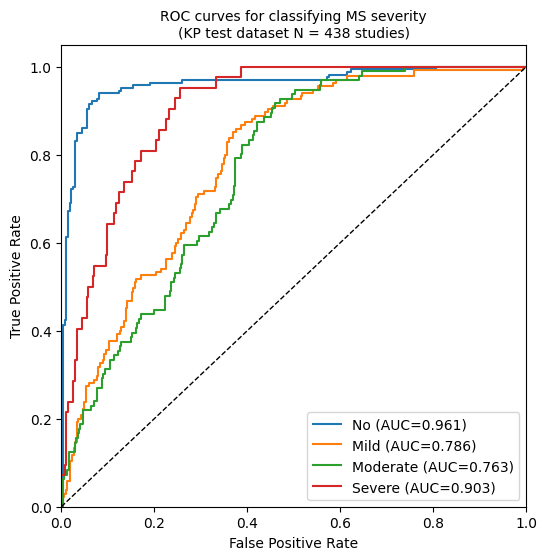
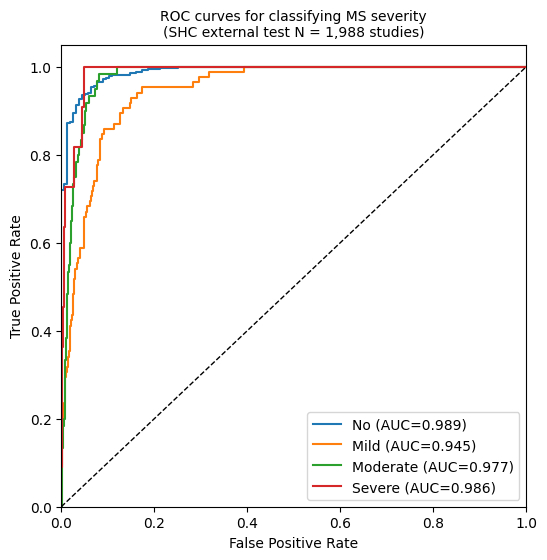
Results: The models were trained on 66,714 videos from 3,921 studies at KP, and evaluated on internal held-out test data (KP; 7,344 videos, 438 studies) and external test data (SHC; 29,181 videos, 1,988 studies). The multi-view ensemble model demonstrated strong performance, achieving a macro-AUC of 0.853 (95% CI: 0.828–0.877; Figure 1) on the KP test dataset. Generalizability was confirmed on the external SHC cohort with an AUC of 0.974 (95% CI: 0.968–0.981; Figure 2).
Conclusion: This study confirmed the ability for multi-view deep learning models to assess MS severity. The model demonstrated accurate, generalizable performance and highlights the potential of AI-powered decision support tools in echocardiographic evaluation of MS.
  • Ieki, Hirotaka  ( Stanford University , Stanford , California , United States )
  • Vukadinovic, Milos  ( Kaiser Permanente , Pleasanton , California , United States )
  • Sahashi, Yuki  ( Cedars-Sinai Medical Center , Beverly Hills , California , United States )
  • He, Bryan  ( Stanford , Stanford , California , United States )
  • Cheng, Paul  ( Stanford University , Stanford , California , United States )
  • Ouyang, David  ( Kaiser Permanente , Pleasanton , California , United States )
  • Author Disclosures:
    Hirotaka IEKI: DO NOT have relevant financial relationships | Milos Vukadinovic: No Answer | Yuki Sahashi: DO have relevant financial relationships ; Consultant:m3:Active (exists now) | Bryan He: No Answer | Paul Cheng: No Answer | David Ouyang: DO have relevant financial relationships ; Consultant:InVision:Active (exists now) ; Consultant:Pfizer:Past (completed) ; Consultant:Ultromics:Past (completed) ; Consultant:EchoIQ:Past (completed) ; Consultant:AstraZeneca:Active (exists now)
Meeting Info:

Scientific Sessions 2025

2025

New Orleans, Louisiana

Session Info:

Predicting Successful Surgical And Catheter-Based Mitral and Tricuspid Valve Repair

Sunday, 11/09/2025 , 09:15AM - 10:30AM

Moderated Digital Poster Session

More abstracts on this topic:
Cross-Platform Variations in Transthoracic Echocardiography: Implications for Clinical Decision-Making

Hashemi Mohammad, Farsiani Yasaman, Pressman Gregg, Amini Mohammadreza, Kheradvar Arash

Clinical outcomes in rheumatic mitral stenosis and the novel Yeo’s index

Leow Ryan, Li Tony, Chiu Jackie, Chan Meei-wah, Kong William, Poh Kian-keong, Kuntjoro Ivandito, Sia Ching-hui, Yeo Tiong-cheng

More abstracts from these authors:
Artificial Intelligence to Automate Guideline-Based Evaluation of Left Ventricular Diastolic Function

Yuan Victoria, Sahashi Yuki, Ieki Hirotaka, Vukadinovic Milso, Binder Christina, Pieszko Konrad, Cheng Paul, Cheng Susan, Ouyang David

Multi-View Deep Learning for Automated Quantification of Aortic Stenosis

Ieki Hirotaka, Vukadinovic Milos, Sahashi Yuki, He Bryan, Cheng Paul, Ouyang David

You have to be authorized to contact abstract author. Please, Login
Not Available