
An Innovative telemonitoring-wearable device with third heart sound detection for early detection of worsening heart failure
Abstract Body (Do not enter title and authors here): Background Approximately 40% of chronic heart failure patients require rehospitalization for worsening heart failure (WHF) within one year after discharge. Implantable devices such as CardioMEMS have been developed to overcome this challenge but with the problem of invasiveness. We have developed a watch-type wearable device and software that could detect WHF early by detecting an outpatient's third heart sound (S3) and conducted a feasibility study at multiple centers in Osaka.
Objective To clarify the accuracy of our system in detecting S3 and WHF events.
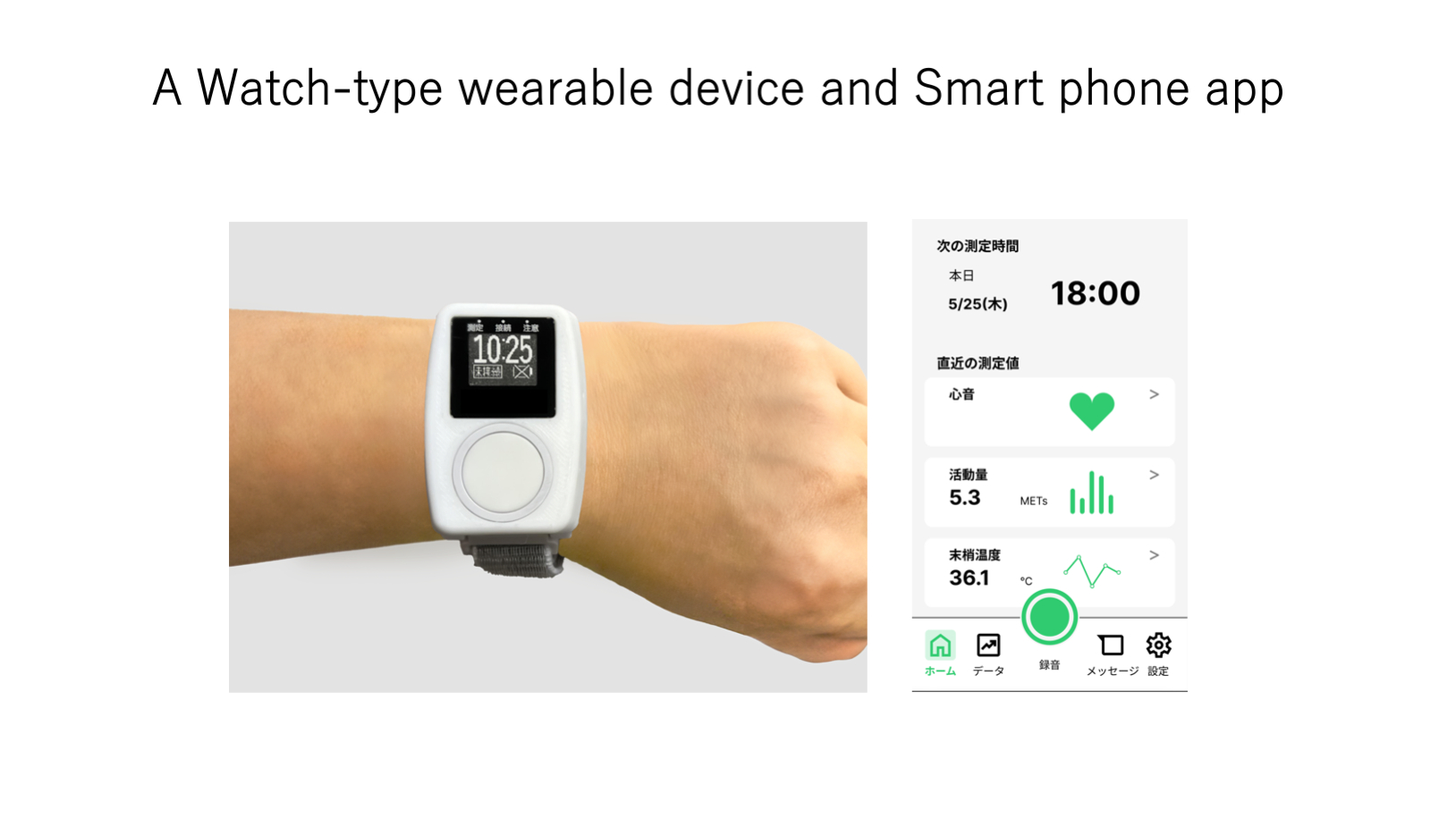
Patients & Methods We lent the watch-type device and the smartphone to collect the outpatient's heart sound data. Patients wore the device with a built-in small microphone for six months, except while bathing or sleeping. The device was put on the patient's left side chest wall to record heart sounds at 8, 13, and 18 o'clock. These data were sent to the smartphone app and our server. Our unique algorithm, including an AI-based analyzing system, identified S3 in the heart sound data. If the WHF events occurred, the patients were admitted to the hospital. A cardiologist heard the same sound data of the server and annotated if the heart sound data included S3. S3 and WHF detection accuracy were measured.
Results Twenty-three patients enrolled, and three patients experienced a WHF event. Four hundred and eighty-three heart sound data were recorded. Four hundred and thirty-four of the sound data were used for building an AI-analysing system as training data, and 49 were used as test data. In the test data, 14 of 49 sound data had S3 due to a cardiologist diagnosis. Our AI system had a sensitivity of 93% and specificity of 80% for detecting S3 among them and predicted all WHF events before rehospitalization, referring to S3 present.
Conclusion Our system could detect S3 and WHF events with acceptable accuracy. This system would be a breakthrough technology for home monitoring in the cardiac field.
Masuda, Hirotada
( OSAKA UNIVERSITY
, Suita
, Japan
)
Ekuni, Shota
( A-wave, Inc.
, Osaka
, Japan
)
Misumi, Yusuke
( OSAKA UNIVERSITY
, Suita
, Japan
)
Akazawa, Yasuhiro
( OSAKA UNIVERSITY
, Suita
, Japan
)
Sakata, Yasushi
( OSAKA UNIVERSITY
, Suita
, Japan
)
Miyagawa, Shigeru
( OSAKA UNIVERSITY
, Suita
, Japan
)
Author Disclosures:
Hirotada Masuda:DO have relevant financial relationships
;
Executive Role:A-wave Inc.:Active (exists now)
| Shota Ekuni:DO NOT have relevant financial relationships
| Yusuke Misumi:DO NOT have relevant financial relationships
| Yasuhiro Akazawa:DO NOT have relevant financial relationships
| Yasushi Sakata:No Answer
| Shigeru Miyagawa:DO NOT have relevant financial relationships