Logo

American Heart Association

  23
  0


Final ID: MP1411

Artificial Intelligence to Automate Guideline-Based Evaluation of Left Ventricular Diastolic Function

Abstract Body (Do not enter title and authors here): Background: Left ventricular diastolic dysfunction (LVDD) is integral to diagnostics and risk stratification for both cardiac and extracardiac pathologies, such as heart failure and T2DM. LVDD is evaluated by echocardiography according to the 2016 American Society of Echocardiography (ASE) guidelines. However, without a sole identifying metric, LVDD is assessed by a diagnostic algorithm that relies on secondary characteristics, is laborious, and has potential for interobserver variability. Artificial intelligence (AI) applied to echocardiography has been shown to develop automated, reproducible workflows and detect cardiovascular diseases.
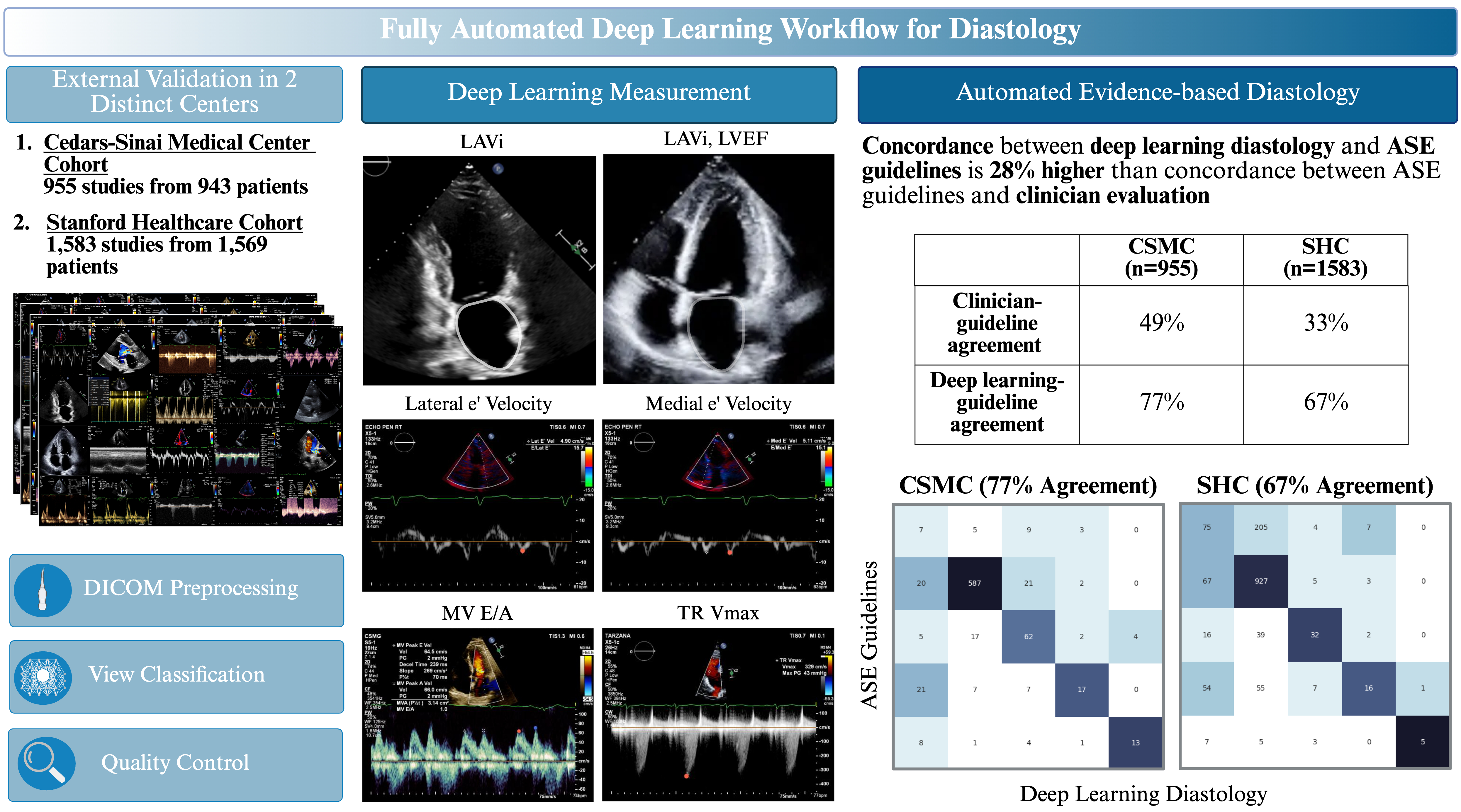
Methods: To characterize concordance in clinical evaluations of LVDD, we evaluated historical echocardiogram studies at two academic medical centers for variability between clinician text reports and assessment by ASE guidelines. We then developed a workflow of 8 AI models trained on over 155,000 studies to automate assessment of LVDD (Figure 1). Model performance was evaluated on temporally distinct held-out test sets from two academic medical centers.
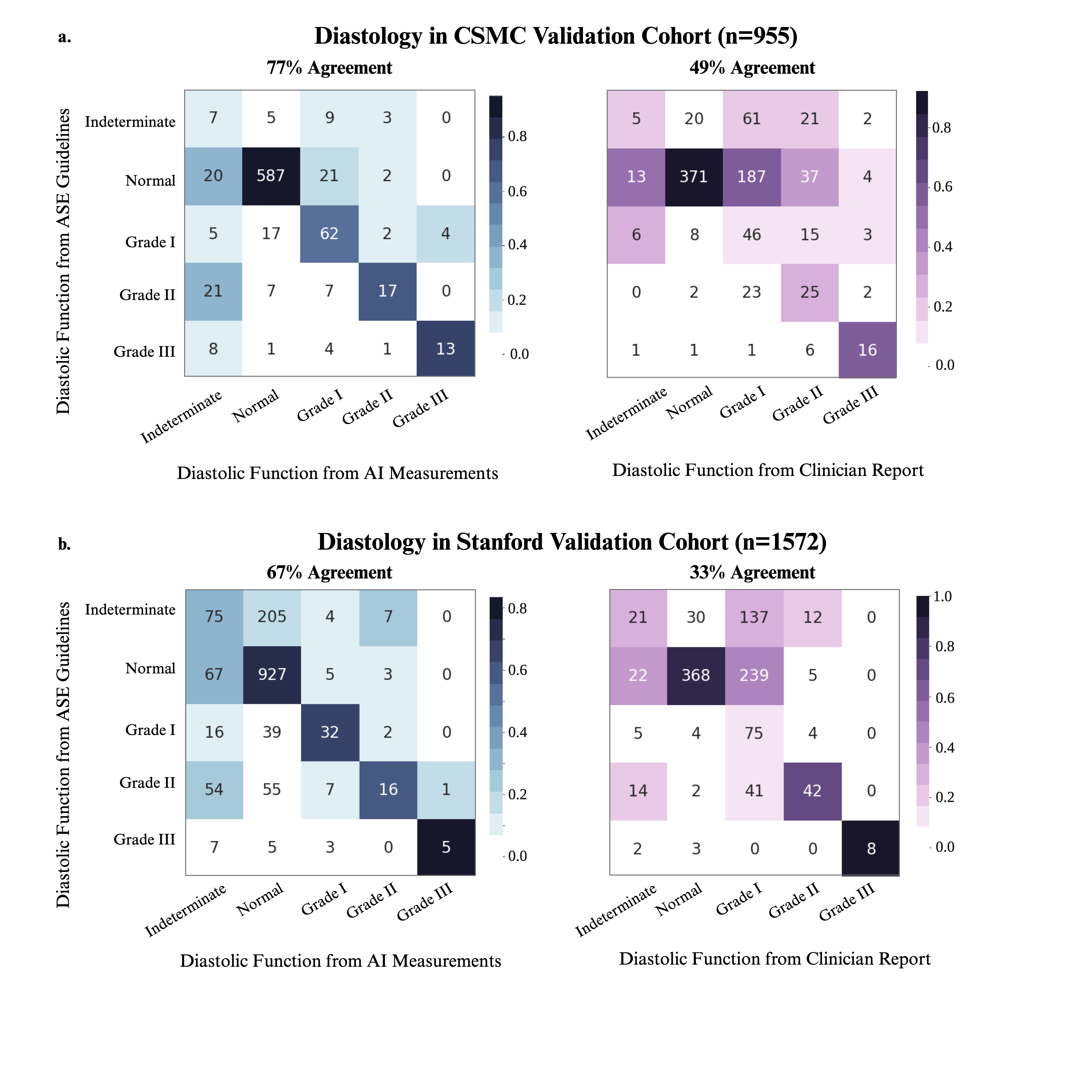
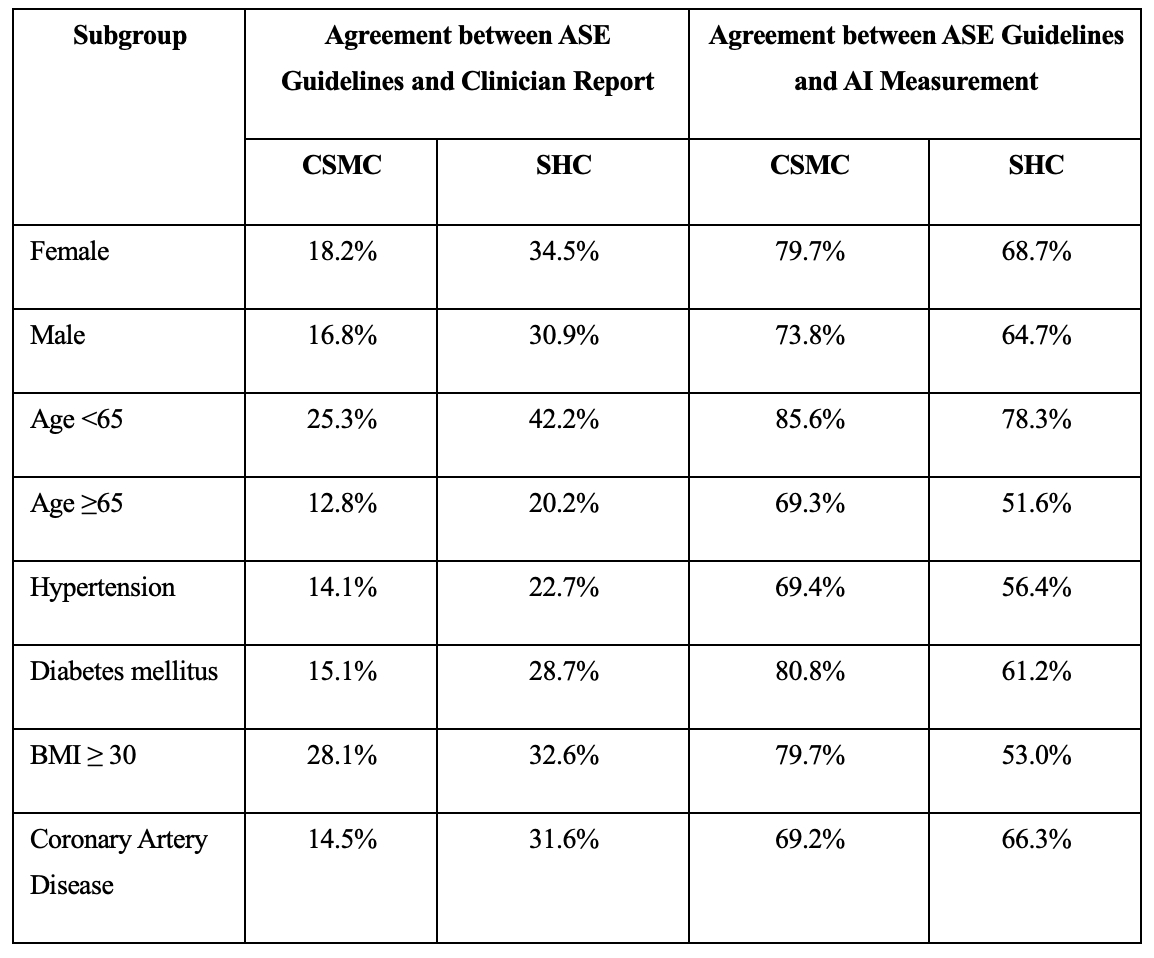
Results: In 124,524 studies at Cedars-Sinai Medical Center (CSMC) and 1,572 studies at Stanford Healthcare (SHC), clinician assessments of diastolic function had only 30.8% agreement and 32.7% agreement with ASE guidelines, respectively. In a validation cohort of 955 studies from CSMC, our AI workflow demonstrated 76.5% agreement and a weighted Cohen’s kappa of 0.52 with ASE guideline assessment using human measurements (Figure 2). In contrast, the clinician report had 48.5% agreement and weighted kappa of 0.29 with ASE guidelines. In the SHC cohort of 1,572 studies, the AI workflow had 66.7% agreement and weighted kappa of 0.27 with ASE guidelines, while the clinician assessment had 32.7% agreement and weighted kappa of 0.06. Performance was consistent across patient subgroups by sex, age, hypertension, diabetes, obesity, and coronary artery disease (Table 1). Our AI workflow also demonstrated strong performance in predicting elevated left atrial pressure, with AUC of 0.84 and 0.76 in CSMC and SHC, respectively.
Conclusion: Clinicians are often inconsistent in evaluating LVDD. We developed an AI pipeline that automates the clinical workflow of grading LVDD and has higher agreement with ASE guidelines than standard-of-care clinician evaluations. Our AI workflow can increase the efficiency and completeness of diastology, contributing to improved diagnosis of heart failure.
  • Yuan, Victoria  ( Cedars-Sinai Medical Center , Los Angeles , California , United States )
  • Sahashi, Yuki  ( Cedars-Sinai Medical Center , Beverly Hills , California , United States )
  • Ieki, Hirotaka  ( Stanford University , Stanford , California , United States )
  • Vukadinovic, Milso  ( Cedars-Sinai Medical Center , Los Angeles , California , United States )
  • Binder, Christina  ( Cedars-Sinai Medical Center , Los Angeles , California , United States )
  • Pieszko, Konrad  ( University of Zielona Gora, Collegium Medicum , Zielona Gora , Poland )
  • Cheng, Paul  ( STANFORD UNIVERSITY , Stanford , California , United States )
  • Cheng, Susan  ( Cedars-Sinai Medical Center , Los Angeles , California , United States )
  • Ouyang, David  ( Kaiser Permanente , Pleasanton , California , United States )
  • Author Disclosures:
    Victoria Yuan: DO NOT have relevant financial relationships | Yuki Sahashi: DO have relevant financial relationships ; Consultant:m3:Active (exists now) | HIROTAKA IEKI: DO NOT have relevant financial relationships | Milso Vukadinovic: No Answer | Christina Binder: No Answer | Konrad Pieszko: No Answer | Paul Cheng: No Answer | Susan Cheng: DO have relevant financial relationships ; Consultant:UCB:Active (exists now) | David Ouyang: DO have relevant financial relationships ; Consultant:InVision:Active (exists now) ; Consultant:Pfizer:Past (completed) ; Consultant:Ultromics:Past (completed) ; Consultant:EchoIQ:Past (completed) ; Consultant:AstraZeneca:Active (exists now)
Meeting Info:

Scientific Sessions 2025

2025

New Orleans, Louisiana

Session Info:
More abstracts on this topic:
A ChatGLM-based stroke diagnosis and prediction tool

Song Xiaowei, Wang Jiayi, Ma Weizhi, Wu Jian, Wang Yueming, Gao Ceshu, Wei Chenming, Pi Jingtao

3D Aortic Geometry is Informative for Risk of Adverse Aortic Events

Pirruccello James

More abstracts from these authors:
Multi-View Deep Learning for Automated Quantification of Aortic Stenosis

Ieki Hirotaka, Vukadinovic Milos, Sahashi Yuki, He Bryan, Cheng Paul, Ouyang David

Multi-View Deep Learning for Automated Quantification of Mitral Stenosis

Ieki Hirotaka, Vukadinovic Milos, Sahashi Yuki, He Bryan, Cheng Paul, Ouyang David

You have to be authorized to contact abstract author. Please, Login
Not Available