
Multi-View Deep Learning for Automated Quantification of Aortic Stenosis
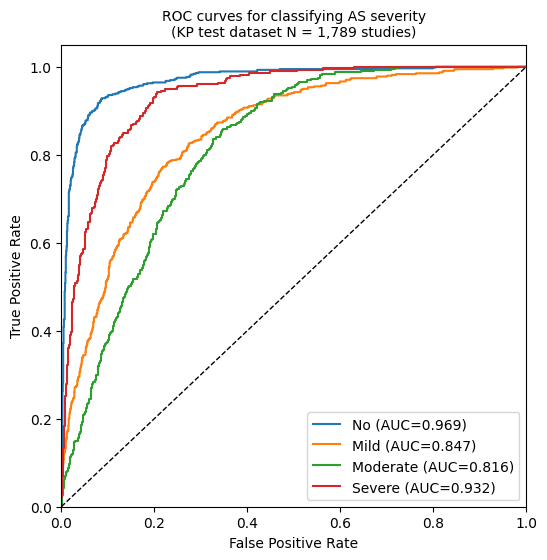
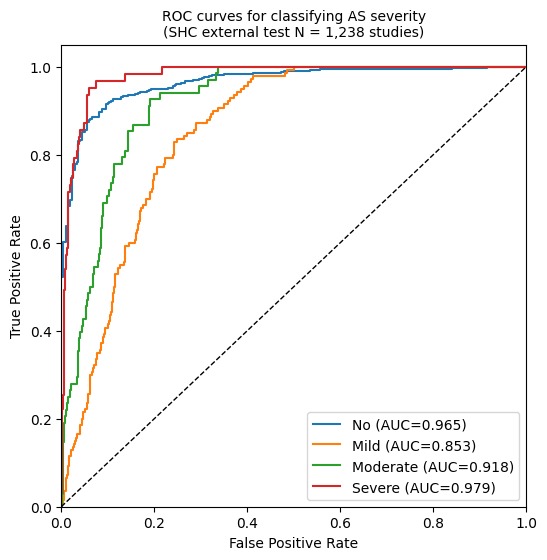
Abstract Body (Do not enter title and authors here): Background: Accurate assessment of aortic stenosis (AS) severity is critical to reduce associated morbidity and mortality. Current evaluation relies on expert interpretation of B-mode and Doppler echocardiography across multiple views. This study aimed to develop and validate a deep learning model for automated AS severity assessment using multi-view B-mode and color Doppler echocardiographic videos. Methods: We designed a two-stage framework for automated AS assessment. First, six video-based convolutional neural networks were trained to classify AS severity from distinct echocardiographic views: B-mode [parasternal long-axis (PLAX), parasternal short-axis (PSAX), apical three-chamber and five-chamber (AP)] and color Doppler [PLAX-color, PSAX-color, and AP-color]. Next, outputs from these models were integrated using a machine learning ensemble (HistGradientBoostingClassifier) to produce a study-level AS severity classification. Performance was assessed using area under the receiver operating characteristic curve (AUC) on held-out test set from Kaiser Permanente (KP) and Stanford Health Care (SHC). Results: The models were trained on 213,814 videos from 16,076 studies at KP, and evaluated on internal test data (KP; 23,492 videos from 1,789 studies) as well as external test data (SHC; 13,278 videos from 1,238 studies). The multi-view ensemble model demonstrated strong performance, achieving a macro-AUC of 0.891 (95% CI: 0.881–0.901; Figure 1) on the KP test dataset. Generalizability was confirmed on the external SHC cohort with an AUC of 0.929 (95% CI: 0.918–0.939; Figure 2). Conclusion: In this study, we applied a deep learning framework integrating multi-view echocardiographic videos to assess AS severity. The model demonstrated accurate, generalizable performance and highlights the potential of AI-powered decision support tools in echocardiographic evaluation of AS.
Ieki, Hirotaka
(
Stanford University
, Stanford , California , United States )
Vukadinovic, Milos
(
University of California Los Angeles
, Los Angeles , California , United States )
Sahashi, Yuki
(
Cedars-Sinai Medical Center
, Beverly Hills , California , United States )
He, Bryan
(
Stanford University
, Stanford , California , United States )
Cheng, Paul
(
Stanford University
, Stanford , California , United States )
Ouyang, David
(
Kaiser Permanente
, Pleasanton , California , United States )
Author Disclosures:
Hirotaka IEKI:DO NOT have relevant financial relationships
| Milos Vukadinovic:No Answer
| Yuki Sahashi:DO have relevant financial relationships
;
Consultant:m3:Active (exists now)
| Bryan He:No Answer
| Paul Cheng:No Answer
| David Ouyang:DO have relevant financial relationships
;
Consultant:InVision:Active (exists now)
; Consultant:Pfizer:Past (completed)
; Consultant:Ultromics:Past (completed)
; Consultant:EchoIQ:Past (completed)
; Consultant:AstraZeneca:Active (exists now)