Itaconate stabilizes ABCA1 to regulate cholesterol burden: insights from targeting with lipid nanoparticles
Abstract Body (Do not enter title and authors here): Background/Aims: Itaconate (ITA) is a tricarboxylic acid cycle (TCA)-derived metabolite that limits atherosclerotic plaque growth and improves plaque stability via immunomodulation. However, the benefits of ITA may also include lipid metabolism regulation. Here, we utilize plaque-targeting, ITA-conjugated lipid nanoparticles (ITA-LNPs) to study how ITA stabilizes ABCA1, a cholesterol transporter with beneficial effects on atherosclerosis, including cholesterol efflux in plaque macrophages.
Methods/Approach: Apoe−/− mice were fed a high-cholesterol/high-fat diet (HCHFD) for 12 weeks and injected intravenously once weekly with 50 mg/kg ITA-LNP or Ctrl-LNP (control nanoparticles). Aortas were tested for ITA-LNP biodistribution, quantification of atherosclerotic plaque burden, whole transcriptome analysis via bulk RNA sequencing (RNAseq) and ABCA1 levels. Bone marrow-derived macrophages (BMDMs) and RAW 264.7 cells were treated with ITA-LNP or Ctrl-LNP in the presence of oxLDL, acLDL, or free cholesterol to investigate ITA’s actions on Abca1 expression and ABCA1 stability under a variety of conditions, including stable gene knockdown.
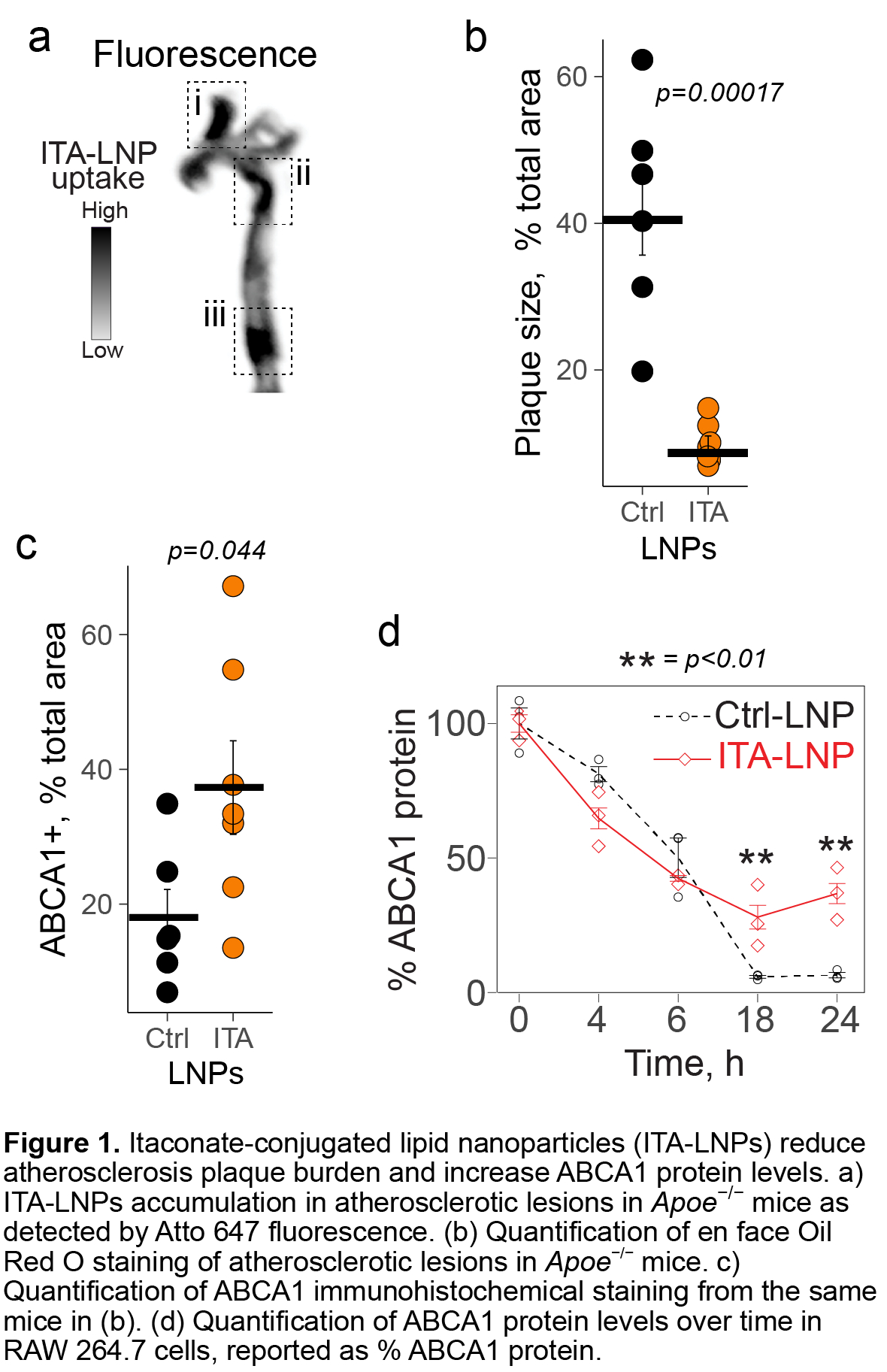
Results/Data: ITA-LNPs, but not Ctrl-LNPs, deposited to atherosclerotic plaque, reduced the plaque size and significantly increased ABCA1 protein levels as seen in branchiocephalic arteries (ITA-LNP = 37.3 ± 6.4% vs 18.0 ± 3.8% of plaque area, p < 0.05, Figure 1a-c), but not at the transcriptional level in whole plaque (via RNAseq, no differentially expressed Abca1 mRNA with FDR<0.05) and in bone marrow-derived macrophages (1.1 ± 0.15 fold vs. 0.73 ± 0.042 fold, p > 0.05). ITA-LNPs prevented ABCA1 decay (82.33 ± 4.78% vs. 28.0 ± 4.4% protein remaining at 18 h after cycloheximide inhibition of de novo protein synthesis, p < 0.01, Figure 1d) via the HO-1-calpain axis and significantly increased cholesterol efflux towards ApoA-I in RAW 264.7 cells (5.31 ± 0.37% vs. 3.09 ± 0.36%, p < 0.001, Figure 1d). This was further confirmed in RAW 264.7 cells with a stable HO-1 knockdown, which did not demonstrate increased ABCA1 stability (28.18 ± 3.05% vs. 33.65 ± 0.30% protein remaining at 18 h, p > 0.05).
Conclusions: ITA-LNPs regulate lipid metabolism in atherosclerosis by inducing cholesterol efflux. ITA-LNPs are thus an exciting first-in-class experimental nanotherapy with effects on both inflammation and lipid metabolism in atherosclerotic plaque.
Hong, Natalie
(
Case Western Reserve University
, Cleveland , Ohio , United States )
Maiseyeu, Andrei
(
Case Western Reserve University
, Cleveland , Ohio , United States )
Author Disclosures:
Natalie Hong:DO NOT have relevant financial relationships
| Andrei Maiseyeu:DO NOT have relevant financial relationships
Jiang Chao, Dong Jianzeng, Cai Jun, Anderson Craig, Du Xin, Tang Yangyang, Han Rong, Song Yanna, Wang Chi, Lin Xiaolei, Yi Yang, Rodgers Anthony, Ma Changsheng