Inpatient Outcomes of Left Atrial Appendage Occlusion in Patients with Advanced Chronic Kidney Disease Compared to End-Stage Renal Disease: A Nationwide Analysis
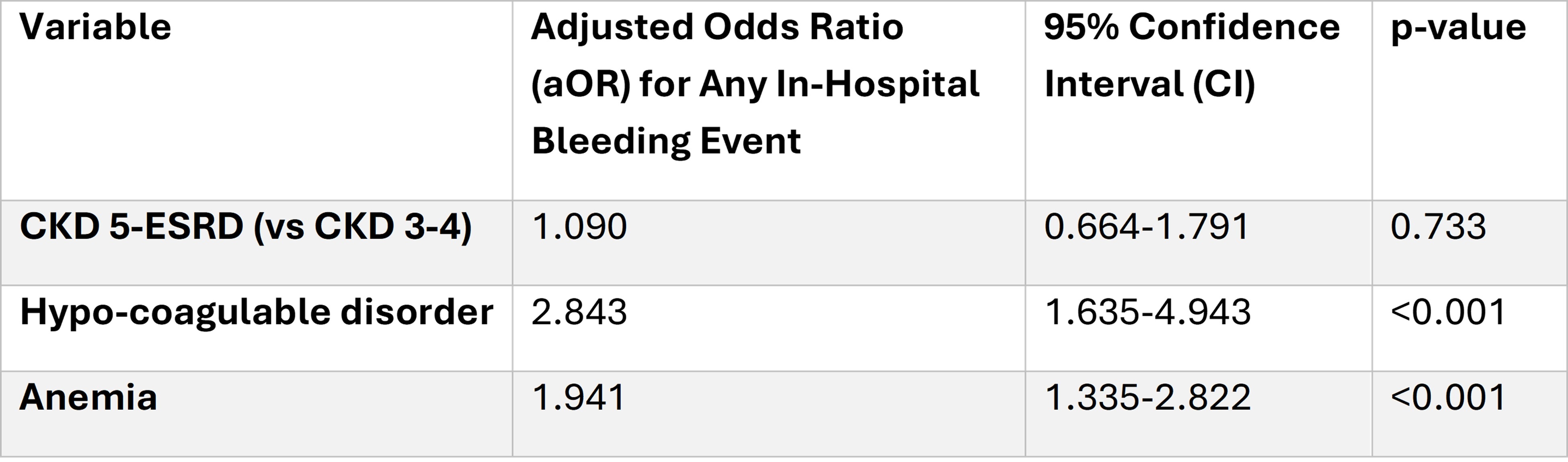
Abstract Body (Do not enter title and authors here): Background: Left atrial appendage occlusion (LAAO) is an alternative to anticoagulation for stroke prevention in atrial fibrillation (AF), particularly for high bleeding risk patients. Chronic kidney disease (CKD) and end-stage renal disease (ESRD) are high-risk groups with elevated thrombosis and bleeding risk. Comparative inpatient outcomes of LAAO between advanced CKD (stages 3-4) and ESRD (stage 5 or dialysis-dependent) remain unclear. Research Question: To compare inpatient outcomes, specifically bleeding events, following LAAO between patients with AF and CKD stages 3-4 versus CKD stage 5 or ESRD, utilizing a large national database. Methods: This retrospective cohort study utilized the Nationwide Inpatient Sample (NIS) database from 2016 to 2019. Adult patients (≥18 years) with AF undergoing LAAO were identified via ICD codes. Patients were stratified into CKD 3-4 and CKD 5-ESRD cohorts. Propensity score matching (PSM) balanced baseline characteristics. Multivariable logistic regression was performed on the pre-matched cohort to evaluate the association between groups and the primary outcome of any in-hospital bleeding event. Secondary outcomes included specific types of bleeding, transfusions, and mortality. Results: A total of 2,987 LAAO patients were included (CKD 3-4: n=2,539; CKD 5-ESRD: n=448). Before matching, CKD 5-ESRD patients were younger, less often female, more frequently Black or Hispanic, and had a higher prevalence of anemia (58.3% vs 24.7%, p<0.001). After PSM (n = 405 per group), baseline characteristics were well-balanced. In the multivariable analysis of the pre-matched cohort, CKD 5-ESRD was not independently associated with increased odds of any bleeding event compared to CKD 3-4 (Adjusted Odds Ratio [aOR] 1.090, 95% CI 0.664-1.791, p=0.733). Significant predictors of any bleeding included hypo-coagulable disorder (aOR 2.843, 95% CI 1.635-4.943, p<0.001) and anemia (aOR 1.941, 95% CI 1.335-2.822, p<0.001). In the matched cohort, the unadjusted odds of any bleeding were similar (OR 1.097, 95% CI 0.604-1.990, p = 0.761). In-hospital mortality was low and similar post-matching (0.5% vs 0.5%, p = 1). Conclusion: LAAO procedure is equally safe in CKD 5/ESRD as in CKD 3-4, as it was not associated with significantly higher odds of acute bleeding complications. Anemia and underlying hypo-coagulable disorders were significant bleeding predictors, underscoring the importance of managing these risks in all CKD patients undergoing LAAO.
Abofrekha, Bahy
(
Northwell
, Staten Island , New York , United States )
Wei, Chapman
(
Northwell
, Staten Island , New York , United States )
Lahoud, Chloe
(
Northwell
, Staten Island , New York , United States )
Shadi, Mahmoud
(
Northwell
, Staten Island , New York , United States )
Jdaidani, Jennifer
(
Northwell
, Staten Island , New York , United States )
Shah, Rina
(
Northwell
, Staten Island , New York , United States )
Saouma, Samer
(
Northwell
, Staten Island , New York , United States )
Parikh, Valay
(
Northwell
, Staten Island , New York , United States )
Author Disclosures:
Bahy Abofrekha:DO NOT have relevant financial relationships
| Chapman Wei:DO NOT have relevant financial relationships
| Chloe Lahoud:No Answer
| Mahmoud Shadi:No Answer
| Jennifer Jdaidani:DO NOT have relevant financial relationships
| Rina Shah:No Answer
| Samer Saouma:DO NOT have relevant financial relationships
| Valay Parikh:DO NOT have relevant financial relationships