Atrial Fibrillation and Chronic Kidney Disease: Do Outcomes Worsen with Advancing Renal Dysfunction?
Abstract Body (Do not enter title and authors here): Background: Chronic kidney disease (CKD) and atrial fibrillation (AF) commonly coexist, creating a high-risk population vulnerable to both thrombotic and hemorrhagic complications. While prior studies have linked CKD to adverse outcomes in AF, few stratify risk by CKD stage or include patients with end-stage renal disease (ESRD). This study fills that gap by comparing in-hospital outcomes between AF patients with moderate CKD (stage 3–4) and those with ESRD using a large, national dataset.
Methods: We conducted a retrospective cohort study of 203,182 patients with AF, stratified by CKD stage: 3–4 vs. ESRD. The primary outcome was in-hospital mortality; secondary outcomes included major bleeding events, gastrointestinal (GI) bleeding, ischemic stroke, and length of stay (LOS). Logistic regression adjusted for demographics, comorbidities, and clinical characteristics. Model performance was assessed using ROC curves (AUC >0.70).
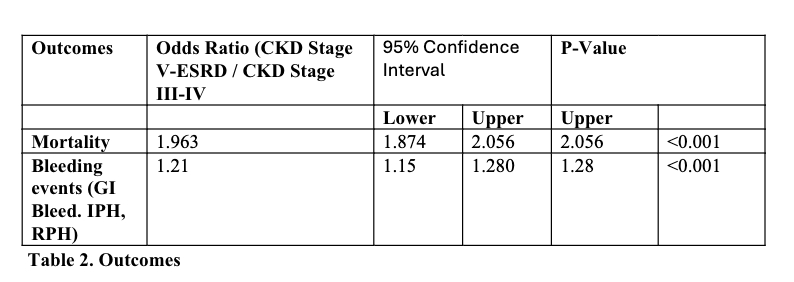
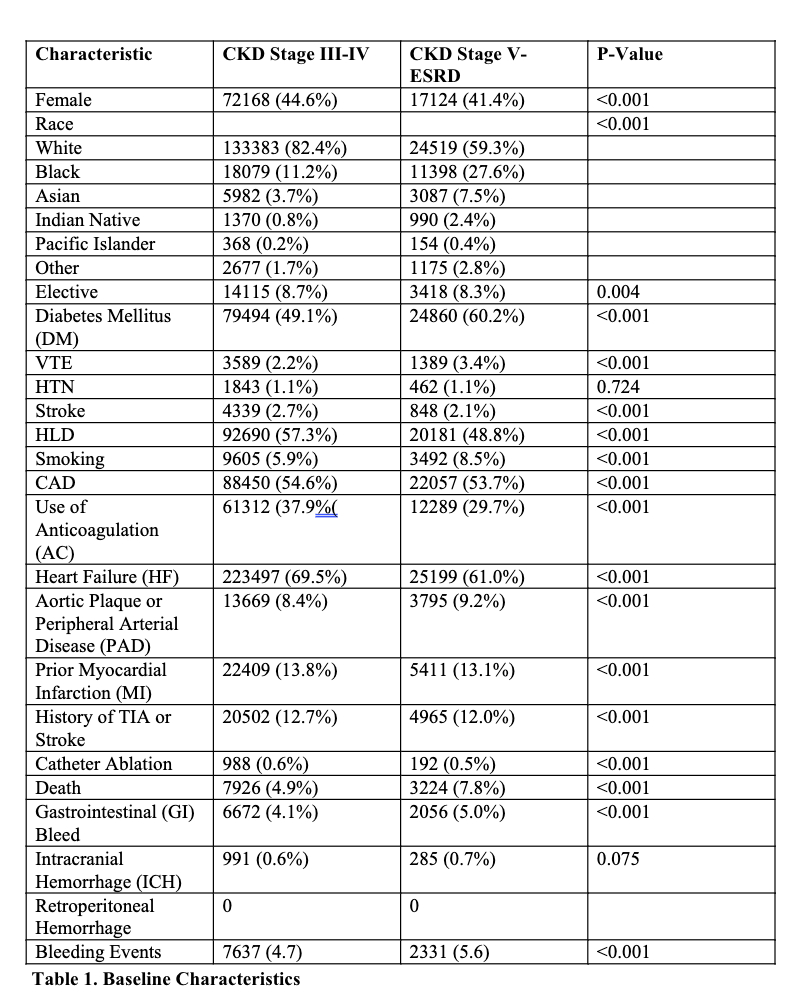
Results: Among 203,182 patients, 20.3% had ESRD. Compared to CKD 3–4, patients with ESRD had higher odds of in-hospital mortality (OR 1.96, 95% CI 1.87–2.06), major bleeding (OR 1.21, 95% CI 1.15–1.28), and GI bleeding (OR 1.22, 95% CI 1.16–1.28), with prolonged LOS. Notably, ESRD patients were less likely to receive anticoagulation (29.7% vs. 37.9%, p<0.001).These associations remained significant after multivariable adjustment.
Conclusions: AF patients with ESRD experience disproportionately worse outcomes than those with stage 3–4 CKD, including nearly double the mortality risk and a significant increase in bleeding complications. These findings emphasize the compounded vulnerability conferred by ESRD, driven in part by uremic platelet dysfunction, dialysis-related hemodynamic shifts, vascular calcifications, and altered anticoagulant pharmacodynamics. This is one of the first national-level studies to directly compare AF outcomes by CKD stage. It not only confirms worse outcomes in ESRD but exposes the of anticoagulation in those who might benefit. Our findings support the urgent need for stage-specific anticoagulation protocols, consideration of left atrial appendage occlusion in select ESRD patients, and future trials that include this historically excluded population. The data advocate for further research on nuanced, individualized strategies to balance stroke prevention against bleeding risk in AF patients with advanced kidney disease.
Rimsky, Elizabeth
(
Northwell
, Staten Island , New York , United States )
Vachss, Dov
(
Northwell Health
, New York , New York , United States )
Zakharia, Antonios
(
Northwell Health
, New York , New York , United States )
Wei, Chapman
(
Northwell Health
, New York , New York , United States )
Ahmed, Zayed
(
Northwell Health
, New York , New York , United States )
Lahoud, Chloe
(
Northwell Health
, New York , New York , United States )
Abofrekha, Bahy
(
Northwell Health
, New York , New York , United States )
Mustafa, Ahmad
(
Northwell Health
, New York , New York , United States )
Parikh, Valay
(
Northwell Health
, New York , New York , United States )
Elsayegh, Suzanne
(
Northwell Health
, New York , New York , United States )
Author Disclosures:
Elizabeth Rimsky:DO NOT have relevant financial relationships
| Suzanne Elsayegh:No Answer
| Dov Vachss:No Answer
| Antonios Zakharia:No Answer
| Chapman Wei:DO NOT have relevant financial relationships
| Ahmed Zayed:DO NOT have relevant financial relationships
| Chloe Lahoud:No Answer
| Bahy Abofrekha:DO NOT have relevant financial relationships
| Ahmad Mustafa:No Answer
| Valay Parikh:No Answer
Kane Jamie, Collins Jeremy, Lee Timmy, Misra Sanjay, Singh Prabh, Kilari Sreenivasulu, Baranwal Gaurav, Naskar Atanu, Montonye Dan, Lutgens Esther, Wang Ying, Negm Ahmed