
Logo

American Heart Association

  24
  0


Final ID: Sa2006

PREVENT Outperforms Pool Cohort Equation in Predicting 10-Year Cardiovascular Risk in a National Cohort

Abstract Body (Do not enter title and authors here): Introduction: PREVENT is a new prediction tool used for cardiovascular risk management. The purpose of this study was to investigate whether the PREVENT risk score is more accurate than the traditional Pooled Cohort Equations (PCE) in predicting atherosclerotic cardiovascular disease (ASCVD).
Hypothesis: It is hypothesized that the novel PREVENT equations will outperform the PCE equations by including kidney function parameters and different risk coefficients in the calculation.
Methods: We used the All of Us dataset which is a national dataset of diverse patients aimed to advance precision medicine, and it has more than 840,000 patients. We identified participants who were not taking statins, did not have a history of cardiovascular events and had at least 10 years of follow-up unless they experienced an event before the 10-year mark. We calculated both the PREVENT and PCE scores for ASCVD which was defined as myocardial infarction, stroke (hemorrhagic or ischemic) or heart failure. Participants were then followed to assess the occurrence of any adverse outcomes. The strength of the model was calculated using standard C-statistics and DeLong’s t-test was applied to evaluate statistical significance. The difference in proportion of adverse events was calculated using Chi-squared test.
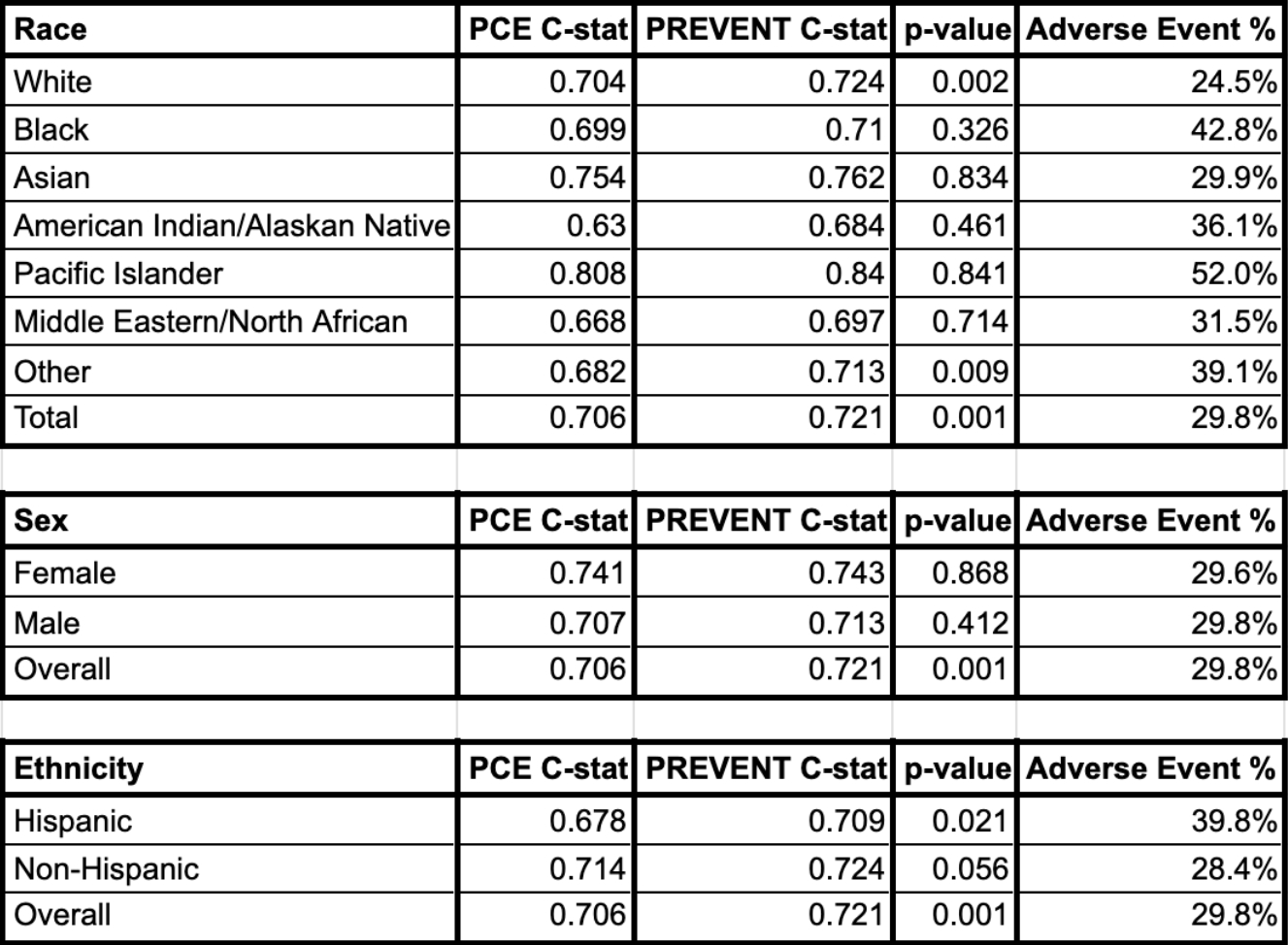
Results: A total of 29,660 participants met out inclusion criteria. The average age was 57.4 and 53.1% were women. White participants represented 66% of the cohort, while black participants represented16.5%. Hispanic participants represented 11.8% the cohort. A total of 29.8% of the participants experienced an event. The PREVENT model demonstrated significantly better discriminative performance compared to the PCE model (C-statistic 0.721 vs 0.706; p= 0.0012). The PREVENT model performed numerically better in all subgroups, although this difference was not consistently statistically significant, table 1.
Conclusions: In a national cohort with up to 10-year follow-up, the PREVENT calculator demonstrated superior accuracy compared to the PCE models for predicting cardiovascular risk.
  • Patel, Jay  ( University of Florida , Gainesville , Florida , United States )
  • Ruzieh, Mohammed  ( University of Florida , Gainesville , Florida , United States )
  • Author Disclosures:
    Jay Patel: DO NOT have relevant financial relationships | Mohammed Ruzieh: DO NOT have relevant financial relationships
Meeting Info:

Scientific Sessions 2025

2025

New Orleans, Louisiana

Session Info:

Social and Structural Determinants of Cardiovascular Outcomes: From Prediction to Policy

Saturday, 11/08/2025 , 10:30AM - 11:30AM

Abstract Poster Board Session

More abstracts on this topic:
An Assessment of the Baseline Characteristics of Participants in the Pilot THRIVE Food is Medicine Study

Washington India, Demarco Samantha, Tomiwa Tosin, Olusola-bello Mojisola, Kyeremeh Djanee, Mcmahon Adrian, Kramer Maya, Saldarriaga Maricielo, Chen Peiyu, Rodriguez Christy, Johnson Mia, Song Shanshan, Xiao William, Gledhill Samuel, Yeboah-manson Samuel, Kurien Natania, Vassiliadi Lydia, Freeman Jennifer, Izquierdo-porrera Anna Maria, Palencia Lessly, Sullivan Valerie, Commodore-mensah Yvonne, Alvarez Kiara, Ogungbe Bunmi, Akubo Chelsea, Adeleye Khadijat, Iribe Irma, Assani-uva Adeline, Dugbartey Janice, Sinyan Aminata

An Economic Evaluation of Non-HDL-Cholesterol and Apolipoprotein B as Treatment Targets for Lipid-Lowering Therapy in Primary Prevention

Luebbe Samuel, Wilkins John, Moran Andrew, Sniderman Allan, Kohli-lynch Ciaran

You have to be authorized to contact abstract author. Please, Login
Not Available