Hypertension Diagnosis Correlates with Psychological Distress Symptoms, Marital Status, and Insurance Status
Abstract Body (Do not enter title and authors here): Introduction/Background Hypertension diagnosis and factors such as exercise and education have been correlated, but often for specific population groups (e.g. Whites and African Americans or people in one county). Evaluating the impact of psychological distress, marital status, and insurance status on hypertension diagnosis in a large, diverse American sample has not been performed.
Hypothesis We hypothesize that hypertension diagnosis is more prevalent among those with psychological distress and no insurance coverage.
Methods We used all adults from CDC’s National Health Interview Survey between 2006 – 2018 as our cohort for this pooled cross-sectional study. We extracted data on the following variables using SAS: hypertension, psychological distress, marital status, insurance, age, sex, race, highest education level in family, BMI, exercise level, diabetes, and smoking status. These were split into categories and their correlation with hypertension in this cohort was assessed using multivariate logistic regression. Python with libraries Numpy, Pandas, Scipy, Statsmodels, Matplotlib, and Seaborn was used for statistical analysis and graphing. The LLM Grok 3 was used for some code generation, and outputs were repeatedly checked for accuracy.
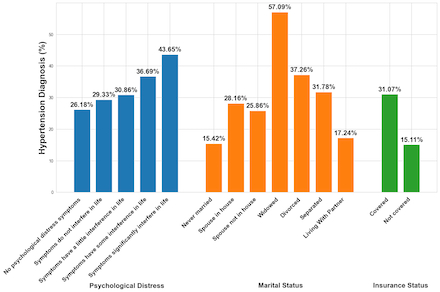
Results A total of 381,989 adults were included. The mean age was 49 years and 55.4% were women. There were 109,487 (28.7%) patients diagnosed with hypertension. Diagnosis was significantly more common among patients with psychological distress symptoms that interfered in their lives than those with no such symptoms (43.7% vs 26.2%, OR: 2.2, 95% CI 2.1-2.3), and the odds of having hypertension increased with more severe psychological distress (Figure 1). Being widowed was associated with the highest hypertension rate relative to the never married (57.1% vs 15.4%, OR: 2.4, 95% CI 2.3-2.4). Lack of insurance was associated with a lower hypertension rate than having insurance (15.1% vs 31.1%, OR 0.6, 95% CI 0.59-0.62).
Conclusions Psychological distress interference in life was associated with markedly higher odds of hypertension. Similarly, marital status showed a strong relationship, with widowed individuals having the highest prevalence. Lack of insurance was linked to a lower rate of hypertension diagnosis, potentially reflecting reduced healthcare access and not lower disease prevalence. These findings underscore the importance of psychosocial and socioeconomic factors in hypertension detection and management.
Griffiths, Connor
(
University of Florida
, Gainesville , Florida , United States )
Murphy, Sarah
(
University of Florida
, Gainesville , Florida , United States )
Ruzieh, Mohammed
(
University of Florida
, Gainesville , Florida , United States )
Author Disclosures:
Connor Griffiths:DO NOT have relevant financial relationships
| Sarah Murphy:DO NOT have relevant financial relationships
| Mohammed Ruzieh:DO NOT have relevant financial relationships