
Logo

American Heart Association

  20
  0


Final ID: MP1471

High Use of P2Y12 Inhibitors and DOACs Persists up to One Year After Percutaneous Left Atrial Appendage Occlusion

Abstract Body (Do not enter title and authors here): Background: Percutaneous left atrial appendage occlusion (pLAAO) is used as an alternative to anticoagulation in patients with atrial fibrillation. Long-term patterns of antiplatelets and anticoagulants use post pLAAO compared to direct oral anticoagulants (DOACs) users are unknown.
Hypothesis: We hypothesized that the use of antiplatelets and anticoagulants remains prevalent up to one year following pLAAO.
Methods: We emulated a target trial where patients with atrial fibrillation were randomly assigned to receive pLAAO or DOACs in the 1:3 ratio using a nationally representative 15% sample of Medicare beneficiaries from Jan 2015 to Dec 2020. We reported the number of patients who received related treatment (>=1 prescription) in the certain time range. We assessed the following drugs up to one year post pLAAO implantation: Antiplatelets (clopidogrel, ticagrelor, prasugrel), 2- vitamin K antagonists (warfarin) and 3- DOACs (apixaban, dabigatran, rivaroxaban, edoxaban).
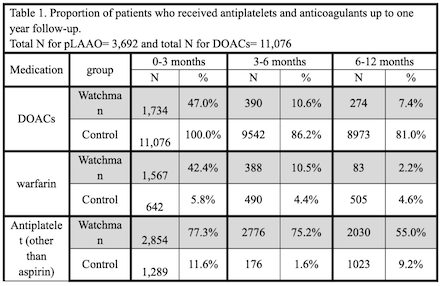
Results: Among 3,692 patients who underwent pLAAO, use of DOACs and warfarin decreased substantially by 6-12 months post pLAAO (from 47.0% to 7.4% and from 42.4% to 2.2%, respectively). In the DOACs arm which had 11,076 patients, use of DOACs remained high on follow up (81.0% at 1-year). At 6-12 months post index date, patients who received pLAAO were significantly less likely to remain on DOACs (7.4% vs. 81.0%; p< 0.001) or warfarin (2.2% vs 4.6%; p < 0.001), but more likely to be on a P2Y12 inhibitor (55.0% vs 9.2%; p < 0.001), table 1.
Conclusion: The use of P2Y12 inhibitors and DOACs remained high at 6-12 months post pLAAO with approximately 1 in 2 patients receiving a prescription for a P2Y12 inhibitor and 1 in 14 receiving a prescription for a DOAC. These high prescribing patterns warrant further investigation as they may be contributing to an increased bleeding risk post pLAAO.
  • Du, Fanxing  ( University of Florida , Bradenton , Florida , United States )
  • Itraish, Jena  ( University of Florida , Bradenton , Florida , United States )
  • Ruzieh, Mohammed  ( University of Florida , Bradenton , Florida , United States )
  • Jiao, Tianze  ( University of Florida , Bradenton , Florida , United States )
  • Author Disclosures:
    Fanxing Du: DO NOT have relevant financial relationships | Jena Itraish: DO NOT have relevant financial relationships | Mohammed Ruzieh: DO NOT have relevant financial relationships | Tianze Jiao: DO NOT have relevant financial relationships
Meeting Info:

Scientific Sessions 2025

2025

New Orleans, Louisiana

Session Info:

Benchmarks, Biomarkers, and Breakthroughs: Real-World Strategies to Improve Cardiovascular Outcomes

Sunday, 11/09/2025 , 11:50AM - 01:00PM

Moderated Digital Poster Session

More abstracts on this topic:
Anticoagulation versus Antiplatelets in Coronary Artery Ectasia and Acute Coronary Syndrome: A Systematic Review and Meta-analysis

Hernandez-pastrana Sarai, Latapi Ruiz Esparza Ximena, Martignoni Felipe, Araiza Diego, Doma Mohamed, Fatima Syeda Rubab, Hemdanieh Maya, Kritya Mangesh, Huang Wilbert, Naji Zahra, Lingamsetty Shanmukh Sai Pavan, Gewehr Douglas

Antithrombotic Strategies and Outcomes in Neonates and Infants with Cardiac Shunts: A Systematic Review and Meta-analysis

Kiskaddon Amy, Do Nhue, Goldenberg Neil, Betensky Marisol, Branstetter Joshua, Ashour Dina, Williams Pamela, Stock Arabela, Silvey Michael, Giglia Therese

More abstracts from these authors:
You have to be authorized to contact abstract author. Please, Login
Not Available