Comparative Cardiovascular Outcomes in Acalabrutinib vs Zanubrutinib in B-Cell
Malignancies: A TriNetX Data Study
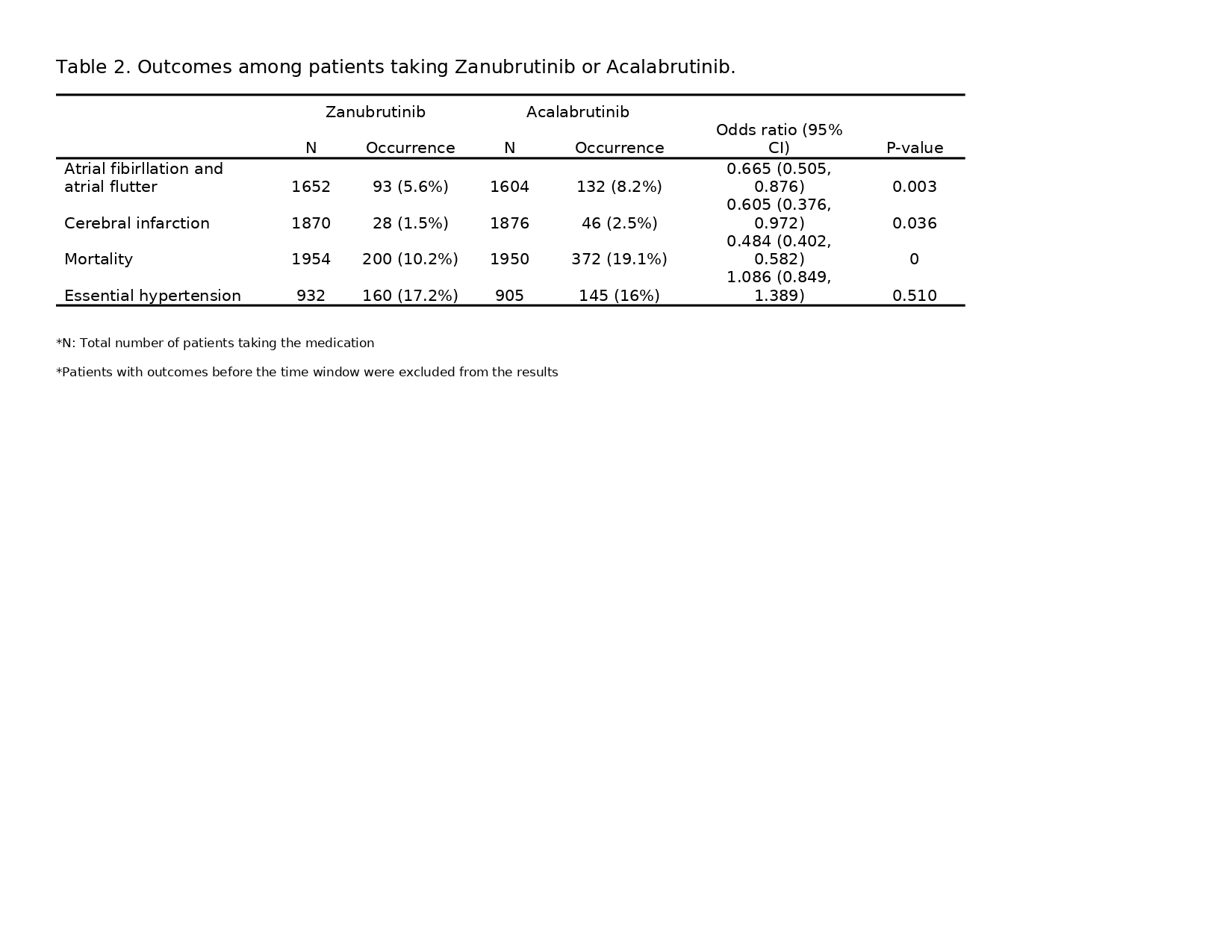
Abstract Body (Do not enter title and authors here): Background: Next-generation Bruton’s tyrosine kinase inhibitors (BTKis) such as acalabrutinib and zanubrutinib have improved treatment outcomes in B-cell malignancies including chronic lymphocytic leukemia (CLL), mantle cell lymphoma (MCL), and Waldenström macroglobulinemia (WM), while reducing off-target toxicities compared to ibrutinib. However, their comparative cardiovascular safety profiles remain poorly characterized. This study evaluates real-world cardiovascular and clinical outcomes between zanubrutinib and acalabrutinib using a large multi-center database. Methods: We conducted a retrospective cohort study using the TriNetX Research Network (October 2017– December 2024) including adult patients with CLL, MCL, WM, or small B-cell lymphoma treated with zanubrutinib or acalabrutinib. Patients with prior exposure to other BTKis were excluded. After 1:1 propensity score matching, 2,363 patients were included in each cohort. We assessed 3-year outcomes: new-onset atrial fibrillation/flutter, cerebral infarction, hypertension, and all-cause mortality using odds ratios (ORs), Kaplan-Meier survival analysis, and log-rank testing. Results: The incidence of atrial fibrillation/flutter was significantly lower in the zanubrutinib group (5.70%) than in the acalabrutinib group (8.61%; OR 0.641, 95% CI 0.501–0.821; p = 0.0004), though Kaplan-Meier analysis showed no difference in event-free survival (p = 0.286). Cerebral infarction was also less common with zanubrutinib (1.42% vs. 2.23%; OR 0.631, 95% CI 0.404– 0.985; p = 0.0409), with no difference in event-free survival (p = 0.54). Hypertension rates were similar (16.2% vs. 15.1%; OR 1.087, 95% CI 0.865–1.366; p = 0.47), though time-to-event analysis favored acalabrutinib (p = 0.0009). All-cause mortality was significantly lower in the zanubrutinib cohort (11.71% vs. 19.23%; OR 0.557, 95% CI 0.474–0.655; p < 0.0001), with survival analysis confirming this finding (p = 0.001). Conclusion: In this large, real-world analysis, zanubrutinib was associated with lower rates of atrialfibrillation, cerebral infarction, and all-cause mortality compared to acalabrutinib. These findings highlight potential cardiovascular safety advantages of zanubrutinib and support its consideration in patients at elevated cardiovascular risk. Prospective head-to-head trials are needed to confirm these observations.
Awad, Maan
(
West Virginia University
, Morgantown , West Virginia , United States )
Patel, Het
(
Willis Knighton Health system
, Shreveport , Louisiana , United States )
Kumsi Sreedhar, Prajwal
(
Willis Knighton Health system
, Shreveport , Louisiana , United States )
Lingamsetty, Shanmukh Sai Pavan
(
Mamata Medical College
, Khammam , India )
Murshid, Abdulrahman
(
West Virginia University
, Morgantown , West Virginia , United States )
Patel, Brijesh
(
Indiana University
, Carmel , Indiana , United States )
Author Disclosures:
Maan Awad:No Answer
| Het Patel:DO NOT have relevant financial relationships
| PRAJWAL KUMSI SREEDHAR:DO NOT have relevant financial relationships
| Shanmukh sai pavan Lingamsetty:DO NOT have relevant financial relationships
| Abdulrahman Murshid:No Answer
| Brijesh Patel:No Answer