
Association of High-Density Lipoprotein Cholesterol in Middle-Aged Adults and Development of Heart Failure with Preserved Ejection Fraction Later in Life
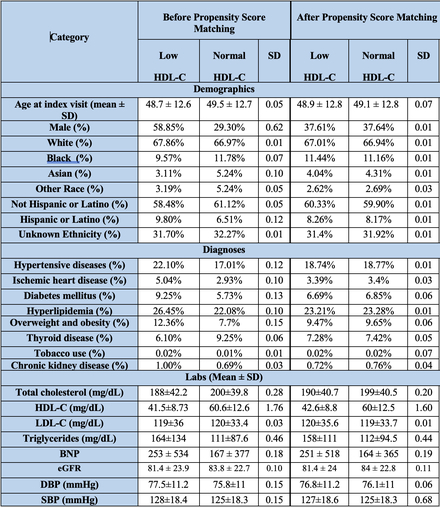
Abstract Body (Do not enter title and authors here): Background: Heart failure with preserved ejection fraction (HFpEF) represents over half of all heart failure cases and is projected to rise with the aging population. High-density lipoprotein cholesterol (HDL-C) has long been recognized for its protective role against atherosclerosis, while more recently, HDL particle number (HDL-P) and HDL functionality have gained attention as potential markers of cardiovascular risk. However, despite the established benefits of HDL in vascular protection and endothelial function, the association between HDL-C levels and HFpEF development remains controversial, particularly in middle-aged adults. Objective: We aim to evaluate the association between HDL-C in middle-aged adults and the development of HFpEF later in life. Methods: We conducted a retrospective cohort study using TriNetX (a global network of de-identified electronic health records) and analyzed adults who had their HDL-C values measured between Jan 2005 and Apr 2006 with no baseline HF or IHD. Patients with HDL-C <50 mg/dL were compared to those with HDL-C 50–80 mg/dL. Propensity score matching (1:1) adjusted for demographics, comorbidities, and lipid profiles. The outcome was incident HFpEF over a 20-year follow-up. Kaplan–Meier analysis and Cox models estimated risk. Stratified analyses were done by sex. Results: After applying criteria, 224,412 adults were included; 112,206 per group post-matching. Mean age was 49 years, and 59% were female. The low HDL-C group had higher triglycerides and lower total and LDL cholesterol, consistent with an atherogenic profile. Over a 20-year follow-up, the incidence of HFpEF was significantly higher in the low HDL-C group (HR: 1.33; 95% CI: 1.29–1.38; p < 0.01). Kaplan–Meier survival curves showed divergence beginning in early follow-up and widening over time. Stratified analysis confirmed elevated HFpEF risk in both sexes: HR 1.29 (95% CI: 1.23–1.36) in males and 1.35 (95% CI: 1.29–1.41) in females, with consistent separation of survival curves across subgroups. Conclusion: In this large cohort, low HDL-C in middle-aged adults was associated with a higher long-term HFpEF risk, regardless of sex or baseline cardiovascular comorbidities. This independent relationship suggests that HDL-C may reflect vascular and myocardial vulnerability beyond traditional risk factors. Incorporating HDL-C into HFpEF risk models could enhance early identification of at-risk individuals and guide targeted preventive strategies for heart failure.
Jafary, Zulkifl
( West Virginia University
, Morgantown
, West Virginia
, United States
)
Rana, Saim
( West Virginia University
, Morgantown
, West Virginia
, United States
)
Murshid, Abdulrahman
( West Virginia University
, Morgantown
, West Virginia
, United States
)
Watson, Hangyu
( West Virginia University
, Morgantown
, West Virginia
, United States
)
Alruwaili, Waleed
( West Virginia University
, Morgantown
, West Virginia
, United States
)
Author Disclosures:
Zulkifl Jafary:DO NOT have relevant financial relationships
| Saim Rana:DO NOT have relevant financial relationships
| Abdulrahman Murshid:No Answer
| HangYu Watson:DO NOT have relevant financial relationships
| Waleed Alruwaili:DO NOT have relevant financial relationships