
Logo

American Heart Association

  149
  0


Final ID: MDP932

5-oxoproline/ OPLAH Axis Alleviates Doxorubicin-induced Cardiomyopathy By Inhibiting Ferroptosis

Abstract Body (Do not enter title and authors here): Background: The clinical utility of doxorubicin (DOX) is constrained by its cardiotoxicity, known as DOX-induced cardiomyopathy (DIC). 5-oxoproline (5-OXO), a degradation product of glutathione, can be converted into glutathione by OPLAH (5-oxoprolinase). However, the role of 5-oxoproline/OPLAH in DIC remains largely unknown.
MethodsBy analyzing murine DIC metabolomics, we identified 5-oxoproline as an important metabolite involved in DIC. To investigate the role of 5-oxoproline/OPLAH axis in DIC, we adopted 5-OXO (5μmol/L; 28 days) and used global OPLAH-knockout mice in DIC mouse models induced with DOX.
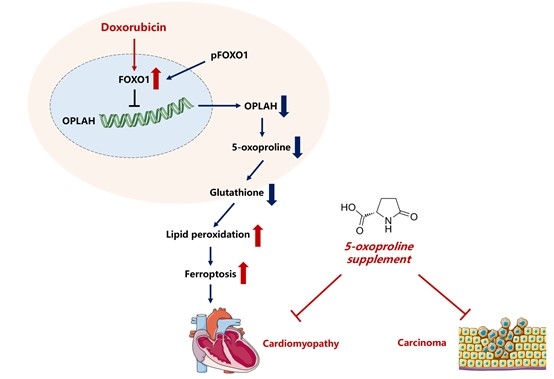
Results: 5-oxoproline exhibited the highest fold change among all metabolites in murine DIC tissues and 5-oxoproline was downregulated in both serum and myocardial tissues of DIC mice. In DIC mouse model, administration of 5-oxoproline significantly alleviated heart dysfunction, oxidative stress and ferroptosis, while OPLAH knockout exacerbated DOX-induced heart dysfunction, oxidative stress and ferroptosis in mice. Moreover, OPLAH knockout abolished the cardioprotective effect of 5-OXO in DIC model. Mechanistically, doxorubicin induced the translocation of FOXO1 from the cytoplasm to the nucleus, facilitating FOXO1’s transcriptional inhibitory effect on OPLAH (5-oxoprolinase) and downregulated the expression of OPLAH. Reduced OPLAH expression in cardiomyocytes decreases the conversion of 5-oxoproline to glutathione, thus aggravated oxidative stress and ferroptosis. Interestingly, 5-OXO supplement inhibited tumor growth while protecting DOX-induced cardiotoxicity in nude mice with implanted breast cancer. Regarding clinical significance, we found that downregulated expression of 5-OXO correlated with high risk in breast cancer patients with DOX treatment.
Conclusions: Our findings indicate a previously unrecognized role of 5-oxoproline in DIC treatment and an undescribed 5-oxoproline/OPLAH axis involved in regulating therapeutic metabolism in cardiomyocytes. It is important that our findings suggest 5-oxoproline can be used as a potential therapeutic agent for DIC and simultaneously antagonizing cancer growth.
  • Jiang, Meng  ( Renji Hospital , Shanghai , China )
  • Guo, Xinning  ( Renji Hospital , Shanghai , China )
  • Author Disclosures:
    Meng Jiang: No Answer | Xinning Guo: DO NOT have relevant financial relationships
Meeting Info:

Scientific Sessions 2024

2024

Chicago, Illinois

Session Info:

The Red Devil's in the Details: Molecular Mechanisms of Anthracycline Cardiomyopathy

Sunday, 11/17/2024 , 11:10AM - 12:35PM

Moderated Digital Poster Session

More abstracts on this topic:
Abnormal Calcium Regulation Leads to Pathological Cardiac Hypertrophy During Pregnancy in the GSNOR-Deficient Mouse Model of Preeclampsia

Dulce Raul, Balkan Wayne, Hare Joshua, Kulandavelu Shathiyah

Acetylation of Mitochondrial Cyclophilin D Increases vascular Oxidative Stress, Induces Glycolitic Switch, Promotes Endothelial Dysfunction and Hypertension

Dikalov Sergey, Sack Michael, Dikalova Anna, Fehrenbach Daniel, Mayorov Vladimir, Panov Alexander, Ao Mingfang, Lantier Louise, Amarnath Venkataraman, Lopez Marcos, Billings Frederic

You have to be authorized to contact abstract author. Please, Login
Not Available