
Logo

American Heart Association

  26
  0


Final ID: Sa3103

Outcomes of Left Atrial Appendage Occlusion Among Cancer Patients with Atrial Fibrillation: A Meta-Analysis

Abstract Body (Do not enter title and authors here): Background:
Atrial fibrillation (AF) is common among cancer patients and poses unique management challenges, especially regarding stroke prevention and bleeding risk. Left atrial appendage occlusion (LAAO) has emerged as a promising non-pharmacological strategy for stroke prevention in patients with non-valvular AF who are at high risk of bleeding. Yet its safety and efficacy in cancer patients remain inadequately characterized. This meta-analysis aimed to evaluate both periprocedural and long-term outcomes of LAAO in patients with AF and cancer.

Methods:
A comprehensive literature search was conducted using PubMed, Embase, and Google Scholar databases. Studies comparing LAAO outcomes in cancer patients with those in non-cancer patients were included in the analysis. Random-effects models were used to calculate Mantel-Haenszel odds ratios (ORs) with 95% confidence intervals (CIs). Statistical significance was set at p < 0.05. Review Manager 5.0 (RevMan) was utilized for all statistical analyses. The outcomes evaluated were periprocedural complications as well as long-term endpoints, including stroke, major bleeding, and all-cause mortality, over a mean follow-up duration of 1.6 years.

Results:
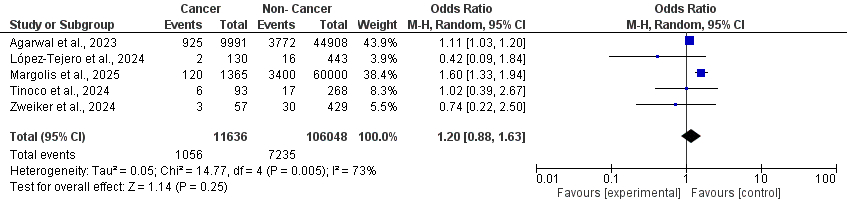
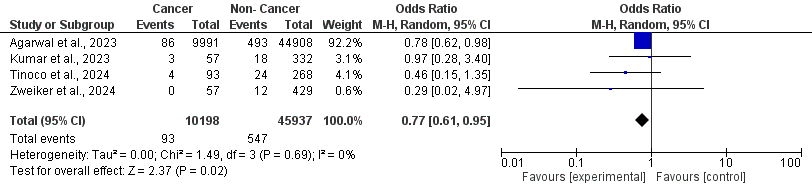
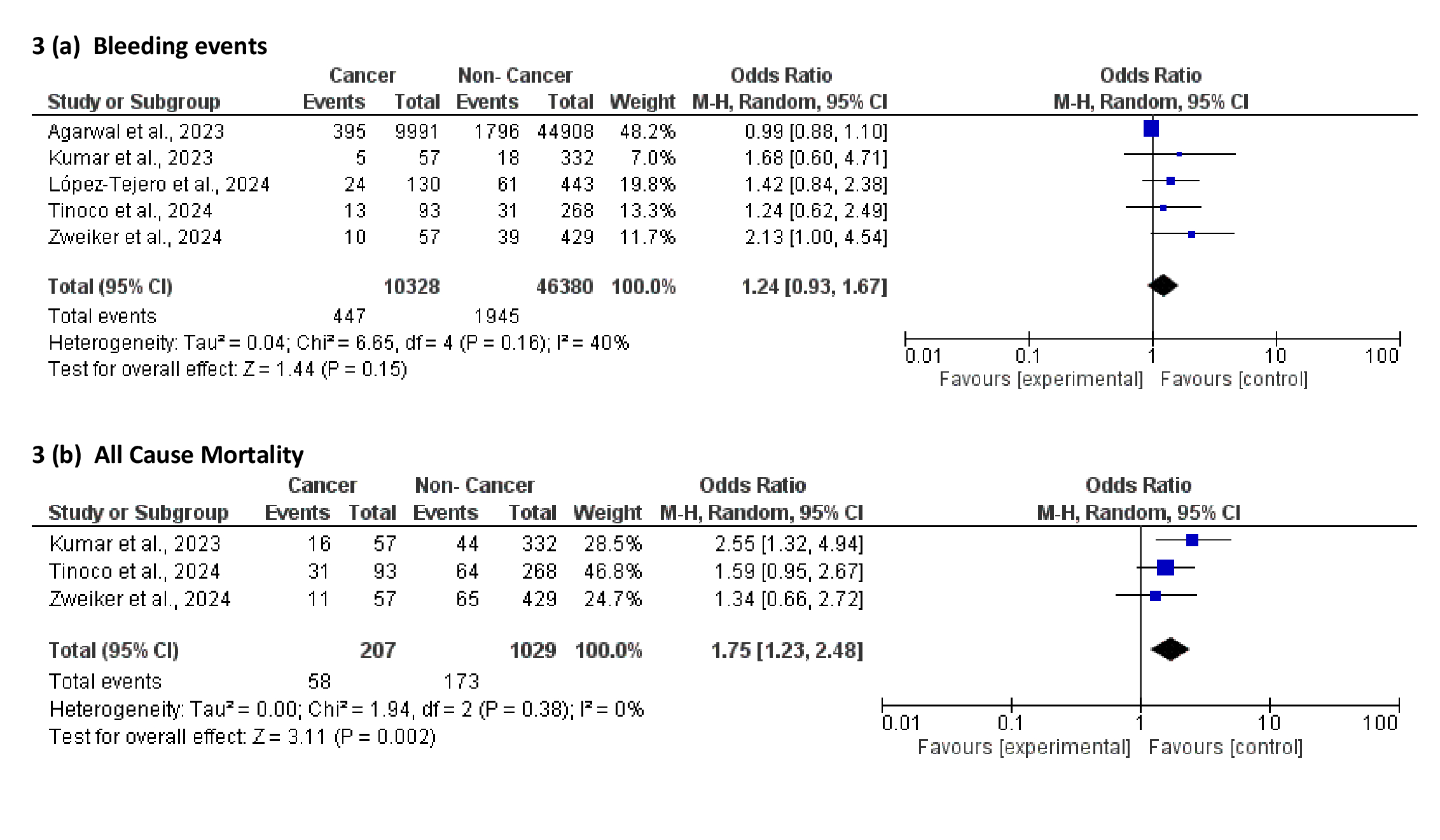
Six studies, including 11,693 cases of cancer with atrial fibrillation (AF), were included. Pooled analysis showed no significant difference in periprocedural complications between cancer and non-cancer patients undergoing the LAAO procedure (OR: 1.20; 95% CI: 0.88–1.63; p = 0.25). Over a mean follow-up of 1.6 years, cancer patients had a significantly lower risk of stroke compared with non-cancer patients (OR: 0.77; 95% CI: 0.61–0.95; p < 0.05). There was no statistically significant difference in the incidence of long-term bleeding events (OR: 1.24; 95% CI: 0.93–1.67; p = 0.15). However, all-cause mortality was significantly higher among cancer patients (OR: 1.75; 95% CI: 1.23–2.48; p < 0.01).

Conclusion:
LAAO appears to be a safe and effective strategy for stroke prevention in cancer patients with AF, with a comparable periprocedural risk profile and lower stroke rates. However, increased all-cause mortality highlights the need for individualized decision-making and further studies to define optimal patient selection.

Keywords: Atrial fibrillation, cancer, left atrial appendage occlusion, stroke, mortality
  • Rathore, Sawai Singh  ( Ascension St. Vincent Hospital Indianapolis (Milwaukee) Program , Milwaukee , Wisconsin , United States )
  • Bhattar, Keshav  ( Memorial Healthcare System, Fl , Pembroke Pines , Florida , United States )
  • Banga, Akshat  ( Mount Auburn Hospital , Cambridge , Massachusetts , United States )
  • Yadav, Ashish  ( University of Toledo , Toledo , Ohio , United States )
  • Al Shyyab, Ibrahim  ( Southern Illinois University , Springfield , Illinois , United States )
  • Alkhalaf, Heba  ( University of Sharjah , Sharjah , United Arab Emirates )
  • Kumar, Mahendra  ( Sardar Patel Medical College , Bikaner , India )
  • Author Disclosures:
    Sawai Singh Rathore: DO NOT have relevant financial relationships | Keshav Bhattar: DO NOT have relevant financial relationships | Akshat Banga: DO NOT have relevant financial relationships | ashish yadav: DO NOT have relevant financial relationships | Ibrahim Al Shyyab: No Answer | Heba Al Khalaf: DO NOT have relevant financial relationships | Mahendra Kumar: DO NOT have relevant financial relationships
Meeting Info:

Scientific Sessions 2025

2025

New Orleans, Louisiana

Session Info:

Cutting Edge Cardio-Oncology Research

Saturday, 11/08/2025 , 02:30PM - 03:30PM

Abstract Poster Board Session

More abstracts on this topic:
A novel deep learning framework identified associated genes and Interpretable deep learning translation of GWAS findings for drug repurposing in Atrial Fibrillation

Tonegawa-kuji Reina, Xu Jielin, Guntupalli Suman, Barnard John, Chung Mina, Cheng Feixiong

A Novel Variant in GNB2 as a Cause of Sick Sinus Syndrome

Bulut Aybike, Karacan Mehmet, Saygili E. Alper, Pirli Dogukan, Aydin Eylul, Ozdemir Ozkan, Balci Nermin, Alanay Yasemin, Bilguvar Kaya, Akgun Dogan Ozlem

More abstracts from these authors:
When Bigger Isn’t Worse: The Obesity Paradox in Pulmonary Embolism — A Meta-Analysis

Rathore Sawai Singh, Banga Akshat, Bhattar Keshav, Al Shyyab Ibrahim, Yadav Ashish, Kumar Mahendra

Left Atrial Posterior Wall Isolation Plus Pulmonary Vein Isolation vs. Pulmonary Vein Isolation Alone by Pulsed Field Ablation for Persistent Atrial Fibrillation: A Meta-Analysis

Rathore Sawai Singh, Banga Akshat, Bhattar Keshav, Yadav Ashish, Al Shyyab Ibrahim, Kumar Mahendra

You have to be authorized to contact abstract author. Please, Login
Not Available