
Logo

American Heart Association

  21
  0


Final ID: MP2589

When Bigger Isn’t Worse: The Obesity Paradox in Pulmonary Embolism — A Meta-Analysis

Abstract Body (Do not enter title and authors here):

Background:
Obesity is a well-established risk factor for venous thromboembolism, including pulmonary embolism (PE). Obese individuals are more likely to develop PE due to prothrombotic and inflammatory states associated with excess adiposity. However, an emerging body of evidence suggests that obese patients may experience unexpectedly favorable outcomes, a phenomenon known as the “obesity paradox.” This meta-analysis aimed to evaluate the impact of obesity on clinical outcomes in patients with pulmonary embolism (PE).

Methods:
A comprehensive literature search was conducted using PubMed, Embase, and Google Scholar databases. Random-effects models were used to calculate Mantel-Haenszel odds ratios (ORs) with 95% confidence intervals (CIs). Statistical significance was set at p < 0.05. Review Manager 5.0 (RevMan) was utilized for all statistical analyses. The primary endpoint was all-cause mortality from hospitalization till one-year follow-up. Secondary outcomes were major bleeding events in the same time frame. Obesity was defined as a body mass index (BMI) of 30 kg/m2 or greater, as per the World Health Organization (WHO) definition.

Results:
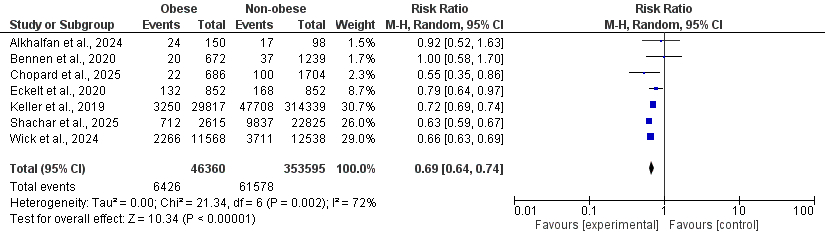
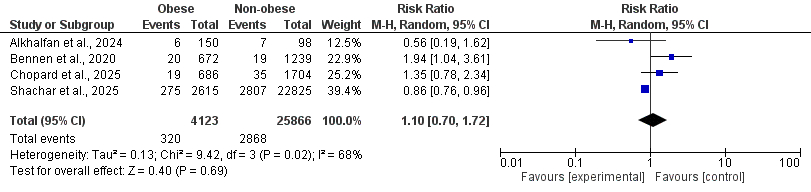
Seven studies, including 404,348 patients with pulmonary embolism (PE), were included in this analysis. Pooled data showed that obese patients had significantly lower all-cause mortality compared to non-obese patients (RR: 0.69; 95% CI: 0.64–0.74; p < 0.001), supporting the concept of a mortality paradox. Despite concerns that obesity might increase bleeding risk, no statistically significant difference in major bleeding events was observed between obese and non-obese groups (RR: 1.10; 95% CI: 0.70–1.72; p = 0.67).

Conclusion:
This meta-analysis demonstrates a clear mortality benefit in obese patients with PE without an increased risk of major bleeding, reinforcing the concept of an obesity paradox. Further research is needed to elucidate the underlying mechanisms and to guide risk-adapted management strategies in this population.
  • Rathore, Sawai Singh  ( Ascension St. Vincent Hospital Indianapolis (Milwaukee) Program , Milwaukee , Wisconsin , United States )
  • Banga, Akshat  ( Mount Auburn Hospital , Cambridge , Massachusetts , United States )
  • Bhattar, Keshav  ( Memorial Healthcare System, Fl , Pembroke Pines , Florida , United States )
  • Al Shyyab, Ibrahim  ( Southern Illinois University , Springfield , Illinois , United States )
  • Yadav, Ashish  ( University of Toledo , Toledo , Ohio , United States )
  • Kumar, Mahendra  ( Sardar Patel Medical College , Bikaner , India )
  • Author Disclosures:
    Sawai Singh Rathore: DO NOT have relevant financial relationships | Akshat Banga: DO NOT have relevant financial relationships | Keshav Bhattar: DO NOT have relevant financial relationships | Ibrahim Al Shyyab: No Answer | ashish yadav: DO NOT have relevant financial relationships | Mahendra Kumar: DO NOT have relevant financial relationships
Meeting Info:

Scientific Sessions 2025

2025

New Orleans, Louisiana

Session Info:

Advances in Venous Thromboembolic Disease

Monday, 11/10/2025 , 01:45PM - 02:45PM

Moderated Digital Poster Session

More abstracts from these authors:
Outcomes of Left Atrial Appendage Occlusion Among Cancer Patients with Atrial Fibrillation: A Meta-Analysis

Rathore Sawai Singh, Bhattar Keshav, Banga Akshat, Yadav Ashish, Al Shyyab Ibrahim, Alkhalaf Heba, Kumar Mahendra

Left Atrial Posterior Wall Isolation Plus Pulmonary Vein Isolation vs. Pulmonary Vein Isolation Alone by Pulsed Field Ablation for Persistent Atrial Fibrillation: A Meta-Analysis

Rathore Sawai Singh, Banga Akshat, Bhattar Keshav, Yadav Ashish, Al Shyyab Ibrahim, Kumar Mahendra

You have to be authorized to contact abstract author. Please, Login
Not Available