
Multimodal Artificial Intelligence Improves the Yield of Nuclear Cardiac Amyloid Testing in Suspected Transthyretin Amyloid Cardiomyopathy: a Report from the TRACE-AI Network
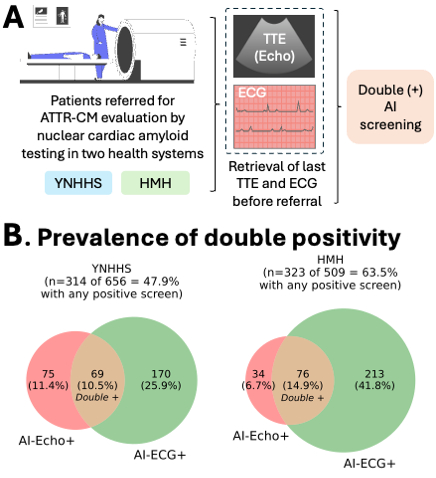
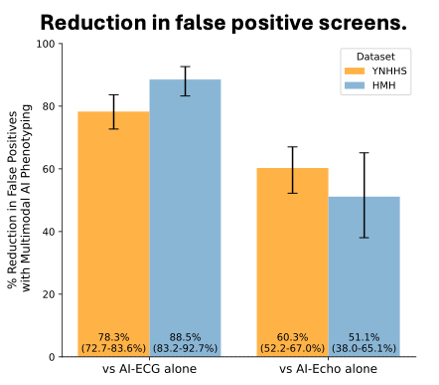
Abstract Body (Do not enter title and authors here): Introduction: Artificial intelligence (AI) applied to single cardiovascular diagnostic modalities is an emerging approach for the scalable screening of transthyretin amyloid cardiomyopathy (ATTR-CM) offering the promise of timely detection and intervention. However, broad clinical deployment strategies may be limited by high rates of false positive screens. Hypothesis: We hypothesize that a multimodal approach that jointly evaluates AI-detectable electrocardiographic (AI-ECG) and echocardiographic (AI-Echo) phenotypes will improve the precision of AI-guided ATTR-CM screening as confirmed on nuclear cardiac amyloid testing. Methods: This was a retrospective analysis of 1,165 unique patients referred for nuclear cardiac amyloid testing for suspicion of ATTR-CM across two independent health systems participating in the TRACE-AI Network Study (Yale-New Haven Health System [YNHHS] and the Houston Methodist Hospitals [HMH]). We retrieved the last 12-lead ECG and transthoracic echocardiogram (TTE) performed in the year before nuclear cardiac amyloid testing and deployed previously validated models trained to discriminate ATTR-CM from age/sex-matched controls. We evaluated the diagnostic performance of unimodal screening strategies using a) AI-ECG alone, or b) AI-Echo alone vs c) a multimodal, joint AI-ECG/AI-Echo strategy. Results: Our study included 656 (73±12 years, 307 [46.8%] female, 50 [7.6%] ATTR-CM) and 509 (70±13 years, 188 [36.9%] female, 96 [18.9%] ATTR-CM) individuals who were referred for nuclear cardiac amyloid testing across YNHHS and HMH, respectively (Fig. 1a). At validated thresholds (≥0.15), 314 (47.9%) and 323 (63.5%) individuals screened positive on at least one modality and 69 (10.5%) and 74 (14.5%) screened positive on both modalities across YNHHS and HMH, respectively (Fig. 1b). Double positivity on multimodal screening resulted in specificity of 0.93 to 0.94 and positive predictive value of 0.36 to 0.66, across sites. At the same probability threshold, this translated into a 78.3% [95%CI 72.7%-83.6%] (YNHHS) to 88.5% [95%CI: 83.2%-92.7%] (HMH) reduction in false positives vs AI-ECG alone, and 51.1% [95%CI: 38.0%-65.1%] (HMH) to 60.3% [95%CI: 52.2%-67.0%] (YNHHS) reduction in false positives vs AI-Echo alone (Fig. 2). Conclusion: Multimodal AI-enabled screening of suspected ATTR-CM significantly decreases false positive screens from unimodal AI models and represents a promising strategy for system-wide screening programs.
Oikonomou, Evangelos
( Yale School of Medicine
, New Haven
, Connecticut
, United States
)
Pedroso, Aline
( Yale School of Medicine
, New Haven
, Connecticut
, United States
)
Vasisht Shankar, Sumukh
( Yale School of Medicine
, New Haven
, Connecticut
, United States
)
Malicki, Caitlin
( Yale School of Medicine
, New Haven
, Connecticut
, United States
)
Coppi, Andreas
( Yale School of Medicine
, New Haven
, Connecticut
, United States
)
Al-kindi, Sadeer
( Houston Methodist
, Houston
, Texas
, United States
)
Khera, Rohan
( Yale School of Medicine
, New Haven
, Connecticut
, United States
)
Author Disclosures:
Evangelos Oikonomou:DO have relevant financial relationships
;
Consultant:Caristo Diagnostics, Ltd:Past (completed)
; Consultant:Ensight-AI, Inc:Active (exists now)
; Ownership Interest:Evidence2Health, LLC:Active (exists now)
| Aline Pedroso:DO NOT have relevant financial relationships
| Sumukh Vasisht Shankar:No Answer
| Caitlin Malicki:DO NOT have relevant financial relationships
| Andreas Coppi:DO NOT have relevant financial relationships
| Sadeer Al-Kindi:DO have relevant financial relationships
;
Research Funding (PI or named investigator):Ionis Pharmaceuticals:Active (exists now)
| Rohan Khera:DO have relevant financial relationships
;
Research Funding (PI or named investigator):Bristol-Myers Squibb:Active (exists now)
; Research Funding (PI or named investigator):NovoNordisk:Active (exists now)
; Research Funding (PI or named investigator):BridgeBio:Active (exists now)