Logo

American Heart Association

  15
  0


Final ID: Mo4095

The 5,000+ Plasma Proteome of an Atherosclerosis Mouse Model Identifies Known and Potential Disease Drivers

Abstract Body (Do not enter title and authors here): Background Mutations in the LDL receptor (LDLR) are causal for familial hypercholesterolemia, inciting the Ldlr-/- model for atherosclerosis. Despite >3,000 reports using this model, technical limitations have impeded efforts to identify candidate disease drivers in plasma. We capitalized on recent advances in mass spectrometry technologies to investigate whether dyslipidemia impacts plasma proteins implicated in human disease.
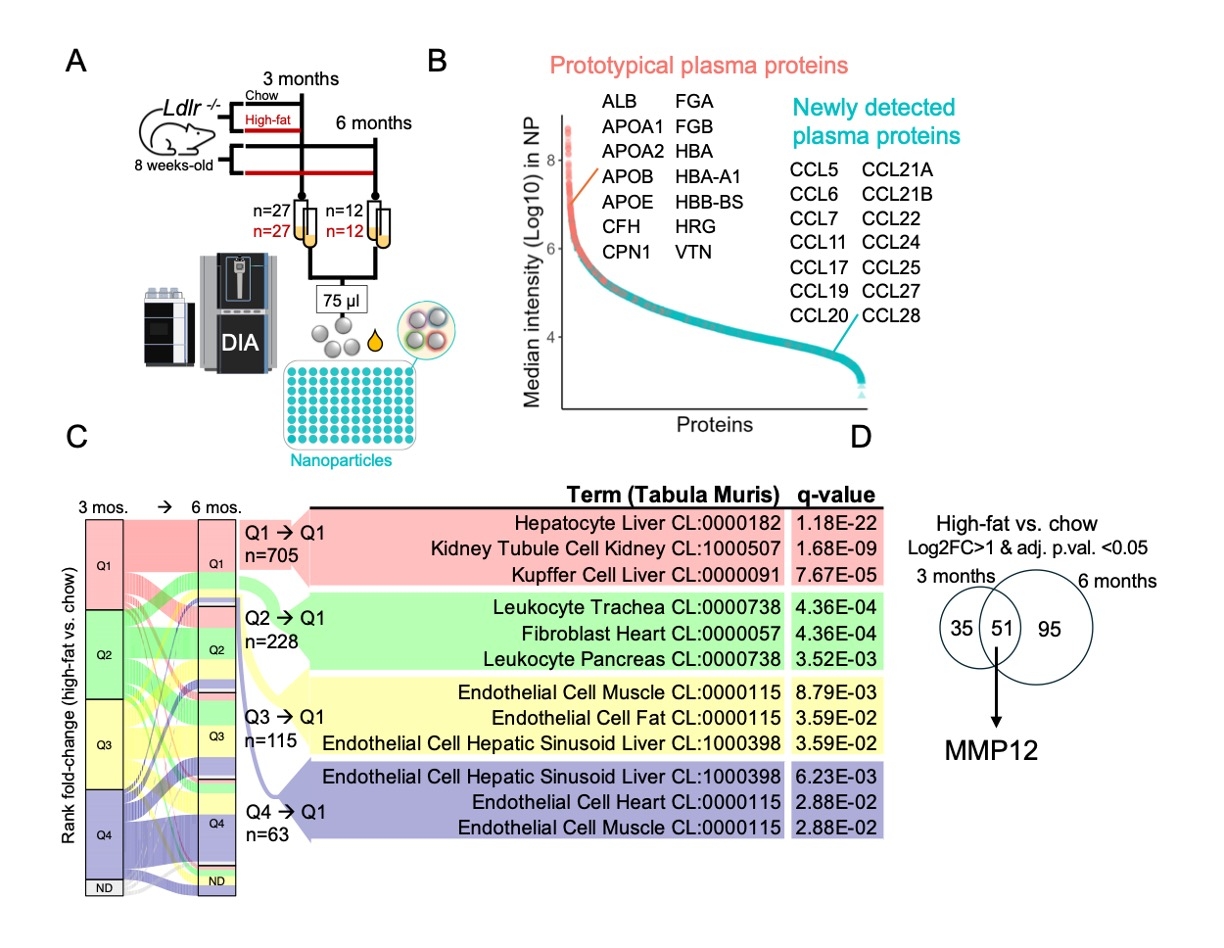
Methods Ldlr-/- mice were fed a chow or high-fat diet (HFD) for 3 (n= 27 per diet) or 6 months (n=12 per diet). Plasma samples were processed using a nanoparticle workflow (Seer), and peptides were analyzed using the OrbitrapTMAstralTM (Thermo) (Fig.A). Proteomes were queried against the Tabula Muris mouse single-cell and Gene Ontology (GO) databases; and queried against a GWAS list of 419 risk loci for coronary artery disease (CAD).
Results We sequenced 5,080 plasma proteins surpassing previous reports by 10-fold. The most intense proteins were the prototypical apolipoproteins whereas proteins associated with cytokine/chemokine signaling represent the previously unchartered mouse plasma proteome (Fig.B). To monitor sweeping changes over time, we divided the proteome into quartiles (Q1-Q4). Proteins with a sustained enrichment in HFD (n=705 remain within Q1) are indicative of liver cell subtypes (Tabula Muris, q<7.7E-0.02; Fig.C). Whereas proteins that moved up from the lower quartiles - Q2 (n=228), Q3 (115) and Q4 (63) - indicate leukocytes and fibroblasts (Q2, q<3.5E-0.03), and endothelial cells (Q3 and Q4, q<2.9E-0.02) (Fig.C); demonstrating that signatures of inflammation and endothelial activation increase with disease progression. We also cross-referenced these interquartile changes to CAD risk loci and confirmed 24 genes including LPL that associate with disease progression, and another 104 genes confirmed in plasma. We focused on the 86 and 146 proteins that increased with a log2FC>1 (q<5.0E-0.02) at each timepoint (Fig.D). Fifty-one were common including MMP12, a candidate atherosclerosis biomarker in humans. Most of these increased proteins are mitochondrial or peroxisomal (q<5.0E-0.02), demonstrating that organelle components for fatty acid oxidation circulate and increase with disease progression.
Conclusions Mass spectrometry now permits us to identify novel biomarkers or targets in Ldlr-/- mice plasma; and to monitor candidate proteins associated with human disease in preclinical interventional therapeutic studies.
  • Delwarde, Constance  ( Brigham and Women's Hospital , Boston , Massachusetts , United States )
  • Matamalas, Joan  ( Brigham and Women's hospital , Boston , Massachusetts , United States )
  • Chelvanambi, Sarvesh  ( Brigham And Womens Hospital , Brighton , Massachusetts , United States )
  • Kasai, Taku  ( Brigham and Women's Hospital , Boston , Massachusetts , United States )
  • Aikawa, Masanori  ( Brigham and Women's Hospital , Boston , Massachusetts , United States )
  • Singh, Sasha  ( Brigham and Women's Hospital , Boston , Massachusetts , United States )
  • Author Disclosures:
    Constance Delwarde: No Answer | Joan Matamalas: No Answer | Sarvesh Chelvanambi: No Answer | Taku Kasai: No Answer | Masanori Aikawa: No Answer | Sasha Singh: DO NOT have relevant financial relationships
Meeting Info:

Scientific Sessions 2025

2025

New Orleans, Louisiana

Session Info:

Emerging Pathways and Mechanisms in Sex Differences and Cardiometabolic Disease

Monday, 11/10/2025 , 01:00PM - 02:00PM

Abstract Poster Board Session

More abstracts on this topic:
A Blood(y) Pressure Crisis: Diffuse Alveolar Hemorrhage as a Rare Manifestation of Severely Uncontrolled Hypertension

Nandyal Shreyas, Amdetsion Gedion Yilma, Varma Revati, Kohli Saksham, Hammo Hasan

A Diagnosis Dilemma of Positional Hypoxia: Scoliosis-Mediated Platypnea-Orthodeoxia Syndrome

Ademuwagun Christianah, Arjoon Roy, Seth Paula, Chang Gene, Ibe Oby

More abstracts from these authors:
Characterization of NIMA-related kinase 7 (NEK7)-NLRP3 inflammasome complex in macrophages by combining CRISPR/Cas9 gene-editing with comprehensive proteomic

Nakamura Yuto, Chelvanambi Sarvesh, Kasai Taku, Whelan Mary, Sasaki Yusuke, Singh Sasha, Aikawa Elena, Aikawa Masanori

ADP-Ribosylation In a Mouse Model of Atherosclerosis: a Potential Novel Link Between Dyslipidemia and Inflammation in Cardiovascular Disease

Delwarde Constance, Mlynarchik Andrew, Perez Katelyn, Campedelli Alesandra, Sonawane Abhijeet, Aikawa Elena, Singh Sasha, Aikawa Masanori, Santinelli Pestana Diego, Kasai Taku, Kuraoka Shiori, Nakamura Yuto, Okada Takeshi, Decano Julius, Chelvanambi Sarvesh, Ge Rile

You have to be authorized to contact abstract author. Please, Login
Not Available