Scarcity of obesity specialists relative to obesity prevalence in US counties
Abstract Body (Do not enter title and authors here): Introduction: Given the obesity epidemic, access to obesity specialists such as endocrinologists and obesity medicine physicians is paramount for adequate treatment to avoid long-term complications. However, geographic distribution of obesity specialists in United States (US) counties and its relationship with obesity prevalence is unclear.
Methods: A cross-sectional analysis was conducted on 3230 US counties categorized by metropolitan status (large central metropolitan, fringe central metropolitan, medium and small metropolitan, and nonmetropolitan). We merged data from the US Census, CDC Atlas, the NPI registry, American Community Survey, US Bureau of Labor Statistics, and the National Center of Health Statistics to form the dataset. 232 counties were excluded from our analysis due to incomplete data on the CDC Atlas (150 from continental US, 82 from US territories including Guam, the US Virgin Islands, and Puerto Rico) to form a final study sample of 2998 counties. Predictors of obesity specialists per 100K adults with obesity by county was determined using regression analysis.
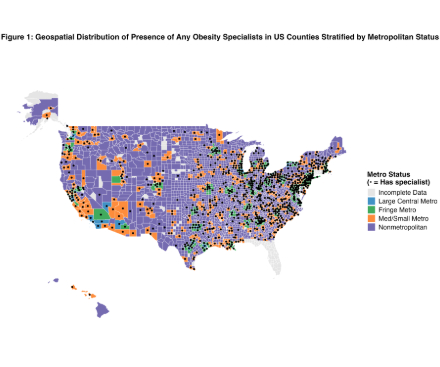
Results: The median demographic composition of the 2,998 US counties is: 50.0% men, 82.3% White, with a median age of 41.6 years. The average percentage of adults with obesity per county was 28.3% (SD 6.5%) and the average number of obesity specialists per county was 5.0 (SD 14.8) per 100K adults with obesity per county. However, substantial variation exists by metropolitan status on the ratio of obesity specialists/100K adults with obesity per county, that ranged from 25.1 (SD 26.1) in large central metro, 8.4 (SD 20.1) in fringe metro, 9.5 (SD 20.8) in medium/small metro to 2.0 (SD 7.9) in non-metro counties, P<0.001 for trend. A total of 70.2% of US counties did not have obesity specialists (Figure 1). Regression modeling adjusted for demographics, socioeconomic status, and total number of physicians per county showed the independent predictors of obesity specialists in US counties to be education, household income, male sex, and nonmetropolitan status.
Conclusions: Significant heterogeneity exists on access to obesity specialists across US counties, especially in nonmetropolitan counties, suggesting the need for more obesity specialists in our communities with inadequate access or the general upskilling of physicians who treat obesity.
Chuang, Samuel
( University of California Riverside
, Riverside
, California
, United States
)
Khetpal, Vishal
( Brown University
, Providence
, Rhode Island
, United States
)
Lu, Frederick
( Brown Health
, Providence
, Rhode Island
, United States
)
Wu, Wen-chih
( Brown University
, Providence
, Rhode Island
, United States
)
Author Disclosures:
Samuel Chuang:DO NOT have relevant financial relationships
| Vishal Khetpal:No Answer
| Frederick Lu:DO NOT have relevant financial relationships
| Wen-Chih Wu:DO NOT have relevant financial relationships