
Estimating Effects of Magnesium Supplement Use on Preventing Heart Failure in Diabetic Patients via Target Trial Emulation
Abstract Body (Do not enter title and authors here): Introduction Magnesium (Mg) deficiency may increase the risk of heart failure (HF) in diabetic patients. Less is known about whether the use of Mg supplements is associated with a lower risk of HF in these patients.
Research Questions We emulated target trials to estimate the effects of Mg supplement use on preventing HF in diabetic patients.
Methods We analyzed data from the US Veterans Health Administration to identify eligible diabetic patients for a Mg supplement target trial from 01/01/2006 to 12/31/2020. Eligibility was checked at an outpatient visit with following criteria: 1) aged 40+ years, 2) free of outcomes, 3) had a HbA1C test in the past year, and 4) no prior Mg use. Mg supplement use was obtained by natural language processing of electronic health record. Mg supplement use was defined as use within 30 days of the eligible outpatient clinic visit. HF diagnosis was the primary outcome; Major adverse cardiac events (MACE), including death and HF hospitalization, was secondary outcome. Patients were followed up to 10 years until the outcome, censored due to no further Mg supplement use for Mg users or starting Mg supplement use for non-users, or receipt of a new Mg prescription.
We used Inverse probability weighting to account for differences in baseline characteristics between Mg user and non-users. We conducted a Cox regression model on the weighted cohort to compare the effect of Mg Supplement use on outcomes.
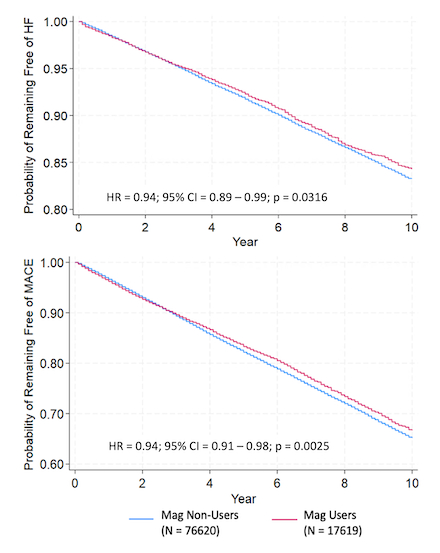
Results A total of 94,239 patients were enrolled in the target trials (17,619 Mg users; mean age, 67.3 years; 4.9% females, 18.5% Blacks). The mean duration of Mg supplement use was 3.7±3.3 yrs. The incidence of HF was slightly lower in Mg users compared to non-users (16.9 vs. 17.9 events per 1000 person-years). Mg supplement use was associated with a lower risk of HF and MACE (Figure 1).
Conclusion Our study showed that long-term Mg supplementation was associated with a lower risk of HF and MACE in diabetic patients. The potential benefits of Mg supplement use should be further confirmed in a randomized-controlled trial.
Cheng, Yan
( George Washington University
, Washington
, District of Columbia
, United States
)
Zullo, Andrew
( Providence VA Medical Center
, Providence
, Rhode Island
, United States
)
Yin, Ying
( George Washington University
, Washington
, District of Columbia
, United States
)
Shao, Yijun
( George Washington University
, Washington
, District of Columbia
, United States
)
Ahmed, Ali
( VA MEDICAL CENTER
, Washington
, District of Columbia
, United States
)
Liu, Simin
( Brown University
, Providence
, Rhode Island
, United States
)
Zeng, Qing
( George Washington University
, Washington
, District of Columbia
, United States
)
Wu, Wen-chih
( VA MEDICAL CENTER
, Washington
, District of Columbia
, United States
)
Author Disclosures:
Yan Cheng:DO NOT have relevant financial relationships
| Andrew Zullo:DO NOT have relevant financial relationships
| Ying Yin:DO NOT have relevant financial relationships
| Yijun Shao:No Answer
| Ali Ahmed:No Answer
| Simin Liu:DO NOT have relevant financial relationships
| Qing Zeng:No Answer
| Wen-Chih Wu:DO NOT have relevant financial relationships