Logo

American Heart Association

  22
  0


Final ID: 4365382

Artificial intelligence versus clinician maximum wall thickness measurement on cardiac MRI for mortality prediction

Abstract Body (Do not enter title and authors here): Background
Maximum wall thickness (MWT) reflects left ventricular hypertrophy, which is associated with adverse prognosis in multiple diseases and at population level. In hypertrophic cardiomyopathy (HCM), MWT is a key marker in risk stratification and is commonly measured by expert clinician annotation. Artificial intelligence (AI) measurement of MWT has shown significantly higher precision than clinicians due to lower test-retest variability, but how this translates to clinical outcome is less understood.

Hypothesis
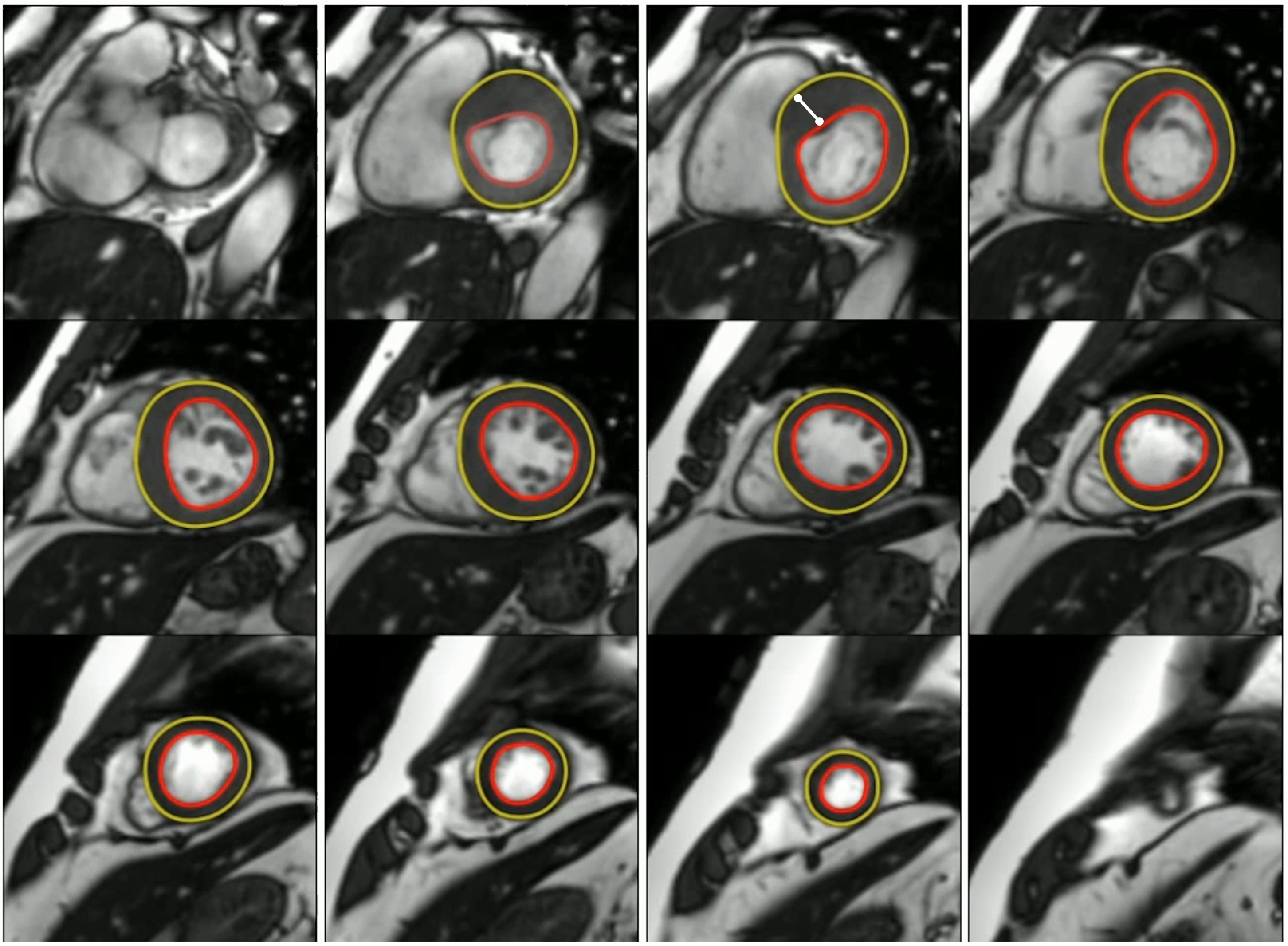
We hypothesized that a deep-learning AI measurement of MWT obtained from cardiac MRI outperforms expert clinician annotation for the prediction of all-cause mortality.

Methods
We studied a retrospective cohort of 10,382 consecutive patients who underwent cardiac MRI (CMR) at a large referral centre. Mortality data was obtained from a national database. The median follow-up was 5.5 years (IQR 4.4–6.9), during which 1,462 patients (14%) died. A subgroup analysis was conducted in n=1,699 subjects with HCM, of which 207 (12%) died.

AI measurement was performed on all CMR studies, and Cox proportional hazards models were fitted to compare the prognostic value of AI-derived MWT with those derived from clinician annotation used in clinical care.

Results
Compared to clinician annotation, AI-derived MWT had higher prediction for all-cause mortality (p<0.001). Differences remained after adjusting for age and sex. In HCM, MWT was poorly predictive of all-cause mortality (both AI and clinicians C-Indices <0.6) and in these there was no significant difference in mortality prediction (p=0.15). AI analysis took <20s per subject.

Conclusion
Compared to clinician experts, AI-derived MWT shows superior prediction of mortality in all-comer patients. In patients with HCM, AI performance was equivalent. AI measurement is delivered at high speed and low-cost. Findings support the superseding of clinician-derived MWT with AI.
  • Joy, George  ( City St George's, London , London , United Kingdom )
  • Davies, Rhodri  ( University College London , London , United Kingdom )
  • Meredith, Benjamin  ( University College London , London , United Kingdom )
  • Pierce, Iain  ( University College London , London , United Kingdom )
  • Shiwani, Hunain  ( University College London , London , United Kingdom )
  • Kellman, Peter  ( NIH , BETHESDA , Maryland , United States )
  • Treibel, Thomas  ( University College London , London , United Kingdom )
  • Manisty, Charlotte  ( University College London , London , United Kingdom )
  • Hughes, Alun  ( University College London , London , United Kingdom )
  • Moon, James  ( UCL , London, UK , United Kingdom )
  • Author Disclosures:
    George Joy: DO have relevant financial relationships ; Consultant:Mycardium AI:Active (exists now) | Rhodri Davies: No Answer | Benjamin Meredith: No Answer | Iain Pierce: DO have relevant financial relationships ; Consultant:MyCardium AI:Active (exists now) | Hunain Shiwani: No Answer | Peter Kellman: No Answer | Thomas Treibel: No Answer | Charlotte Manisty: No Answer | Alun Hughes: DO NOT have relevant financial relationships | James Moon: No Answer
Meeting Info:

Scientific Sessions 2025

2025

New Orleans, Louisiana

Session Info:

Hypertrophic Cardiomyopathy Medical Society Oral Abstracts

Friday, 11/07/2025 , 02:30PM - 03:45PM

Abstract Oral Session

More abstracts on this topic:
A Multicenter Friedreich Ataxia Registry Identifies Posterior Wall Thickness as a Predictor of Major Adverse Cardiac Events

Lin Kimberly, Johnson Jonathan, Mccormack Shana, Lynch David, Tate Barbara, Feng Yixuan, Huang Jing, Mercer-rosa Laura, Dedio Anna, Mcsweeney Kara, Fournier Anne, Yoon Grace, Payne Ronald, Cripe Linda, Patel Aarti, Niaz Talha

A Hypertrophic Cardiomyopathy Polygenic Score Modifies Penetrance of Pathogenic Hypertrophic and Dilated Cardiomyopathy Variants in Opposite Directions

Abramowitz Sarah, Hoffman-andrews Lily, Depaolo John, Judy Renae, Owens Anjali, Damrauer Scott, Levin Michael

More abstracts from these authors:
Cumulative Life-course Blood Pressure Burden and Steepness of Increase Are Associated with Reduced Myocardial Perfusion in Older Age: Insights from MyoFit46

Topriceanu Constantin-cristian, Wong Andrew, Pierce Iain, Davies Rhodri, Lambiase Pier, Chaturvedi Nishi, Kellman Peter, Hardy Rebecca, Moon James, Hughes Alun, Captur Gabriella, Webber Matthew, Shiwani Hunain, Chan Fiona, Martin Emma, Falconer Debbie, Bennett Jonathan, Gonzalez Martin Pablo, Shah Haytham

Genome-wide association study of aortic stiffness derived from deep learning in CMR images of 45,789 individuals identifies loci linked with cell-matrix structure

Paliwal Nikhil, Henry Albert, Finan Chris, Davies Rhodri, Hughes Alun, Williams Bryan, Malarstig Anders, Lumbers Tom, Hingorani Aroon

You have to be authorized to contact abstract author. Please, Login
Not Available