
Reduced serum cholesterol levels and bias towards the alternative biliary pathway in myeloid Fmr1 deficient mice implicates increased Tgr5 expression
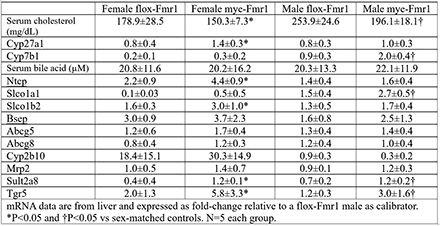
Abstract Body (Do not enter title and authors here): Background: Fragile X Syndrome (FXS) is a genetic disorder caused by increased CGG repeats in the Fragile X Messenger Ribonucleoprotein 1 (FMR1) gene which encodes an RNA-binding protein (FMRP) that alters mRNA processing, translation and stability including metabolic signaling affecting serum cholesterol levels. The pathways involved in the modulation of cholesterol and bile synthesis by FMR1 remain largely unknown. Methods: Total Fmr1 deficient (Fmr1-/-), Fmr+/+, myeloid-specific Fmr1 deficient (mye-Fmr1) and Fmr1-flox control mice were fed Western diet for 6 weeks. Serum cholesterol levels, serum bile and hepatic gene expression were evaluated. Phase II bile detoxification sulfotransferase family 2a member 8 (Sult2a8) was overexpressed using AAV. Results: Fmr1-/- mice had reduced serum cholesterol (142.1±20.8 vs 167.8±18.7 mg/dL; N=5 each, P<0.05) and hepatic LDLR protein expression (0.7±0.3 vs 2.4±2.0; P<0.05) compared to Fmr1+/+ mice, suggesting a non-LDLR pathway of cholesterol clearance such as the biliary pathway. Reduced serum cholesterol was replicated in mye-Fmr1 deficiency. Female mye-Fmr1 mice had significantly increased hepatic bile synthesis gene cytochrome P450 family 27 subfamily A member 1 (Cyp27a1) mRNA expression while male mice had significantly increased Cyp7b1 compared to flox-Fmr1 controls (Table 1). Western blots confirmed mRNA results suggesting that bile synthesis is biased towards the alternative pathway, with no differences in serum bile acid levels. Female mye-Fmr1 mice had significantly increased hepatic bile transporters Na+-taurochlorate cotransporting polypeptide (Ntcp) and solute carrier organic anion transporter family member 1b2 (Slco1b2) mRNA expression, while male mye-Fmr1 mice had significantly increased Slco1a1 compared to controls (Table 1). Bile salt export protein (Bsep), Abcg5, Abcg8, Phase I bile detoxification genes Cyp2b10 and Multidrug resistance-associated protein 2 (Mrp2) mRNA expression were not different. Sult2a8 was increased in mye-Fmr1 mice but over-expression in Western diet fed wild type mice did not alter serum cholesterol levels. However, bone marrow-derived macrophage and hepatic expression of bile acid receptor Takeda G-protein coupled receptor-5 (Tgr5) was significantly increased in mye-Fmr1 compared to control. Conclusion: The results delineate metabolic effects and modulation of bile acid synthesis pathway by myeloid Fmr1 deficiency and suggest a novel interaction between Fmr1 and Tgr5.
Zhao, Xiaoning
(
CEDARS-SINAI MEDICAL CENTER
, Los Angeles , California , United States )
Zhou, Jianchang
(
CEDARS-SINAI MEDICAL CENTER
, West Hollywood , California , United States )
Chyu, Kuang-yuh
(
CEDARS-SINAI MEDICAL CENTER
, Los Angeles , California , United States )
Erbay, Ebru
(
UCLA
, Los Angeles , California , United States )
Cercek, Bojan
(
CEDARS-SINAI MEDICAL CENTER
, Los Angeles , California , United States )
Shah, Prediman
(
CEDARS-SINAI MEDICAL CENTER
, Los Angeles , California , United States )
Dimayuga, Paul
(
CEDARS-SINAI MEDICAL CENTER
, Los Angeles , California , United States )
Author Disclosures:
Xiaoning Zhao:No Answer
| Jianchang Zhou:No Answer
| Kuang-Yuh Chyu:DO NOT have relevant financial relationships
| Ebru Erbay:No Answer
| Bojan Cercek:No Answer
| Prediman Shah:DO NOT have relevant financial relationships
| Paul Dimayuga:DO NOT have relevant financial relationships