
Logo

American Heart Association

  15
  0


Final ID: Wed129

A Neuroendocrine Cardiac Neuron Pathway Mediates Metabolic Stress Induced Arrhythmia In Drosophila

Abstract Body: Cardiac arrhythmia is a major consequence of obesity and diabetes, yet the mechanisms linking metabolic stress to cardiac rhythm remain poorly defined. Glucagon signaling has long been implicated in heart rate control, but whether it acts directly on cardiomyocytes or through alternative mechanisms remains unresolved. Here we uncover a previously unrecognized neuroendocrine pathway that links metabolic stress to cardiac arrhythmia.
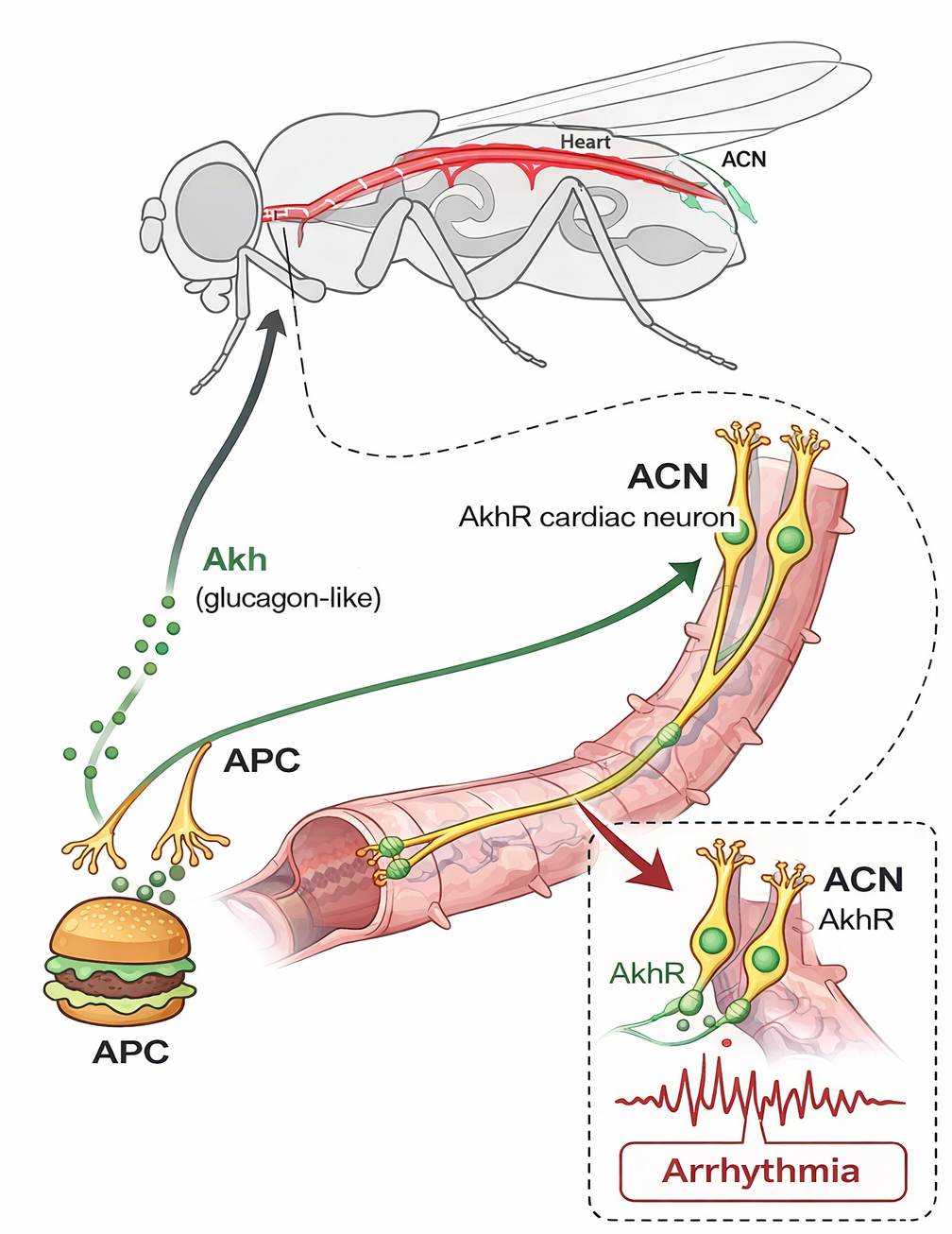
Flies exposed to a high fat diet developed marked tachycardia and arrhythmia accompanied by increased expression and activity of adipokinetic hormone producing cells, which secrete the glucagon like hormone adipokinetic hormone. Genetic suppression of adipokinetic hormone or ablation of these endocrine cells completely rescued diet induced arrhythmia, establishing a causal role for this hormonal signal. Consistently, loss of function of the adipokinetic hormone receptor abolished arrhythmia under high fat diet conditions.
Strikingly, adipokinetic hormone receptor expression was absent in cardiomyocytes but instead localized to a previously unknown pair of neurons positioned at the posterior heart. These neurons extend projections along the heart and form synaptic contacts with cardiac muscle, revealing a direct neurocardiac interface. Functional perturbation demonstrated that loss of a single neuron was sufficient to induce severe arrhythmia, indicating that these cells function as critical regulators of cardiac rhythm.
These findings redefine the mechanism of glucagon like signaling in the heart by establishing an endocrine neural cardiac axis in which metabolic signals are transduced through specialized cardiac neurons rather than cardiomyocytes. This work provides a mechanistic framework for how metabolic disease drives arrhythmia and identifies cardiac innervation as a potential therapeutic target.
Methods: Adult flies were maintained on normal or high fat diet and cardiac function was quantified using optical coherence tomography. Gene expression was measured by reverse transcription quantitative PCR. Neuronal activity was assessed using calcium dependent transcriptional reporters. Tissue specific genetic manipulations including RNA interference, null mutants, and targeted cell ablation were used to define pathway components. Neuronal structure and synaptic connectivity were analyzed by confocal imaging and immunostaining.
  • Zhao, Yunpo  ( University of Maryland School of Medicine , BALTIMORE , Maryland , United States )
  • Duan, Jianli  ( University of Maryland School of Medicine , BALTIMORE , Maryland , United States )
  • Han, Zhe  ( Univ of Maryland School of Medicine , Baltimore , Maryland , United States )
  • Author Disclosures:
Meeting Info:

Basic Cardiovascular Sciences 2026

2026

Boston, Massachusetts

Session Info:

Poster Session 3

Wednesday, 07/15/2026 , 04:30PM - 07:00PM

Poster Session and Reception

More abstracts on this topic:
84 Immune checkpoint profiling in major aortic diseases leads to identification of potential roles of CD155-CD206 pathway in suppressing inflammation and immune responses

Shao Ying, Saaoud Fatma, Xu Keman, Lu Yifan, Jiang Xiaohua, Wang Hong, Yang Xiaofeng

Early GLP-1 Receptor Agonist Initiation Reduces Major Cardiac and Renal Events in Older Adults with Type 2 Diabetes Without Prior Cardiovascular or Renal Disease: A Target Trial Emulation

Chi Kuan Yu, Chang Yu, Varrias Dimitrios, Nanna Michael, Nouri Armin, Lee Pei-lun, Hsieh Rebecca, Mangalesh Sridhar, Hu Jiun-ruey, Ezenna Chidubem, Akman Zafer, Romero Acero Laura

You have to be authorized to contact abstract author. Please, Login
Not Available