
LL-37 autoantigen immune response differentiates myocardial infarction from other atherosclerotic cardiovascular disease phenotypes
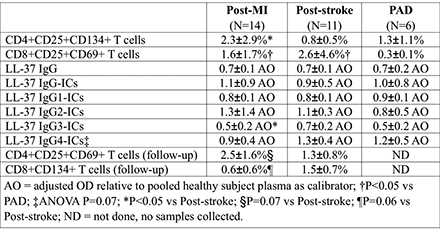
Abstract Body (Do not enter title and authors here): Background: Myocardial infarction (MI), stroke and peripheral artery disease (PAD) are viewed to have atherosclerosis as a common underlying pathology. Given the common underlying pathology, these atherosclerotic cardiovascular disease (ASCVD) phenotypes are thus expected to have shared immune responses to atherosclerosis-associated autoantigens. LL-37 is one such autoantigen that provokes a break in tolerance in acute coronary syndrome. Hypothesis: In this study, we hypothesized that ASCVD phenotypes MI, stroke and PAD will have a common immune profile directed against LL-37. Methods: PBMCs and plasma samples were collected from stable ASCVD patients enrolled within 12 months after myocardial infarction (MI) or stroke or diagnosed with peripheral artery disease (PAD). A subgroup of post-acute patients provided additional PBMCs at follow-up (14.7±3.6 months). PBMCs were stimulated with LL-37 and evaluated for activation induced markers by flow cytometry. Plasma levels of LL-37 IgG and LL-37 IgG-immune complexes (ICs) were tested using ELISA. LDL is a reported binding partner of LL-37 in plasma. Therefore, cross-reactivity of LL-37 IgG-ICs with native LL-37 or LL-37 complexed with LDL (LL-37_LDL) was assessed using immune depletion. Results: Post-MI patients had significantly increased CD4+CD25+CD134+ T cells in response to LL-37 stimulation compared to Post-stroke patients (Table 1). CD8+CD25+CD69+ T cells were significantly reduced in PAD patients in response to LL-37 compared to Post-MI and Post-stroke (Table 1). LL-37 IgG and LL-37 IgG-IC levels were comparable among the groups. However, IgG subclass analysis showed significantly reduced LL-37 IgG3-IC levels in Post-MI compared to Post-stroke, with a similar trend for LL-37 IgG4-IC levels (Table 1). Immune-depletion of plasma showed cross-reactivity of LL-37 IgG-ICs with both native LDL and LL-37_LDL in Post-MI while Post-stroke and PAD had cross-reactivity only with either one. At follow-up, CD4+CD25+CD69+ T cells were higher and CD8+CD134+ T cells were lower in Post-MI compared to Post-stroke patients. Conclusion: The differential immune profile among MI, stroke and PAD suggests the utility of profiling the immune response to LL-37 to differentiate ASCVD phenotypes and provides mechanistic insight.
Dimayuga, Paul
(
CEDARS-SINAI MEDICAL CENTER
, Los Angeles , California , United States )
Chyu, Kuang-yuh
(
CEDARS-SINAI MEDICAL CENTER
, Los Angeles , California , United States )
Zhou, Jianchang
(
CEDARS-SINAI MEDICAL CENTER
, West Hollywood , California , United States )
Zhao, Xiaoning
(
CEDARS-SINAI MEDICAL CENTER
, Los Angeles , California , United States )
Wei, Janet
(
CEDARS-SINAI MEDICAL CENTER
, Los Angeles , California , United States )
Cercek, Bojan
(
CEDARS-SINAI MEDICAL CENTER
, Los Angeles , California , United States )
Shah, Prediman
(
CEDARS-SINAI MEDICAL CENTER
, Los Angeles , California , United States )
Author Disclosures:
Paul Dimayuga:DO NOT have relevant financial relationships
| Kuang-Yuh Chyu:DO NOT have relevant financial relationships
| Jianchang Zhou:No Answer
| Xiaoning Zhao:No Answer
| Janet Wei:DO NOT have relevant financial relationships
| Bojan Cercek:No Answer
| Prediman Shah:DO NOT have relevant financial relationships