Contemporary Trends in Total and Low-Density Lipoprotein Cholesterol Among Young Adults in the United States, 2005–2024
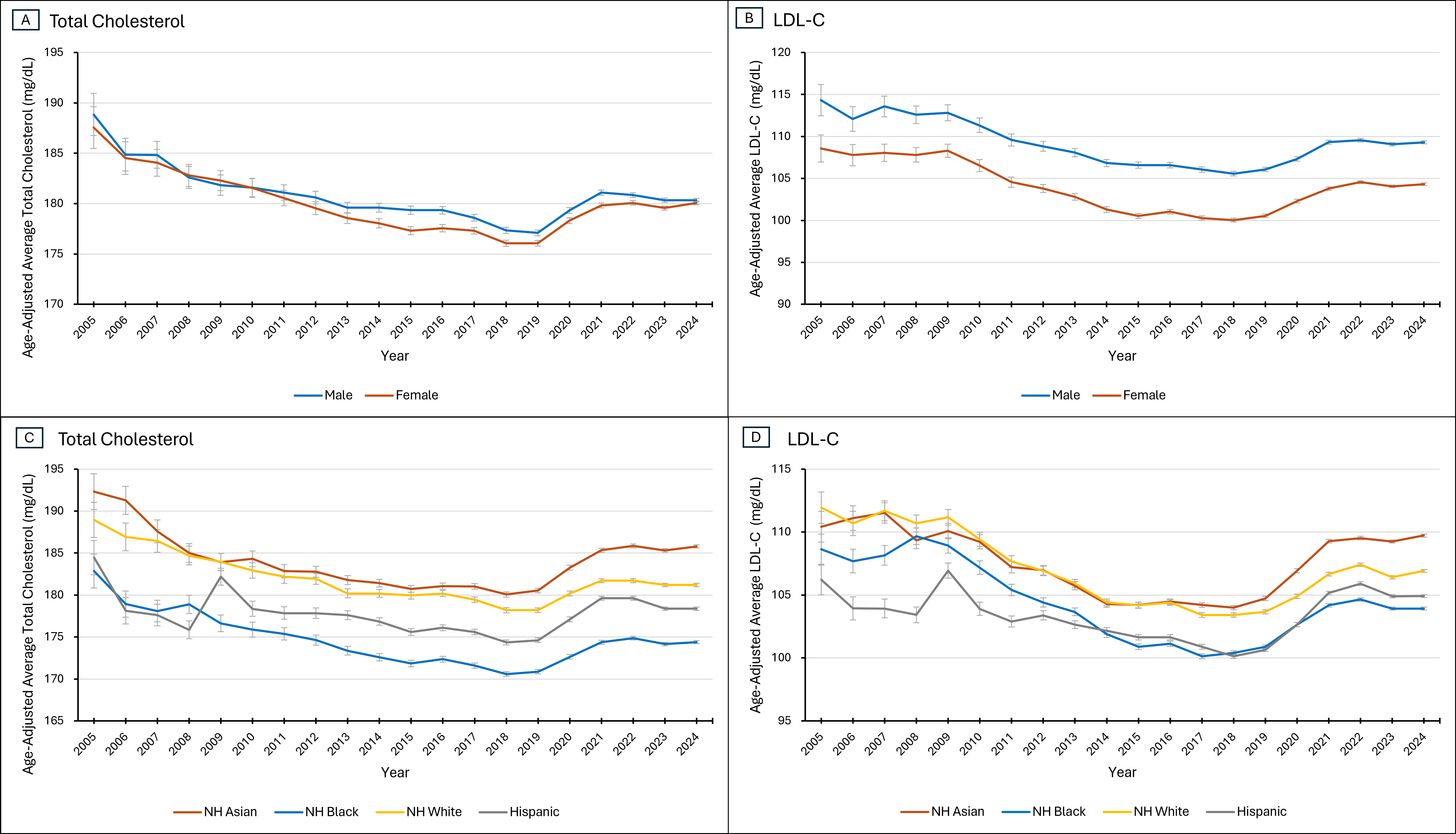
Abstract Body (Do not enter title and authors here): Background: Cholesterol levels in early adulthood are a key determinant of lifetime cardiovascular risk, yet young adults are often overlooked in screening and prevention efforts. In recent years, the cardiometabolic risk profile of this population has shifted significantly, with increasing rates of obesity, diabetes, and other metabolic conditions emerging at younger ages. Evaluating changes in total cholesterol and low-density lipoprotein cholesterol (LDL-C) over the past two decades is essential to assess the adequacy of current prevention strategies and to detect early signs of worsening cardiometabolic risk in a population not routinely targeted by clinical guidelines. Aim: To evaluate trends in total cholesterol and LDL-C among young adults in the U.S. from 2005 to 2024. Methods: This retrospective serial cross-sectional study used data from Epic’s Cosmos, a large, nationally representative, deidentified electronic health record database. Adults aged 20 to 39 years with documented total cholesterol and LDL-C measurements between 2005 and 2024 were included. Pregnant individuals and those missing sex or race/ethnicity data were excluded. Age adjustment was performed using 2020 U.S. Census population weights across 5-year strata. Mean lipid values were reported with 95% confidence intervals, calculated using the normal approximation method. Results: The study cohort included 19,795,711 non-pregnant U.S. adults aged 20–39 years (57.5% female; 68.3% White, 16.7% Black, 8.2% Hispanic, 6.8% Asian). Between 2005 and 2018, both total cholesterol and LDL-C levels declined steadily across all sex (Panels A and B) and racial/ethnic groups (Panels C and D). This period of improvement was followed by a reversal beginning in 2019, with lipid levels suddenly rising and then plateauing through 2024. The trend was most pronounced among Asian and Hispanic individuals, whose LDL-C levels increased by ~6 mg/dL from their respective lows, approaching or exceeding levels observed at the start of the study period. Conclusion: While lipid levels improved through the late 2010s, emerging trends suggest a plateau—or even a reversal—of earlier progress. Given the cumulative nature of atherosclerotic burden and the lack of prevention guidelines specifically targeting this age group, a renewed focus on lipid surveillance and early intervention in young adulthood is essential to sustain long-term gains in population health.
Oltman, Connor
( University of Illinois Urbana-Champaign
, Urbana
, Illinois
, United States
)
Taylor, Brandon
( University of Illinois Urbana-Champaign
, Urbana
, Illinois
, United States
)
Cao, Kellie
( University of Illinois Urbana-Champaign
, Urbana
, Illinois
, United States
)
Mishra, Anvita
( University of Illinois Urbana-Champaign
, Urbana
, Illinois
, United States
)
Buehler, Avery
( University of Illinois Urbana-Champaign
, Urbana
, Illinois
, United States
)
Moussa, Issam
( University of Illinois Urbana-Champaign
, Urbana
, Illinois
, United States
)
Author Disclosures:
Connor Oltman:DO NOT have relevant financial relationships
| Brandon Taylor:DO NOT have relevant financial relationships
| Kellie Cao:DO NOT have relevant financial relationships
| Anvita Mishra:DO NOT have relevant financial relationships
| Avery Buehler:No Answer
| Issam Moussa:No Answer