Logo

American Heart Association

  21
  0


Final ID: MP1696

Impact of Concomitant Tricuspid Regurgitation on Outcomes Following Transcatheter Aortic Valve Replacement, 2017-2022

Abstract Body (Do not enter title and authors here): Background: Tricuspid regurgitation (TR) is a prevalent comorbidity among patients with severe aortic stenosis (AS) undergoing transcatheter aortic valve replacement (TAVR), affecting 5–30% of patients. While most patients show improvement in TR after TAVR, 5–7% have persistent TR. Severe residual TR has been associated with a twofold increase in early and midterm all-cause mortality. ESC/EACTS Guidelines indicate concomitant tricuspid valve repair or replacement in patients already undergoing a left-sided valve surgery. However, no guidelines currently exist for managing concomitant TR in TAVR patients.
Aim: To characterize the impact of concomitant TR on post-TAVR and evaluate compatibility with breakthrough therapies, including transcatheter edge-to-edge repair (TEER) and transcatheter tricuspid valve replacement (TTVR).
Methods: We conducted a retrospective cohort study using Epic’s Cosmos, a nationally representative, deidentified electronic health records database. All-cause mortality and readmission were studied two years following the TAVR procedure, along with major periprocedural complications, identified as independent predictors of short-term mortality after TAVR. These included ischemic stroke, valvular mechanical complications, and conduction abnormalities. Patients were included if they had a diagnosis of rheumatic or nonrheumatic tricuspid valve disease within 1 to 31 days prior to the procedure. Outcomes were compared between patients with TR (n=6,347) and those without TR (n=120,879).
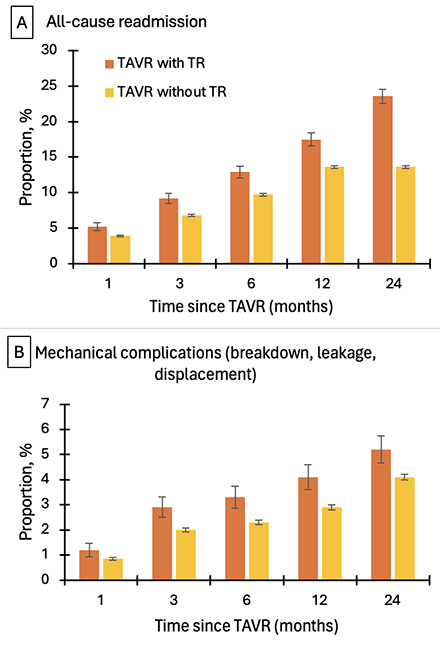
Results: TR was associated with a higher 2-year unadjusted cumulative incidence of death (21.3% vs 14.0%, HR=1.59) and higher all-cause readmission rates (23.6±1% vs 13.6±0.2%), implying increasingly complicated long-term outcomes. While rates of ischemic stroke and conduction abnormalities were comparable between the TR and non-TR groups, the rates of mechanical complications were significantly higher for TR patients (5.2% vs 4.1%).
Conclusion: Patients with preexisting TR demonstrated worse outcomes across all measured metrics compared to those without. Notably, the burden of mechanical valvular complications, in the TR cohort potentially highlights the increased volume and pressure demands leading to structural remodeling. As TAVR use continues to expand, targeted surveillance is needed to establish evidence-based strategies to incorporate TEER and TTVR in management of concomitant TR in patients with multivalvular, complex cardiovascular diseases.
  • Cao, Kellie  ( Carle Illinois College of Medicine , Urbana , Illinois , United States )
  • Oltman, Connor  ( Carle Illinois College of Medicine , Urbana , Illinois , United States )
  • Tsai, Kathryn  ( Carle Illinois College of Medicine , Urbana , Illinois , United States )
  • Moussa, Issam  ( Carle Foundation Hospital , Urbana , Illinois , United States )
  • Author Disclosures:
    Kellie Cao: DO NOT have relevant financial relationships | Connor Oltman: DO NOT have relevant financial relationships | Kathryn Tsai: DO NOT have relevant financial relationships | Issam Moussa: DO NOT have relevant financial relationships
Meeting Info:

Scientific Sessions 2025

2025

New Orleans, Louisiana

Session Info:

TAVR in Focus: Expanding Frontiers in Patient Selection, Procedural Strategy, and Long-Term Outcomes

Sunday, 11/09/2025 , 11:50AM - 01:00PM

Moderated Digital Poster Session

More abstracts on this topic:
More abstracts from these authors:
Contemporary Trends in Total and Low-Density Lipoprotein Cholesterol Among Young Adults in the United States, 2005–2024

Oltman Connor, Taylor Brandon, Cao Kellie, Mishra Anvita, Buehler Avery, Moussa Issam

You have to be authorized to contact abstract author. Please, Login
Not Available