
Logo

American Heart Association

  20
  0


Final ID: Su2104

Increased Emergency Department Discharges for Chest Pain Patients Without Myocardial Infarction During COVID Did Not Worsen Outcomes

Abstract Body (Do not enter title and authors here): Background: Patients presenting to the emergency department (ED) with chest pain but no myocardial infarction are frequently admitted for monitoring or testing, though the value of these admissions has been questioned. During the COVID-19 pandemic, hospital crowding altered admission practices leading to more of these patients being discharged from the ED. Nonetheless, the impact on patients’ outcomes remains unclear.
Hypothesis: Increased ED discharges of chest pain patients during COVID did not lead to worse outcomes.
Methods: We used OneFlorida+ dataset, which contains data on over 19 million patients from Florida, Georgia and Alabama, to identify patients with chest pain without myocardial infarction who presented to the ED between Jan 1, 2019 and until Dec 31, 2022 and compared the outcomes of patients admitted or observed vs discharged. We evaluated the impact of the COVID-19 pandemic (2020–2022) on management patterns and outcomes, compared to the pre-COVID period in 2019. The primary outcome was a composite of 30-day death or myocardial infarction.
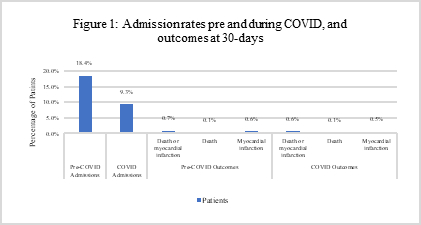
Results: A total of 82,717 patients met our inclusion criteria. The average age of patients was 46.3 years and 56.7% were women. The admission/ observation rate was significantly lower during the COVID era (9.3% vs 18.4%, OR: 0.46; 95% CI: 0.44 – 0.47). Using univariate analysis, the outcome of death or myocardial infarction at 30-days did not increase during COVID (0.7% pre-COVID vs 0.6% during COVID) and death at 30-days was the same in both periods (0.1%). Among discharged patients, the outcome of death or myocardial at 30-days was unchanged between pre-COVID vs COVID era (0.3%). On multivariate analysis including interaction based on pre-COVID vs during COVID, the significant reduction in admissions during COVID did not have significant impact on our primary outcome (-0.08% predicted risk pre COVID vs 0.04% predicted risk during COVID). On Interrupted time series analysis, The onset of COVID was not associated with an immediate change in the primary outcome (estimate= 0.00; p = 0.82), and the rate primary outcome in the post-COVID period remained unchanged (estimate= 0.00; p = 0.40).
Conclusion: Patients presenting to the ED with chest pain but without myocardial infarction have a very low rate of adverse events. The reduction in admissions during the COVID era was not associated with worse outcomes, highlighting a significant opportunity to safely increase discharge rates.
  • Penmetcha, Abhinav  ( University of Florida COM , Florida , Florida , United States )
  • Sha, Zixin  ( University of Florida COM , Gainesville , Florida , United States )
  • Dasa, Osama  ( The University Of Florida , Gainesville , Florida , United States )
  • Lewandowski, Thomas  ( The University Of Florida , Gainesville , Florida , United States )
  • Ruzieh, Mohammed  ( The University Of Florida , Gainesville , Florida , United States )
  • Author Disclosures:
    Abhinav Penmetcha: DO NOT have relevant financial relationships | Zixin Sha: DO NOT have relevant financial relationships | Osama Dasa: No Answer | Thomas Lewandowski: No Answer | Mohammed Ruzieh: DO NOT have relevant financial relationships
Meeting Info:

Scientific Sessions 2025

2025

New Orleans, Louisiana

Session Info:

After the Infarct: Trends, Treatments, and Missed Opportunities

Sunday, 11/09/2025 , 03:15PM - 04:15PM

Abstract Poster Board Session

More abstracts on this topic:
Acute clinical outcomes following virtual reality implementation in the electrophysiology laboratory

Romano Letizia, Calvelli Pierangelo, Quirino Gianluca, Tomaselli Caterina, Talarico Antonello, Pasqua Pino, Curcio Antonio

A Meta-Analysis on the Effect of Chronic Total Occlusion of Coronary Arteries on Cardiovascular Outcomes in Patients Undergoing Transcatheter Aortic Valve Replacement

Goyal Aman, Tariq Muhammad Daoud, Zahra Rubab, Jain Hritvik, Khan Rozi, Mahalwar Gauranga

You have to be authorized to contact abstract author. Please, Login
Not Available