Increasing Rates of Lipoprotein(a) Testing in the United States from 2015-2024: An Analysis of 300 Million Individuals
Abstract Body (Do not enter title and authors here): Background: Lipoprotein(a) [Lp(a)] is a genetically determined biomarker associated with increased risk of cardiovascular disease. Elevated Lp(a) is common, with approximately 1 in 5 individuals having Lp(a) >50 mg/dL (>125 nmol/L). However, Lp(a) testing remains underutilized in clinical practice, and limited data on national testing trends are available.
Methods: This study includes data from Epic Cosmos, a nationwide, de-identified electronic health record dataset comprising over 300 million patients, between January 1, 2015, to December 31, 2024. We evaluated the number of distinct patients tested for Lp(a) per year, the testing rate per annual patient population, geographical variation, and percentages of patients tested stratified by age, sex, ethnicity, and race.
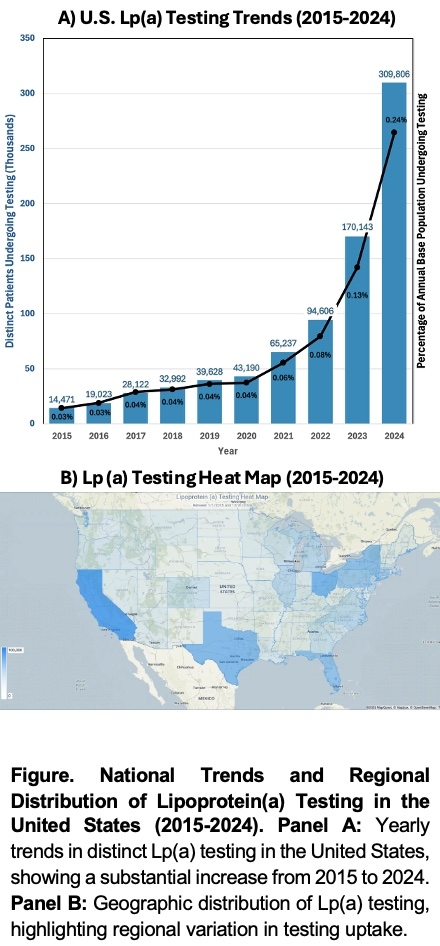
Results: From 2015 to 2024, a total of 728,550 (0.2% of U.S. population) distinct patients underwent Lp(a) testing, the annual number of tested patients increased significantly from 14,471 in 2015 to 309,806 in 2024 (χ2test, p<0.001), and the annual percentage of the total patient population undergoing Lp(a) testing increased from 0.03% in 2015 to 0.24% in 2024. The highest number of tests were performed in California (11.6%), Ohio (8.6%), and Texas (7.6%). Age-stratified analyses revealed that testing was most frequently conducted among adults between the ages of 50-65 years (253,409 patients; 34.8%). Lp(a) testing rates were similar by sex, with 51.8% (377,053) among males and 48.2% (351,384) among females. Among patients undergoing testing with reported ethnic identity, only 51,950 (7.1%) identified as Hispanic or Latino, while the remaining 676,600 (92.9%) identified as non-Hispanic. Most patients undergoing testing with reported racial data identified as White (581,101; 79.8%), followed by Other Race (82,320; 11.3%), Black or African American (65,683; 9.0%), Asian (44,131; 6.1%), and fewer non-Hispanic individuals identifying as American Indian or Alaska Native or selecting “None of the above”.
Conclusion: Although the number of Lp(a) tests has increased significantly over the past decade, persistently low rates of testing and the variation by region, age and race/ethnicity suggest that further efforts are needed to promote standardized Lp(a) screening guidelines nationwide. Further research is needed to understand the drivers of these trends and to optimize the use of Lp(a) testing for cardiovascular risk stratification.
Naguib, Mustafa
(
UCSD Medical Center
, La Jolla , California , United States )
Dzotsi, Marissa
(
UCSD Medical Center
, La Jolla , California , United States )
Wilkinson, Michael
(
UCSD Medical Center
, La Jolla , California , United States )
Mahmud, Ehtisham
(
UCSD Medical Center
, La Jolla , California , United States )
Taub, Pam
(
UCSD Medical Center
, La Jolla , California , United States )
Bhatia, Harpreet
(
UCSD Medical Center
, La Jolla , California , United States )
Ramsis, Mattheus
(
UCSD Medical Center
, La Jolla , California , United States )