
Logo

American Heart Association

  16
  0


Final ID: Mo3058

Circulating PCSK9 as an Independent Prognostic Marker in High-Risk Coronary Multi-Vessel Disease: Evidence from a Multicenter Cohort Study

Abstract Body (Do not enter title and authors here): Background: Although PCSK9 inhibitors have demonstrated significant cardiovascular benefits, the prognostic role of circulating PCSK9 levels in patients with coronary multi-vessel disease (MVD) remains controversial. Given the complex pathophysiology of MVD, further evidence is needed to clarify the relationship between PCSK9 levels, disease severity, and long-term outcomes.
Aims: To investigate the association between circulating PCSK9 levels and long-term cardiovascular outcomes and coronary lesion severity in MVD patients.
Methods: This secondary analysis utilized data from a large, prospective, multicenter observational cohort involving 18,701 patients with coronary artery disease (CAD). A total of 1,060 MVD patients who underwent percutaneous coronary intervention were included. The primary endpoint was 2-year major adverse cardiovascular events (MACE, including all-cause death, myocardial infarction, and unplanned revascularization). The secondary endpoints were unplanned revascularization and coronary lesion severity, assessed using the SYNTAX score (≥22 indicating intermediate-high severity). Cox and logistic regression analyses were used to evaluate associations between PCSK9 levels and outcomes.
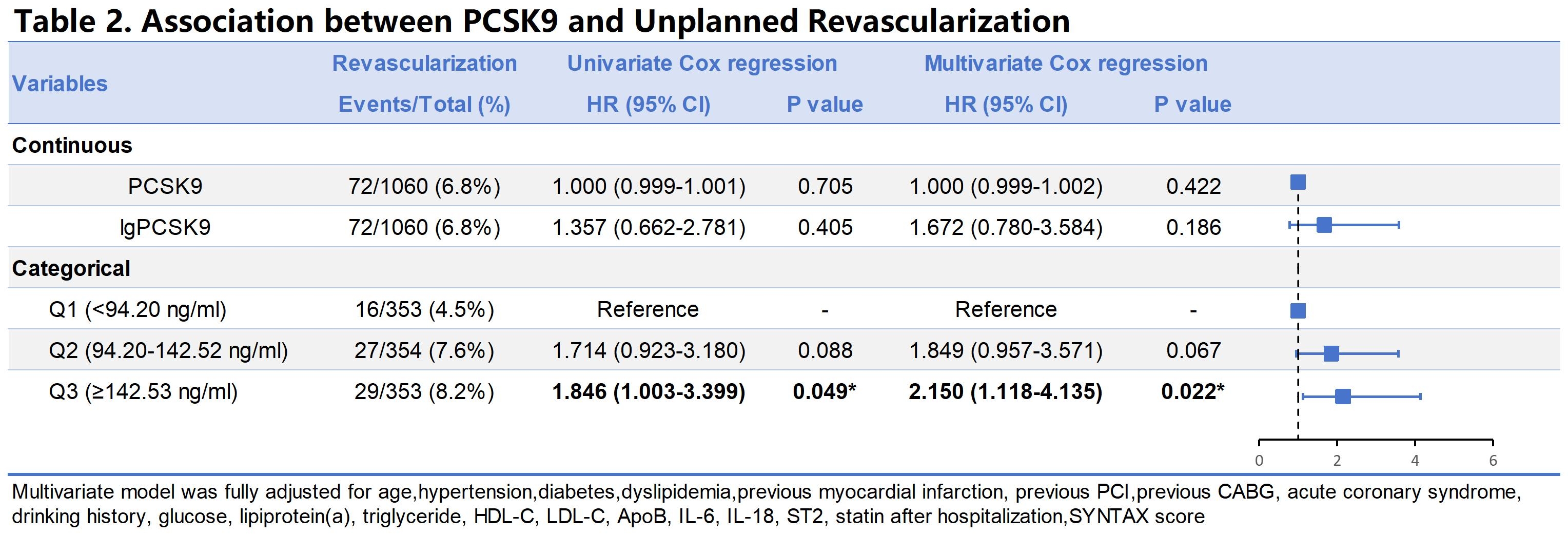
Results: The mean age of patients was 62.5 ± 10.7 years, with 75.8% being male. The median PCSK9 concentration was 114.93 ng/mL (IQR: 81.55–165.30). For the primary endpoint, multivariable Cox regression analysis demonstrated that patients in the highest PCSK9 tertile (Q3) had a significantly higher risk of MACE compared to those in the lowest tertile (Q1) (HR: 1.751; 95% CI: 1.035–2.961; p = 0.037), even after adjusting for LDL-C and apolipoprotein B (Table 1). No significant interaction was observed between PCSK9 and LDL-C levels. Furthermore, elevated PCSK9 levels were independently associated with a higher risk of unplanned revascularization (HR: 2.150; 95% CI: 1.118–4.135; p = 0.022) (Table 2). In addition, higher PCSK9 levels were significantly associated with intermediate-to-high coronary lesion severity, as defined by a SYNTAX score ≥22 (OR: 1.458; 95% CI: 1.014–2.097) (Table 3).
Conclusion: Elevated circulating PCSK9 levels are significantly associated with worse clinical outcomes and greater coronary lesion severity in patients with MVD, highlighting the potential of PCSK9 as a prognostic biomarker and therapeutic target beyond traditional lipid parameters in high-risk CAD populations.
  • Yan, Kailun  ( Fuwai Hospital, CAMS and PUMC , Beijing , China )
  • Li, Jiawen  ( Fuwai Hospital, CAMS and PUMC , Beijing , China )
  • Zhang, Kexin  ( Fuwai Hospital, CAMS and PUMC , Beijing , China )
  • Liu, Menglu  ( Fuwai Hospital, CAMS and PUMC , Beijing , China )
  • Yuan, Jinqing  ( Fuwai Hospital, CAMS and PUMC , Beijing , China )
  • Zhao, Xueyan  ( Fuwai Hospital, CAMS and PUMC , Beijing , China )
  • Author Disclosures:
    Kailun Yan: DO NOT have relevant financial relationships | Jiawen Li: DO NOT have relevant financial relationships | Kexin Zhang: DO NOT have relevant financial relationships | Menglu Liu: DO NOT have relevant financial relationships | Jinqing Yuan: No Answer | Xueyan Zhao: No Answer
Meeting Info:

Scientific Sessions 2025

2025

New Orleans, Louisiana

Session Info:

Novel Biomarkers, Indices & Blood-Pressure Targets in Stable CAD

Monday, 11/10/2025 , 01:00PM - 02:00PM

Abstract Poster Board Session

More abstracts on this topic:
More abstracts from these authors:
Comprehensive Association of Frailty and TyG Index with Cardiovascular Disease in Middle-aged and Older Adults

Liu Menglu, Ye Yunqing, Zhang Kexin, Li Jiawen, Yan Kailun, Yuan Jinqing, Zhao Xueyan

Impact of Neutrophil on Ischemic Risk in Acute Coronary Syndrome Patients Across Different Low Density Lipoprotein Cholesterol Levels

Yan Kailun, Li Jiawen, Zhang Kexin, Liu Menglu, Yuan Jinqing, Zhao Xueyan

You have to be authorized to contact abstract author. Please, Login
Not Available