Comprehensive Association of Frailty and TyG Index with Cardiovascular Disease in Middle-aged and Older Adults
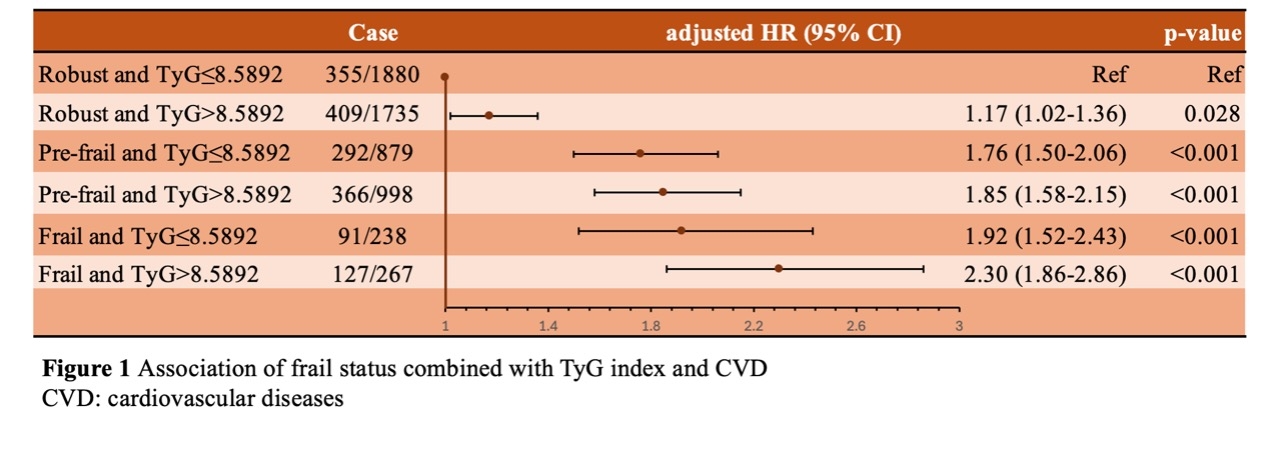
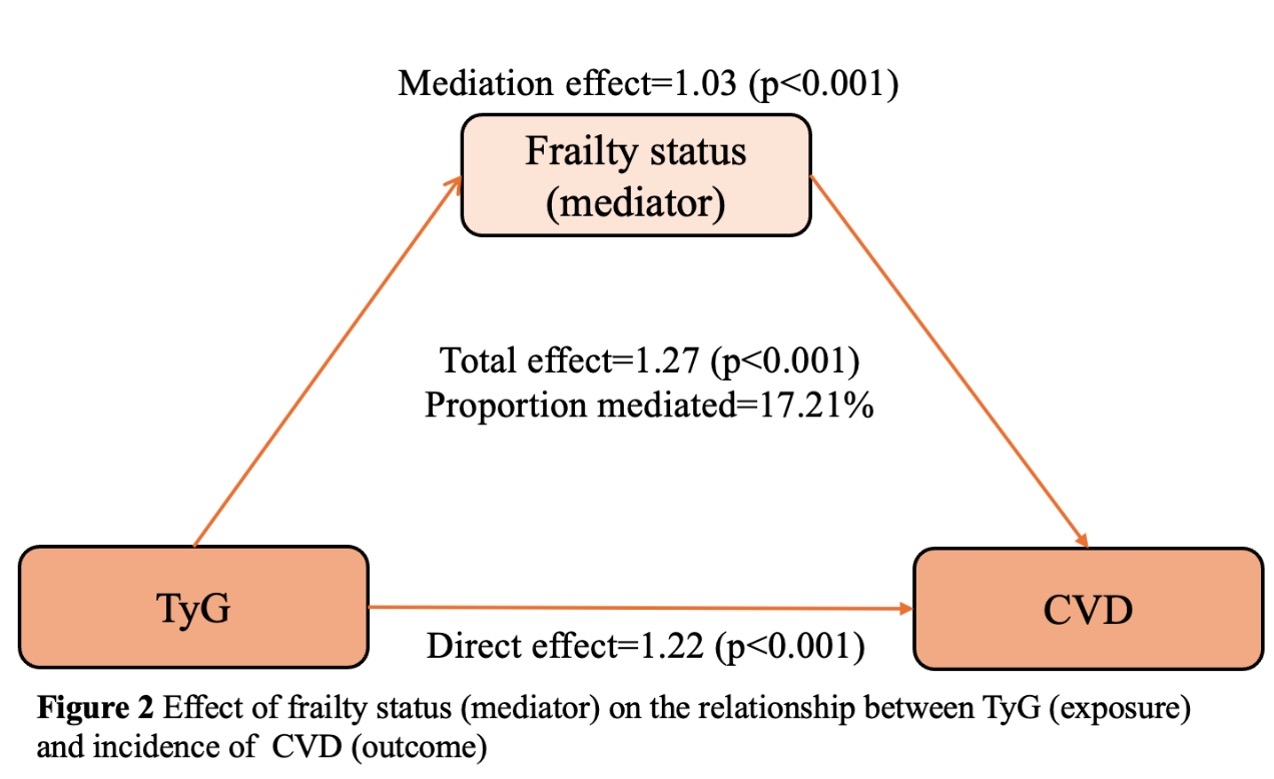
Abstract Body (Do not enter title and authors here): Background: Frailty is a common condition in older adults, associated with an increased risk of cardiovascular disease (CVD). The triglyceride-glucose index (TyG), a marker of insulin resistance, has also emerged as a potential predictor of CVD risk. Frailty and insulin resistance often coexist in the elderly, however, the combined role of frailty and TyG in the incidence of CVD remain unclear. Purpose: This study investigates the combined association of frailty and TyG with the incidence of CVD in middle-aged and older adults. Methods: This study utilized data from five waves of the China Health and Retirement Longitudinal Study (CHARLS). Frailty status was assessed using the Rockwood frailty index, which classified participants into three categories: robust (FI ≤ 0.10), pre-frail (0.10 < FI < 0.25), and frail (FI ≥ 0.25). The TyG index was calculated as Ln [fasting triglyceride (mg/dL) × fasting glucose (mg/dL) / 2] and categorized based on the median value. The cox regression and mediation analysis were used to assess the association between frailty status, TyG, and the incidence of CVD. Results: A total of 5,997 participants aged 45 years and older (48.40% male; mean age 57.51 ± 8.40 years) with no cardiovascular disease were enrolled in 2011. Over a maximum follow-up period of 9 years, 1,640 (27.3%) individuals developed CVD. After adjusting for potential confounders, the combined impact of frailty status and TyG showed the highest risk in frail individuals with high TyG (HR 2.30, 95% CI: 1.86-2.86), followed by frail individuals with low TyG (HR 1.92, 95% CI: 1.52-2.43), pre-frail individuals with high TyG (HR 1.85, 95% CI: 1.58-2.15), pre-frail individuals with low TyG (HR 1.76, 95% CI: 1.50-2.06), and robust individuals with high TyG (HR 1.17, 95% CI: 1.02-1.36) (Figure 1). Additionally, frailty status was found to significantly mediate 17.21% of the association between TyG and CVD (Figure 2). Conclusions: The results highlight the combined effect and mutual mediation between frailty status and TyG on the incidence of CVD. It is important to consider both frailty status and TyG together in risk assessments for better residual risk stratification and primary prevention of cardiovascular diseases, particularly in older populations.
Liu, Menglu
(
Fuwai Hospital, Chinese Academy of Medical Sciences & Peking Union Medical College
, Beijing , China )
Ye, Yunqing
(
fuwai hospital
, Beijing , China )
Zhang, Kexin
(
Fuwai Hospital, Chinese Academy of Medical Sciences & Peking Union Medical College
, Beijing , China )
Li, Jiawen
(
fuwai hospital
, Beijing , China )
Yan, Kailun
(
Fuwai Hospital
, Beijing , China )
Yuan, Jinqing
(
Fuwai Hospital
, Beijing , China )
Zhao, Xueyan
(
Fuwai Hospital
, Beijing , China )
Author Disclosures:
Menglu Liu:DO NOT have relevant financial relationships
| Yunqing Ye:No Answer
| Kexin Zhang:DO NOT have relevant financial relationships
| Jiawen Li:DO NOT have relevant financial relationships
| Kailun Yan:DO NOT have relevant financial relationships
| Jinqing Yuan:No Answer
| Xueyan Zhao:No Answer