
Logo

American Heart Association

  19
  0


Final ID: MP1647

Plasma proteomics identifies S100A8/A9 as a novel biomarker and therapeutic target for fulminant myocarditis

Abstract Body (Do not enter title and authors here): Introduction
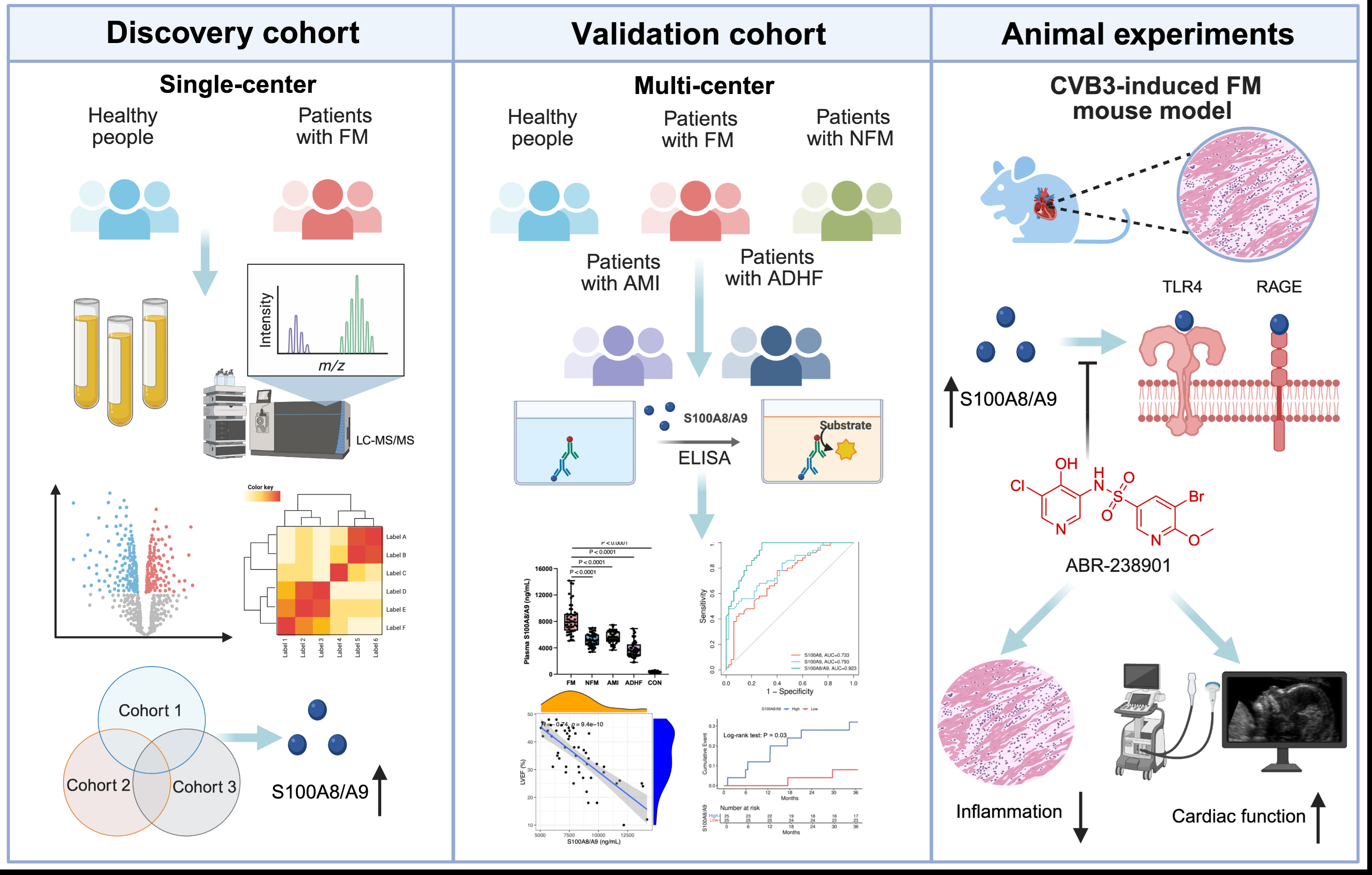
Fulminant myocarditis (FM) is a severe inflammatory myocardial disease that progresses rapidly and is often fatal. Diagnosing and predicting FM is challenging due to its acute nature and poor prognosis. Understanding the proteomic profiles of FM patients could shed light on underlying pathological mechanisms, unveil novel biomarkers for early detection, and guide the development of targeted therapeutic interventions.
Research Questions
What are the proteomic signatures associated with cardiac dysfunction and disease severity in FM patients? Can S100A8/S100A9 be validated as biomarkers for the diagnosis and severity assessment of FM? How does the inhibition of the S100A8/A9 affect the progression of FM?
Methods
A comprehensive proteomic analysis was conducted using plasma samples collected from FM patients across three clinical cohorts. The findings were validated in an independent patient cohort to ensure reliability. Additionally, a CVB3-induced FM mouse model was used to further explore the role of these biomarkers in myocardial tissues and to assess the effects of targeted therapeutic interventions. Specifically, the study evaluated the impact of ABR-238901, an inhibitor targeting the S100A8/A9, on the progression of FM mouse model.
Results
Proteomic analysis revealed a marked activation of innate immune responses and significant metabolic disturbances in FM patients. Notably, the proteins S100A8 and S100A9 were identified as key biomarkers, with their elevated plasma levels strongly correlating with increased cardiac dysfunction and disease severity. Elevated levels of the S100A8/A9 heterodimer were associated with more serious FM. In the CVB3-induced FM mouse models, an increase in S100A8/S100A9 levels in myocardial tissues was observed. Treatment with ABR-238901 significantly reduced mortality by mitigating acute inflammation and improving cardiac function.
Conclusion
S100A8/A9 emerged as an essential biomarker and a promising therapeutic target for FM. These findings offer new insights into FM diagnosis and suggest potential intervention strategies. These results pave the way for further research to validate the clinical application of S100A8/A9-targeted therapies, potentially improving outcomes for patients suffering from this severe cardiac condition.
  • Wang, Dao Wen  ( Tongji Hospital , Wuhan , China )
  • He, Wu  ( Tongji Hospital , Wuhan , China )
  • Author Disclosures:
    Dao Wen Wang: DO NOT have relevant financial relationships | Wu He: DO NOT have relevant financial relationships
Meeting Info:

Scientific Sessions 2025

2025

New Orleans, Louisiana

Session Info:

Hopping Heart Failure Science

Sunday, 11/09/2025 , 03:15PM - 04:25PM

Moderated Digital Poster Session

You have to be authorized to contact abstract author. Please, Login
Not Available