Brisk Usual Walking Pace Causally Remodels Brain, Heart and Metabolic Tissues
Abstract Body (Do not enter title and authors here): Background Physical activity benefits multiple organs, yet its causal molecular mechanisms remain unclear. We hypothesised that a faster usual walking pace drives coordinated organ remodelling via shared genomic and proteomic mediators. Second, we posited that circulating protein levels influence both physical-activity behaviour and downstream organ remodelling, thereby completing the causal triangulation.
Methods Accelerometer, ergometry, and questionnaire-based physical activity traits were obtained from the UK Biobank (≈ 100 000). MRI data from brain, heart, and abdomen were dimension-reduced into clinically labelled principal components (PCs) (e.g., brain-PC6: white matter). Genome-wide association studies (GWAS) identified linkage-disequilibrium (LD)-clumped genetic instruments (p<5×10-05). Inverse-variance-weighted Mendelian randomisation assessed causality between physical activity traits and PCs, and between cis-protein quantitative trait loci (cis-pQTLs) and both physical activity and imaging PCs (Bonferroni-corrected p<0.05).
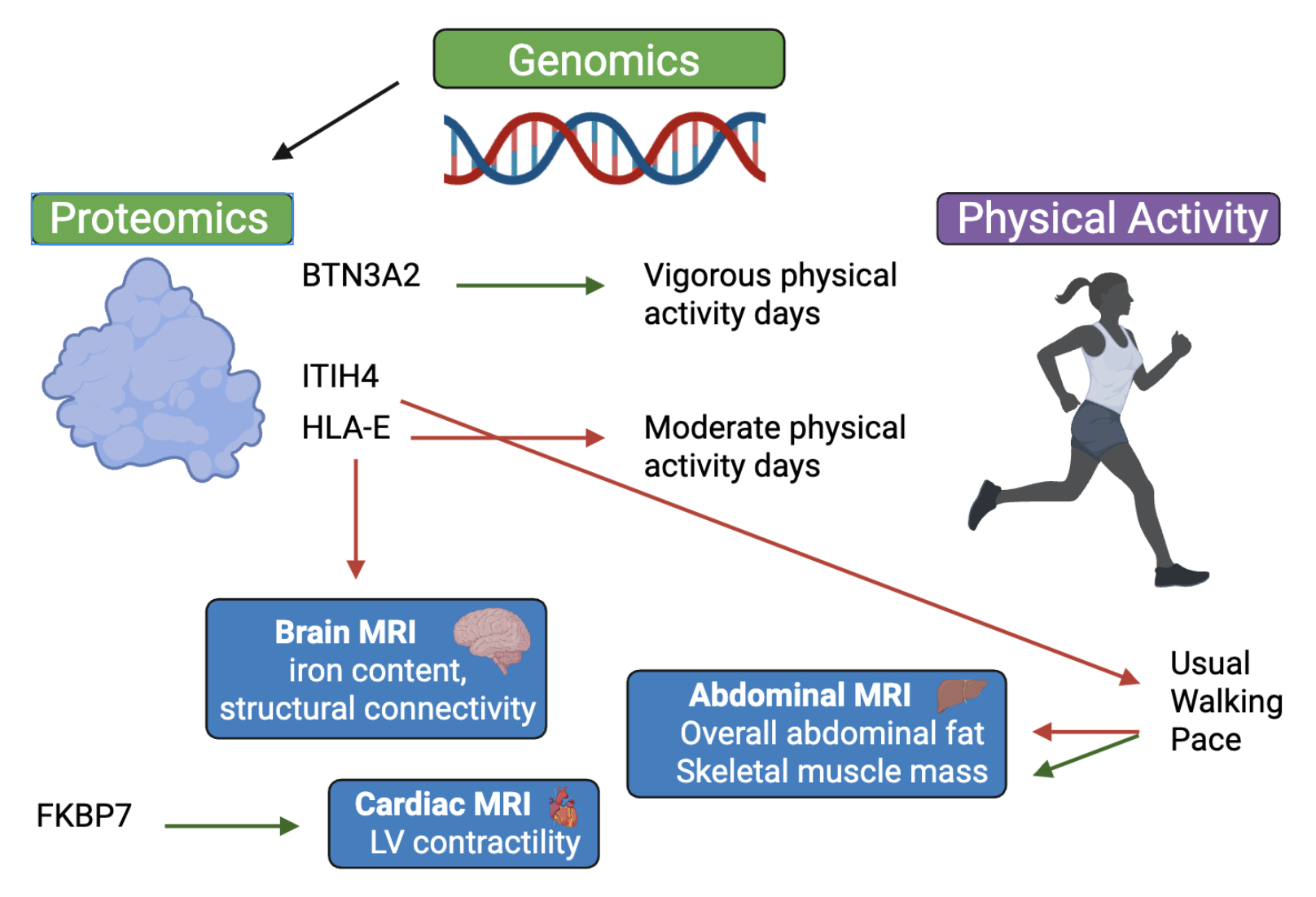
Results A brisker walking pace showed large causal effects (Figure 1): lower overall abdominal fat (abdominal-MRI-PC1, β = –3.12, p=6.3×10-177), greater skeletal-muscle mass (PC2, β = 0.71, p=9.1×10⁻¹⁹), reduced left ventricular hypertrophy (cardiac-MRI-PC1, β = –0.88, p=6.4×10⁻¹¹) with improved strain (PC4, β = 0.76, p=1.3×10⁻²³), expanded cortical surface area (brain-MRI-PC1, β = 7.83, p=8.7×10-72) and healthier white-matter microstructure (brain-MRI-PC6, β = –2.14, p=3.1×10⁻²⁵). Cis-pQTL Mendelian randomisation pinpointed previously unrecognised immune-modulatory proteins influencing walking pace, including HLA-E, which also curtailed moderate-physical activity (β = –0.074, p=1.6×10-46) and lowered brain-MRI-PC2 (iron content/structural connectivity) (β = –1.34, p=1.3×10-46); ITIH4 decreased Usual Walking Pace (β = -0.01, p=6.0×10⁻¹⁰). NCAN reduced liver fat (abdominal-MRI-PC4, β = –1.28, p=1.7×10-290), while FKBP7 enhanced contractility (cardiac-MRI-PC2, β = 3.30, p=1.9×10⁻²⁸).
Conclusions Genome-wide Mendelian Randomization demonstrates that brisk walking pace causally promotes favourable changes in adiposity, cardiac mechanics, and neuro-architecture. Residual pleiotropy remains possible, warranting experimental validation. Immune-linked proteins regulate activity levels, highlighting potential therapeutic targets and supporting walking pace as an accessible biomarker for cardio-metabolic and cerebrovascular risk assessment.
Gomes Botelho Quintas, Bruna Filipa
(
Stanford University
, Stanford , California , United States )
Xia, Roger
(
Stanford University
, Stanford , California , United States )
Loong, Shaun
(
Stanford University
, Stanford , California , United States )
Reddy, Shriya Gampala
(
Stanford University
, Stanford , California , United States )
Cao, Fang
(
Stanford University
, Stanford , California , United States )
Steffner, Kirsten
(
Stanford University
, Stanford , California , United States )
Geraldo, Ana
(
Stanford University
, Stanford , California , United States )
Lindholm, Malene
(
Stanford University
, Stanford , California , United States )
Amar, David
(
Stanford University
, Stanford , California , United States )
Ashley, Euan
(
Stanford University
, Stanford , California , United States )
Author Disclosures:
Bruna Filipa Gomes Botelho Quintas:DO NOT have relevant financial relationships
| Euan Ashley:No Answer
| Roger Xia:DO NOT have relevant financial relationships
| Shaun Loong:No Answer
| Shriya Gampala Reddy:DO NOT have relevant financial relationships
| Fang Cao:DO NOT have relevant financial relationships
| Kirsten Steffner:DO NOT have relevant financial relationships
| Ana Geraldo:No Answer
| Malene Lindholm:DO NOT have relevant financial relationships
| David Amar:No Answer