4D Flow MRI Allows for Enhanced Characterization of Aortic Regurgitation
Abstract Body (Do not enter title and authors here): Introduction: Severe aortic regurgitation (AR) is characterized by significant retrograde blood flow in the aorta and remains difficult to quantitively evaluate by echocardiography. By providing comprehensive insights into hemodynamic changes and quantifying regurgitant fraction (RF) across various locations of the aorta, this study investigated the potential of 4D flow MRI to enhance diagnostic accuracy and inform clinical decision-making.
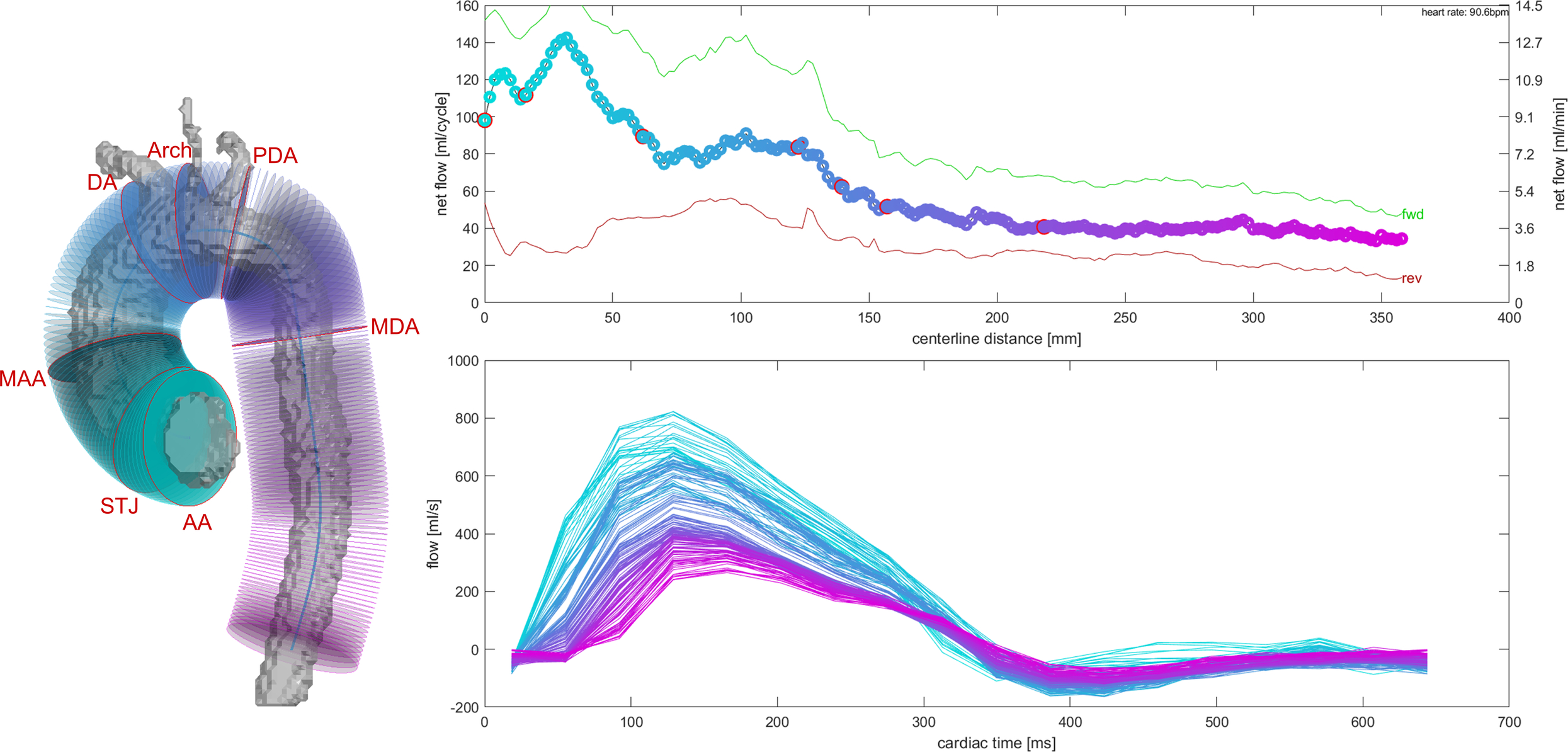
Methods: An institutional database was queried for patients with chronic AR on echocardiography and paired cardiac MRIs with aortic 4D flow MRI. Patients with LVEF < 50%, concomitant mitral regurgitation and aortic stenosis were excluded. A fully automated 4D flow MRI processing tool, performing standard preprocessing corrections and aortic 3D segmentation using separately trained machine learning models (Dense U-net convolutional neural network architecture) was used. Through-plane flow was quantified at 7 AHA-standardized locations: aortic annulus, sinotubular junction, mid ascending aorta, distal ascending aorta, aortic arch, proximal descending aorta and mid descending aorta. 4D flow MRI-based quantifications of RF were assessed for differentiating severe AR, using echo gradings as reference classification. Adjudicated clinical outcome data included cardiac-related hospitalizations such as heart failure, arrhythmias, and inpatient management of valve intervention.
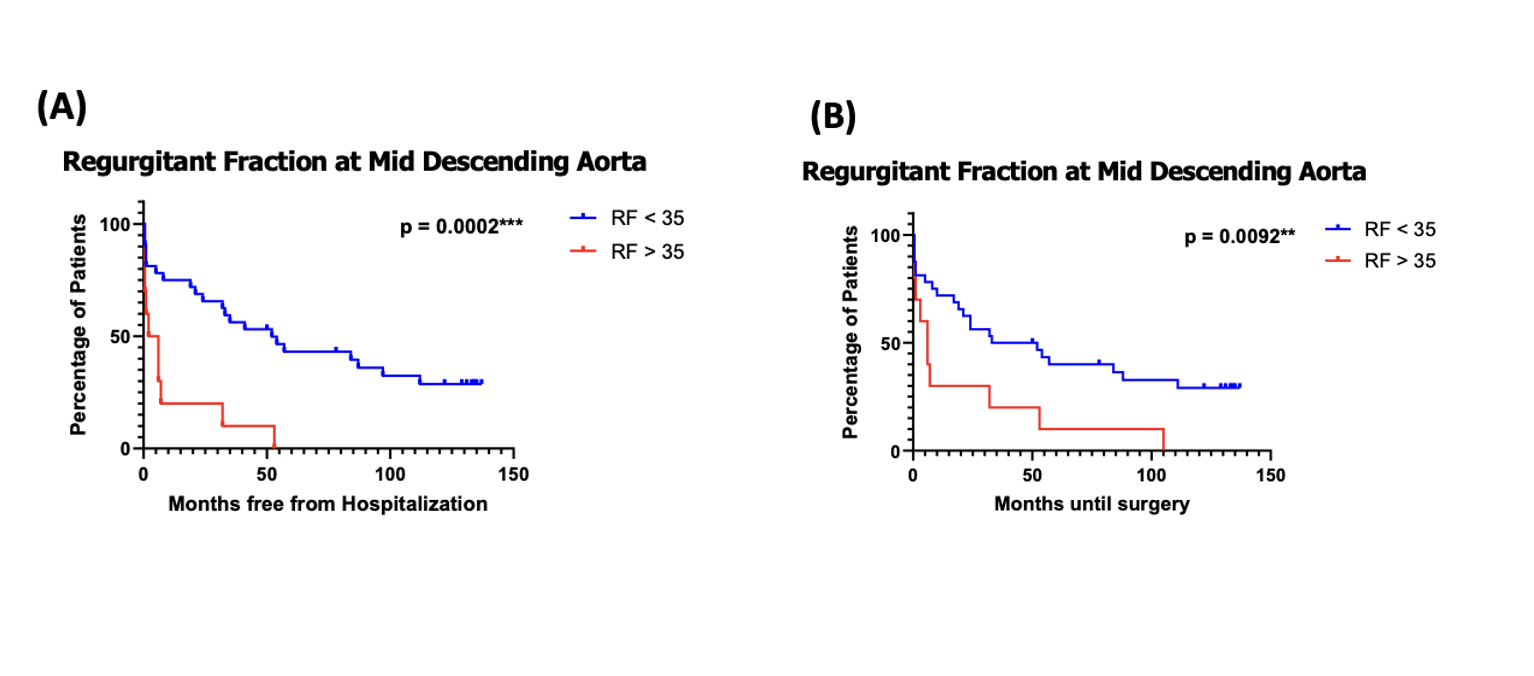
Results: Of 59 patients with chronic AR, the mean age was 49 ± 14.5 years, LVEF 56.5 ± 8.3%, LV end diastolic volume 251 ± 74 mL, 90% male and 73% had bicuspid aortic valves. Receiver operator characteristic (ROC) analysis of 4D flow MRI RFs revealed the optimal anatomic location to differentiate severe AR, as graded by echo was the mid descending aorta (AUC = 0.79). In patients with moderate, moderate-severe, and severe AR on echo, Kaplan-Meyer analysis reveals significant differences in cardiac-related hospitalization rates and time to valve intervention when patients were median split by optimal mid-descending aorta ROC RF (35%) but not at other locations of the aorta nor RFs calculated by traditional 2D Phase Contrast MRI (Figure 1).
Conclusion: The optimal location in discerning severe aortic regurgitation as per RF by 4D flow analysis is the mid-descending aorta. 4D flow quantified RF of 35% at the mid-descending aorta was associated with cardiac related hospitalizations.
Avgousti, Harris
( Feinberg School of Medicine
, Chicago
, Illinois
, United States
)
Johnson, Ethan
( Northwestern University
, Chicago
, Illinois
, United States
)
Berhane, Haben
( Northwestern University
, Chicago
, Illinois
, United States
)
Thomas, James
( Northwestern University
, Chicago
, Illinois
, United States
)
Allen, Bradley
( Northwestern University
, Chicago
, Illinois
, United States
)
Markl, Michael
( Northwestern University
, Chicago
, Illinois
, United States
)
Appadurai, Vinesh
( The Prince Charles Hospital
, Chermside
, Queensland
, Australia
)
Author Disclosures:
Harris Avgousti:DO NOT have relevant financial relationships
| Ethan Johnson:DO have relevant financial relationships
;
Employee:Third Coast Dynamics, Inc:Active (exists now)
| Haben Berhane:No Answer
| James Thomas:No Answer
| Bradley Allen:DO have relevant financial relationships
;
Ownership Interest:Third Coast Dynamics:Active (exists now)
; Other (please indicate in the box next to the company name):Burns White (legal consulting):Past (completed)
; Speaker:MRI Online:Past (completed)
; Royalties/Patent Beneficiary:Northwestern University:Active (exists now)
; Research Funding (PI or named investigator):Guerbet:Active (exists now)
; Speaker:Circle :Past (completed)
; Speaker:Siemens:Past (completed)
| Michael Markl:DO have relevant financial relationships
;
Research Funding (PI or named investigator):Siemens:Active (exists now)
; Ownership Interest:Third Coast Dynamics:Active (exists now)
; Research Funding (PI or named investigator):Circle Cardiovascular Imaging:Active (exists now)
| Vinesh Appadurai:DO have relevant financial relationships
;
Research Funding (PI or named investigator):Abbott Laboratories:Active (exists now)
; Speaker:Edwards:Past (completed)