Logo

American Heart Association

  20
  0


Final ID: MP1361

Negative CT-derived Fractional Flow Reserve Predicts the Long-term Event-free Survival in Patients with CAD: A Meta-analysis of Reconstructed Time-to-event Data

Abstract Body (Do not enter title and authors here): Background
Computed tomography-derived fractional flow reserve (CT-FFR) is an emerging analytical tool that
enables noninvasive physiological evaluation and risk stratification of patients with coronary artery
disease (CAD) and correlates closely with invasive FFR. However, data regarding the long-term
prognosis of patients with CAD and negative CT-FFR (>80) are still limited.
Research Questions
Can a CT-FFR >80 predict the long-term event-free survival in patients diagnosed with stable CAD?
Methods
In this systematic review and meta-analysis, a thorough search was conducted in PubMed, Embase, Web
of Science, and Scopus to identify studies that compare clinical outcomes between patients diagnosed
with CAD with CT-FFR >80 or ≤80 regarding major adverse cardiac events (MACE) published until (!).
Time and survival probabilities were extracted from Kaplan-Meier curves for each group. Individual
patient data were reconstructed by processing the extracted time points, survival probabilities, and the
number of patients at risk. The aggregated survival curves and Cox proportional hazard model were fitted
to estimate HRs and 95% CIs. The restricted mean survival time (RMST) was also calculated as the area
under the survival curve for each group.
Results
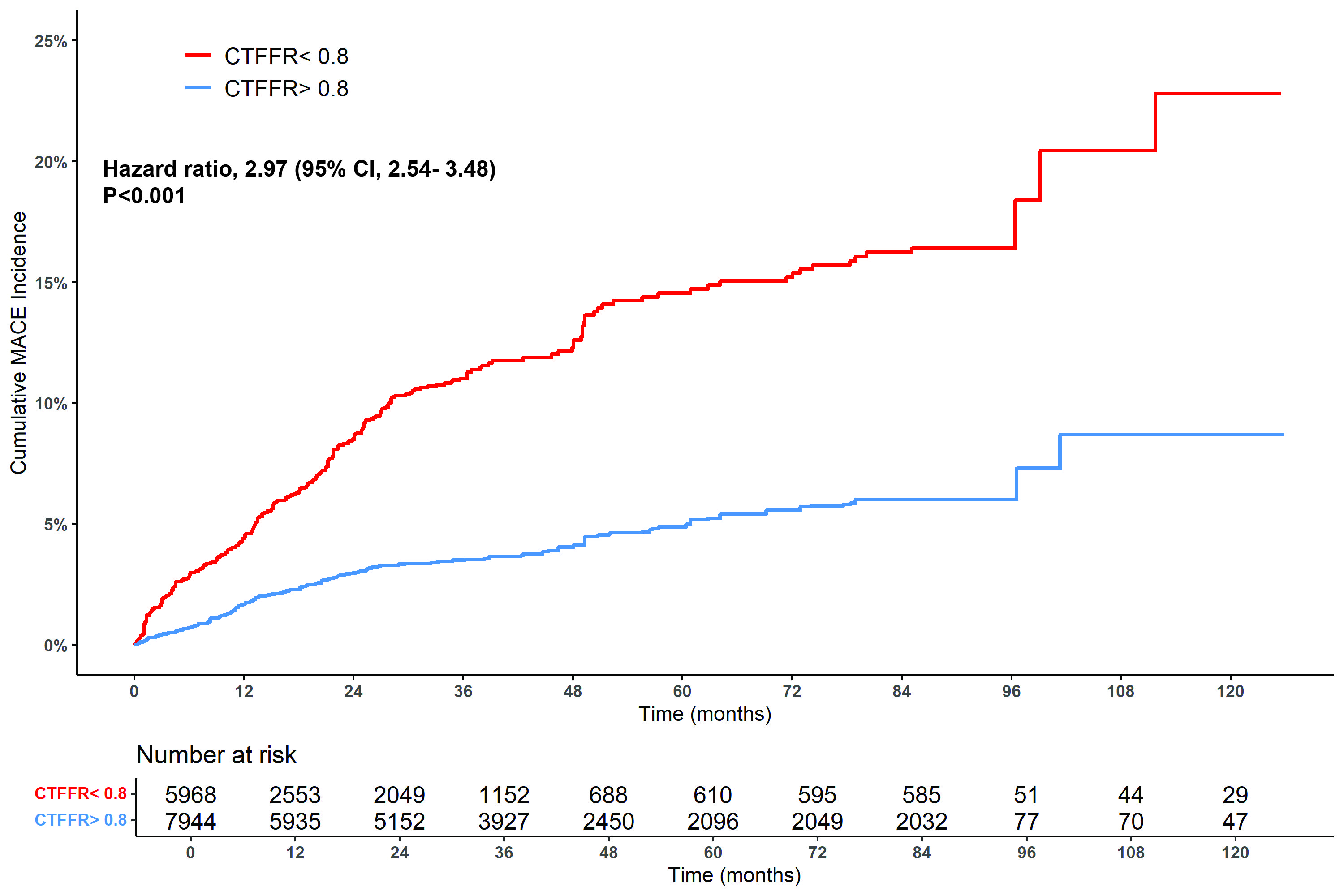
A total of 14 studies comprising 13,912 patients were included in the IPD-reconstructed meta-analysis for
MACE. Over a follow-up period of up to 120 months, patients with CT-FFR ≤0.80 experienced a
markedly higher cumulative incidence of MACE compared to those with CT-FFR >0.80. The 10-year
MACE-free survival rate was 77.1% in the CT-FFR ≤0.80 group versus 91.4% in the CT-FFR >0.80
group. CT-FFR ≤0.80 was associated with a 197% increased risk of MACE (HR: 2.97; 95% CI:
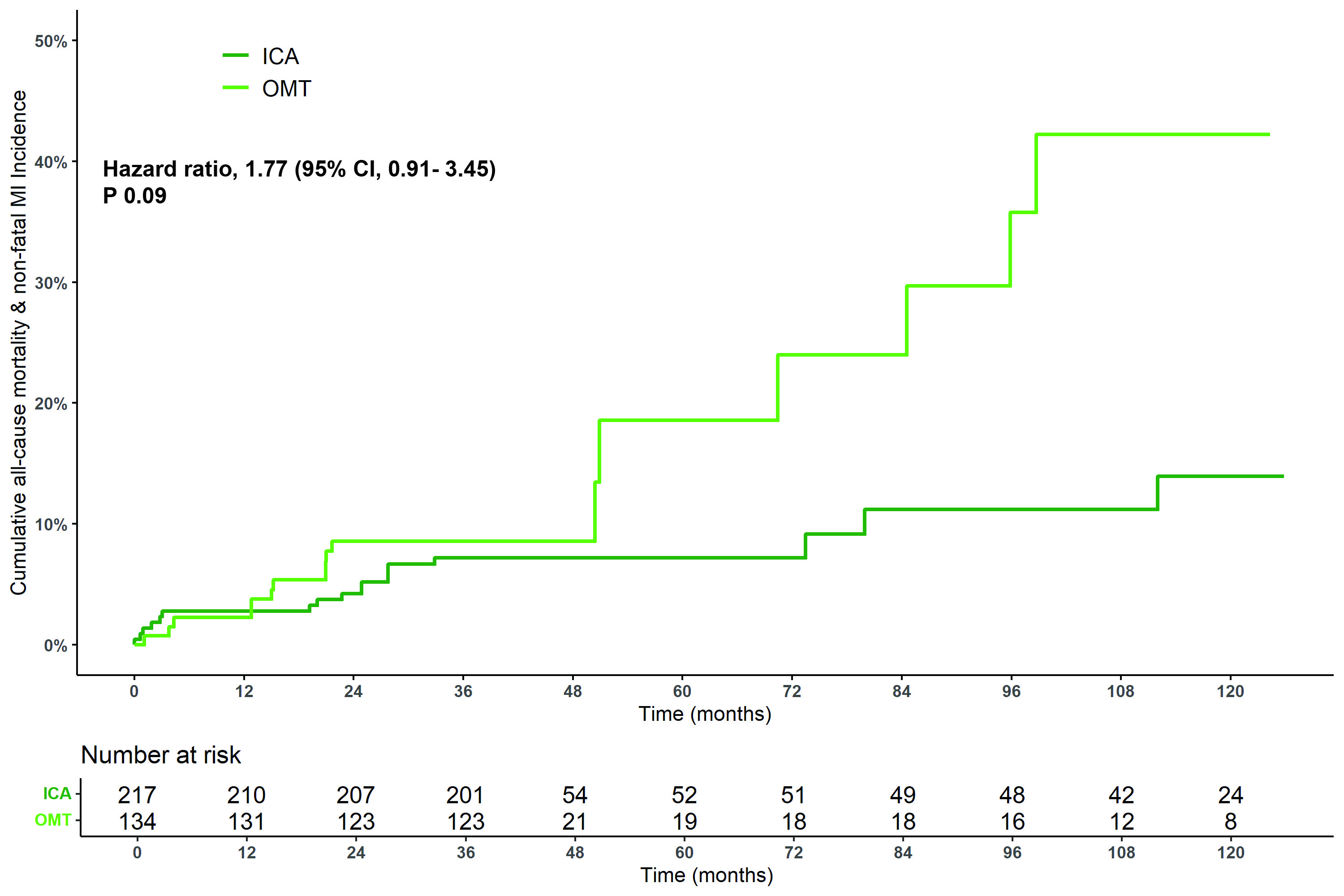
2.54–3.48; p < 0.001). Furthermore, patients with CT-FFR ≤0.80 managed with Optimal Medical Therapy
exhibited a higher cumulative incidence of MACE than those undergoing Invasive coronary angiography,
with 10-year MACE-free survival rates of 57.85% and 86.1%, respectively. However, this difference did
not reach statistical significance (HR: 1.77; 95% CI: 0.91–3.45; p = 0.09). RMST analysis revealed that
Patients with CT-FFR >0.80 had a mean MACE-free survival of 114.3 months (95% CI: 113.4–115.3),
compared to 105.1 months (95% CI: 103.3–106.9) in those with CT-FFR ≤0.80 (p < 0.001).
Conclusion
Patients with stable CAD and CT-FFR > 80 can be safely stratified as low risk for future fatal and non-
fatal cardiac events due to their long-term predicted MACE-free survival.
  • Narimani-javid, Roozbeh  ( Cardiovascular Diseases Research Institute, Tehran University of Medical Sciences, , Tehran , Iran (the Islamic Republic of) )
  • Alsaid, Amro  ( BSW The Heart Hospital Plano , Plano , Texas , United States )
  • Hosseini, Kaveh  ( Cardiovascular Diseases Research Institute, Tehran University of Medical Sciences , Tehran , Iran (the Islamic Republic of) )
  • Khalique, Omar  ( Division of Cardiovascular Imaging, St Francis Hospital and Heart Center, , Roslyn , New York , United States )
  • Tavakoli, Kiarash  ( Cardiovascular Diseases Research Institute, Tehran University of Medical Sciences , Tehran , Iran (the Islamic Republic of) )
  • Dastjerdi, Parham  ( Cardiovascular Diseases Research Institute, Tehran University of Medical Sciences , Mashhad , Iran (the Islamic Republic of) )
  • Parastooei, Bahar  ( Cardiovascular Diseases Research Institute, Tehran University of Medical Sciences , Tehran , Iran (the Islamic Republic of) )
  • Najafinezhad, Fatemeh  ( Cardiovascular Diseases Research Institute, Tehran University of Medical Sciences , Tehran , Iran (the Islamic Republic of) )
  • Javadi, Minoo  ( Cardiovascular Diseases Research Institute, Tehran University of Medical Sciences , Tehran , Iran (the Islamic Republic of) )
  • Aghaei, Mona  ( Cardiovascular Diseases Research Institute, Tehran University of Medical Sciences , Tehran , Iran (the Islamic Republic of) )
  • Fathian Sabet, Mehrshad  ( Department of Internal Medicine, McLaren/Flint/Michigan State University , Flint , Michigan , United States )
  • Haseeb Ul Rasool, Muhammad  ( Icahn School of Medicine at Mount Sinai, Queens Hospital Center , New York , New York , United States )
  • Author Disclosures:
    Roozbeh Narimani-Javid: DO NOT have relevant financial relationships | Amro Alsaid: DO NOT have relevant financial relationships | Kaveh Hosseini: DO NOT have relevant financial relationships | Omar Khalique: No Answer | Kiarash Tavakoli: DO NOT have relevant financial relationships | Parham Dastjerdi: DO NOT have relevant financial relationships | Bahar Parastooei: No Answer | fatemeh najafinezhad: No Answer | Minoo Javadi: No Answer | Mona Aghaei: No Answer | Mehrshad Fathian Sabet: DO NOT have relevant financial relationships | Muhammad Haseeb ul Rasool: No Answer
Meeting Info:

Scientific Sessions 2025

2025

New Orleans, Louisiana

Session Info:

Transforming Cardiac Risk Assessment Using Imaging and Advanced Prognostic Modeling

Sunday, 11/09/2025 , 09:15AM - 10:30AM

Moderated Digital Poster Session

More abstracts on this topic:
CRP is associated with High-Risk Coronary Plaque phenotypes in Patients with Suspected Acute Coronary Syndromes

Myrmel Gard, Omland Torbjorn, Aakre Kristin, Steiro Ole-thomas, Karaji Iman, Tjora Hilde, Langoergen Joerund, Bjoerneklett Rune, Pedersen Eva, Dey Damini, Vikenes Kjell

Associations of Predicted CVD risk by the PREVENT Equation with AI-analyzed Coronary Atherosclerotic Plaque Characteristics

Gurevitz Chen, Fisher Rebecca, Muntner Paul, Fisher Edward, Rosenson Robert

More abstracts from these authors:
Chronotropic Incompetence Predicts Reduced Survival and Exercise Capacity in Heart Failure: A Meta-Analysis of Reconstructed Time-to-Event Data Across HFrEF and HFpEF

Tavakoli Kiarash, Dastjerdi Parham, Narimani-javid Roozbeh, Babaei Mohammadreza, Mahalleh Mehrdad, Behnoush Amir Hossein, Rezaee Malihe, Keykhaei Mohammad, Tajdini Masih

CT-derived fractional flow reserve; A comparison of diagnostic performance between machine learning and computational fluid dynamic approached in patients with coronary artery disease

Narimani-javid Roozbeh, Shafiei Sasan, Khansari Nakisa, Shaghaghi Zahra, Nozhat Salma, Hosseini Kaveh, Hosseini Seyed Kianoosh, Moradi Mehdi, Najafi-vosough Roya, Arzhangzadeh Alireza, Khalique Omar, Mojibian Hamid, Kuno Toshiki, Mohsen Amr, Alam Mahboob

You have to be authorized to contact abstract author. Please, Login
Not Available