Logo

American Heart Association

  57
  0


Final ID: MP112

CRP is associated with High-Risk Coronary Plaque phenotypes in Patients with Suspected Acute Coronary Syndromes

Abstract Body (Do not enter title and authors here): Background: Circulating myocardial injury and inflammatory markers are used to aid risk stratification in patients with suspected acute coronary syndromes (ACS), but their relationship to specific coronary plaque characteristics, including high-risk plaque features is poorly defined.
Hypothesis: We hypothesized that key prognostic biomarkers in patients with suspected ACS are associated with distinct coronary plaque phenotypes, using Coronary CT angiography (CCTA)–derived quantitative measures including non-calcified low-attenuation plaque (LAP) volume and 1k-plaque volume.
Methods: We included 484 patients from the WESTCOR trial presenting with suspected non-ST-elevation ACS (NSTE-ACS) without myocardial infarction. Coronary plaque was analyzed using semi-automated CCTA software. Circulating biomarkers included high-sensitivity cardiac troponin T (hs-cTnT), high-sensitivity cardiac troponin I (hs-cTnI), N-terminal pro–B-type natriuretic peptide (NT-proBNP), C-reactive protein (CRP), and growth differentiation factor-15 (GDF-15).
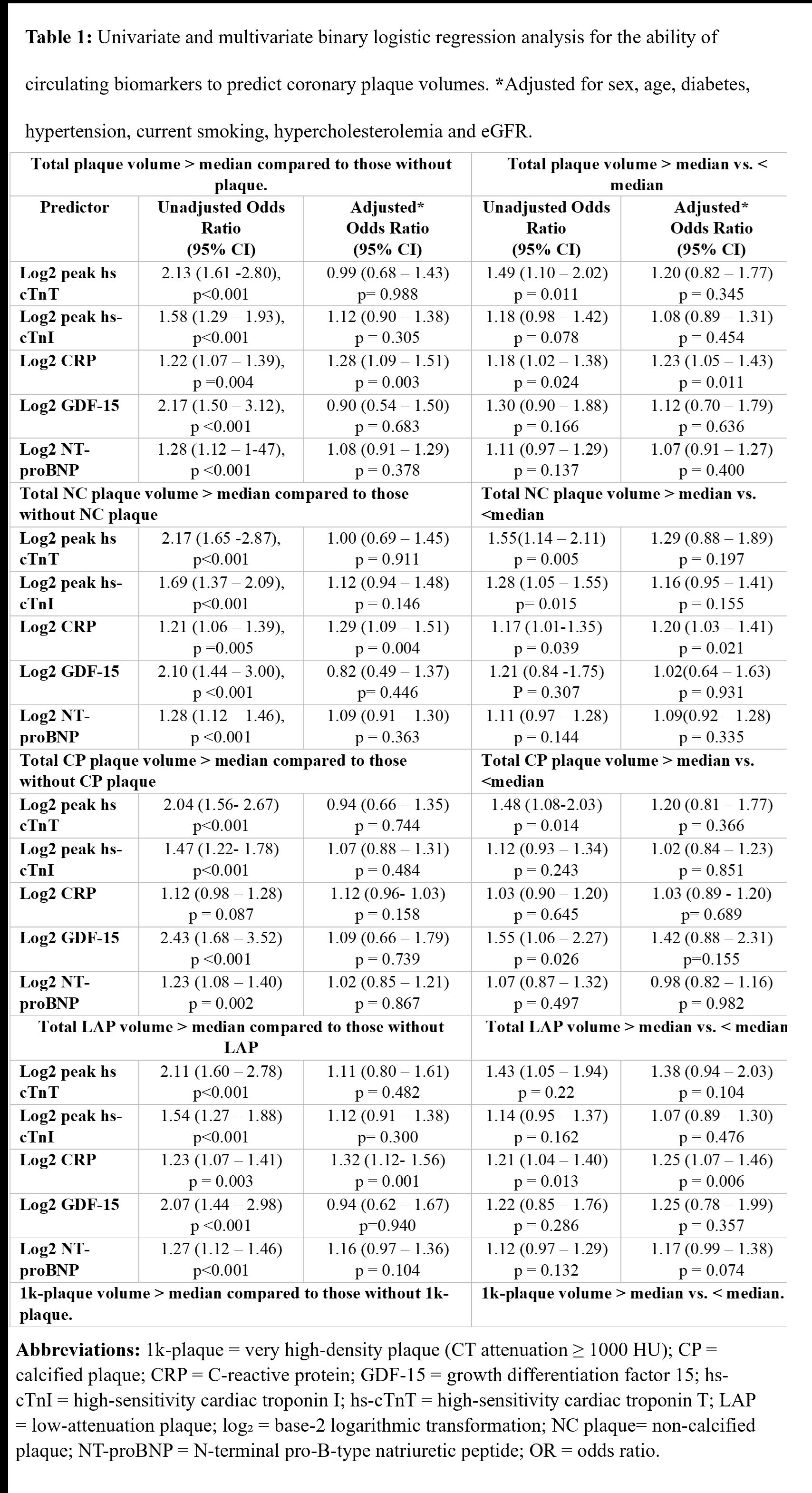
Results: A doubling of CRP concentration predicted LAP volumes above the median both vs. no LAP (OR 1.32, 95 % CI 1.12–1.56; p = 0.001) and vs. below-median LAP (OR 1.25, 95 % CI 1.07–1.46; p = 0.006), independent of conventional atherosclerotic risk factors (Table 1). CRP was not associated with stable plaque features, including calcified plaque volume (OR: 1.12, 95% CI: 0.96- 1.03, p = 0.158) or 1k-plaque volume (OR: 1.05, 95% CI: 0.91 – 1.20, p = 0.527). In univariate analyses, hs-cTnT, hs-cTnI, GDF-15, and NT-proBNP were associated with all plaque volume subtypes compared to patients without coronary plaque. However, these associations were lost after adjusting for conventional cardiovascular risk factors, suggesting an indirect relationship between these biomarkers and coronary atherosclerosis.
Conclusion: In patients with suspected acute coronary syndromes, increasing CRP concentrations are associated with greater coronary atherosclerotic volume and high-risk plaque features, including LAP, independent of traditional atherosclerotic risk factors. While the overall prognostic value of CRP is modest, it may reflect high-risk atherosclerosis which is not directly mirrored by other biomarkers.
  • Myrmel, Gard  ( Haukeland University Hospital , Bergen , Norway )
  • Omland, Torbjorn  ( University of Oslo , Nordbyhagen , Norway )
  • Aakre, Kristin  ( Haukeland University Hospital , Bergen , Norway )
  • Steiro, Ole-thomas  ( Haukeland University Hospital , Bergen , Norway )
  • Karaji, Iman  ( Haukeland University Hospital , Bergen , Norway )
  • Tjora, Hilde  ( Haukeland University Hospital , Bergen , Norway )
  • Langoergen, Joerund  ( Haukeland University Hospital , Bergen , Norway )
  • Bjoerneklett, Rune  ( HAUKELAND UNIVERSITY HOSPITAL , Bergen , Norway )
  • Pedersen, Eva  ( HAUKELAND UNIVERSITY HOSPITAL , Bergen , Norway )
  • Dey, Damini  ( Biomedical Imaging Research Institute, Cedars-Sinai Medical Centre , Los Angeles , California , United States )
  • Vikenes, Kjell  ( Haukeland University Hospital , Bergen , Norway )
  • Author Disclosures:
    Gard Myrmel: DO have relevant financial relationships ; Researcher:the Western Norway Regional Health Authority:Active (exists now) | Torbjorn Omland: No Answer | Kristin Aakre: No Answer | Ole-Thomas Steiro: DO NOT have relevant financial relationships | Iman Karaji: DO have relevant financial relationships ; Speaker:Boehringer Ingelheim Norway:Past (completed) | Hilde Tjora: No Answer | Joerund Langoergen: No Answer | Rune Bjoerneklett: No Answer | Eva Pedersen: No Answer | Damini Dey: DO have relevant financial relationships ; Royalties/Patent Beneficiary:Cedars-Sinai Medical Center:Active (exists now) ; Research Funding (PI or named investigator):NIH/NHLBI:Active (exists now) | Kjell Vikenes: DO NOT have relevant financial relationships
Meeting Info:

Scientific Sessions 2025

2025

New Orleans, Louisiana

Session Info:

Chronic Coronary Disease 1

Saturday, 11/08/2025 , 01:45PM - 02:35PM

Moderated Digital Poster Session

More abstracts on this topic:
Anti-inflammatory effects of colchicine after myocardial infarction

Muroke Valtteri, Diaz Rafael, Maggioni Aldo Pietro, Pinto Fausto, Kouz Simon, Berry Colin, Lopez-sendon Jose, Koenig Wolfgang, Cossette Marieve, Guertin Marie-claude, Rheaume Eric, Rhainds David, Tardif Jean-claude, Brodeur Mathieu, Marchand Claude, Charpentier Daniel, Pedneault-gagnon Valerie, Rivest Patricia, Latour Frederic, Roubille Francois

Aging-Associated Protein Medin Induces Human Coronary Artery Endothelial Proinflammatory and Prothrombotic Activation

Karamanova Nina, Morrow Kaleb, Maerivoet Alana, Madine Jillian, Li Ming, Migrino Raymond

More abstracts from these authors:
Beta-Blocker Therapy After Myocardial Infarction in Patients with Preserved Left Ventricular Ejection Fraction: An Individual Patient Data Meta-Analysis of Randomized Controlled Trials

Kristensen Anna Meta, Fuster Valentin, Hofmann Robin, Vikenes Kjell, Maeng Michael, Pocock Stuart, Karlström Patric, Bakken Arnhild, Barrabes Jose A, Benatar Jocelyne, Fagerland Morten Wang, Rossello Xavier, Holmager Therese Lucia Friis, Ozasa Neiko, Prescott Eva, Munkhaugen John, Jernberg Tomas, Ibanez Borja, Atar Dan, Yndigegn Troels, Kimura Takeshi, Latini Roberto, Lindahl Bertil, Halvorsen Sigrun, Hecht Olsen Michael

Serum Homoarginine is a Strong Predictor of Cardiovascular Mortality in Patients with Chest Pain and Non-Obstructive Coronary Artery Disease

Storesund Silje Kjellevold, Mccann Adrian, Ueland Per Magne, Lonnebakken Mai Tone, Nygard Ottar, Pedersen Eva

You have to be authorized to contact abstract author. Please, Login
Not Available