
Logo

American Heart Association

  19
  0


Final ID: MP2402

Chronotropic Incompetence Predicts Reduced Survival and Exercise Capacity in Heart Failure: A Meta-Analysis of Reconstructed Time-to-Event Data Across HFrEF and HFpEF

Abstract Body (Do not enter title and authors here): Background: Chronotropic incompetence (CI) is the inability of the heart to increase its rate adequately during activity. It is common in heart failure (HF) patients and is associated with poorer exercise capacity and clinical outcomes. This study systematically examines prognosis and functional outcomes in HF patients with and without CI.
Method: We searched PubMed, Embase, Scopus, and the Cochrane Library for studies published up to April 8, 2025, comparing overall survival and exercise performance in HF patients with and without CI. All-cause mortality was assessed using Cox proportional hazards models based on reconstructed individual patient data. Exercise performance differences were analyzed as mean differences (MD) using the DerSimonian and Laird random-effects model. Subgroup and restricted mean survival time (RMST) analyses were also conducted.
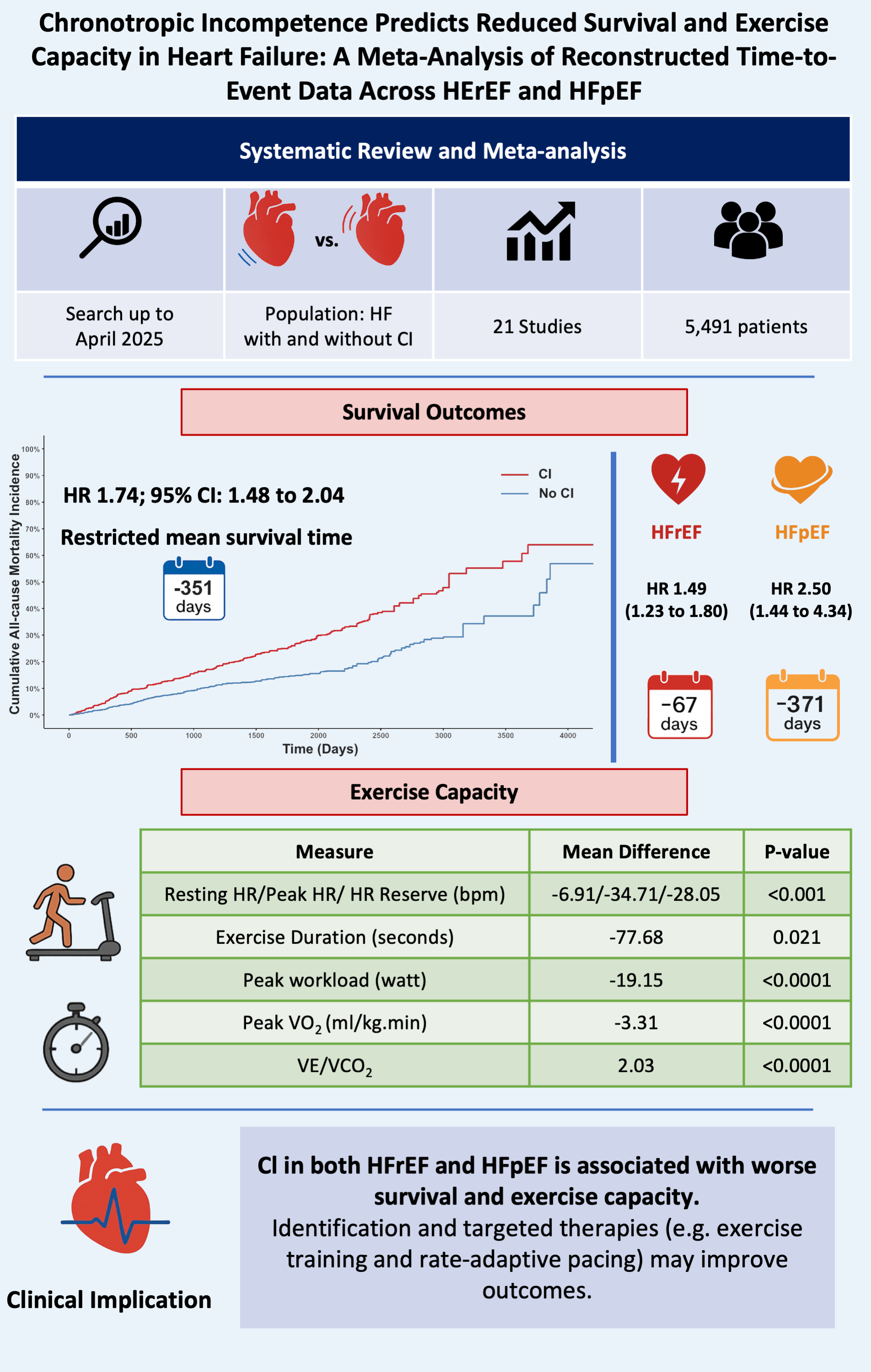
Results: A total of twenty-one studies were included. CI was associated with a 74% higher risk of all-cause mortality (HR: 1.74; 95% CI: 1.48 to 2.04; P < 0.001). Compared to patients without CI, those with CI had significantly lower exercise performance across all parameters: resting heart rate (MD: –6.91 bpm; P < 0.0001), peak heart rate (MD: –34.71 bpm; P < 0.001), heart rate reserve (MD: –28.05 bpm; P < 0.001), exercise duration (MD: –77.68 seconds; P = 0.021), peak workload (MD: –19.15 watts; P < 0.0001), and peak VO2 (MD: –3.31 ml.kg-1.min-1; P < 0.0001). Additionally, VE/VCO2 slope was significantly higher in the CI group (MD: 2.03; P < 0.0001), indicating poorer ventilatory efficiency. Subgroup analysis showed CI was linked to poor survival in both HF patients with reduced and preserved ejection fraction (HR: 1.49 and 2.50, respectively). Additionally, RMST analysis revealed fewer event-free days over five years in patients with CI, with differences of 67 days in the HFrEF subgroup (P < 0.001) and 371 days in the HFpEF subgroup (P < 0.001), compared to their non-CI counterparts.
Conclusion: HF patients with CI have poorer survival and reduced functional and ventilatory efficiency during physical activity. These findings emphasize the importance of this often-overlooked condition in HF patients and suggest that identifying CI and adopting personalized treatment strategies such as exercise rehabilitation and rate-adaptive pacing could potentially improve survival in this high-risk group.
  • Tavakoli, Kiarash  ( Tehran Heart Center , Tehran , Iran (the Islamic Republic of) )
  • Dastjerdi, Parham  ( Tehran Heart Center , Tehran , Iran (the Islamic Republic of) )
  • Narimani-javid, Roozbeh  ( Tehran Heart Center , Tehran , Iran (the Islamic Republic of) )
  • Babaei, Mohammadreza  ( Rajaie Cardiovascular Institute , Tehran , Iran (the Islamic Republic of) )
  • Mahalleh, Mehrdad  ( Tehran Heart Center , Tehran , Iran (the Islamic Republic of) )
  • Behnoush, Amir Hossein  ( Tehran Heart Center , Tehran , Iran (the Islamic Republic of) )
  • Rezaee, Malihe  ( Johns Hopkins University , Baltimore , Maryland , United States )
  • Keykhaei, Mohammad  ( Johns Hopkins University , Baltimore , Maryland , United States )
  • Tajdini, Masih  ( Tehran Heart Center , Tehran , Iran (the Islamic Republic of) )
  • Author Disclosures:
    Kiarash Tavakoli: DO NOT have relevant financial relationships | Parham Dastjerdi: DO NOT have relevant financial relationships | Roozbeh Narimani-Javid: DO NOT have relevant financial relationships | Mohammadreza Babaei: DO NOT have relevant financial relationships | Mehrdad Mahalleh: DO NOT have relevant financial relationships | Amir Hossein Behnoush: DO NOT have relevant financial relationships | Malihe Rezaee: DO NOT have relevant financial relationships | Mohammad Keykhaei: DO NOT have relevant financial relationships | Masih Tajdini: DO NOT have relevant financial relationships
Meeting Info:

Scientific Sessions 2025

2025

New Orleans, Louisiana

Session Info:

Clinical Electrophys: Diagnosis and Risk Stratification

Monday, 11/10/2025 , 10:45AM - 11:45AM

Moderated Digital Poster Session

More abstracts on this topic:
A Case of Dilated Cardiomyopathy and Systemic Thromboembolism in a Young Patient on Testosterone Replacement Therapy

Sabri Muhammad, Ijaz Naila, Nadeem Ramsha, Checchio Lucy, Riaz Faiza

9-Year Longitudinal Assessment of the 12-lead Electrocardiogram of Volunteer Firefighters

Bae Alexander, Dzikowicz Dillon, Lai Chi-ju, Brunner Wendy, Krupa Nicole, Carey Mary, Tam Wai Cheong, Yu Yichen

More abstracts from these authors:
Negative CT-derived Fractional Flow Reserve Predicts the Long-term Event-free Survival in
Patients with CAD: A Meta-analysis of Reconstructed Time-to-event Data

Narimani-javid Roozbeh, Alsaid Amro, Hosseini Kaveh, Khalique Omar, Tavakoli Kiarash, Dastjerdi Parham, Parastooei Bahar, Najafinezhad Fatemeh, Javadi Minoo, Aghaei Mona, Fathian Sabet Mehrshad, Haseeb Ul Rasool Muhammad

Constitutive mTORC1 Activation in Macrophages Lacking TSC2 Enhances GPNMB to Ameliorate Cardiac Ischemia-Reperfusion Injury

Keykhaei Mohammad, Koleini Navid, Meddeb Mariam, Tajdini Masih, Farshidfar Farnaz, Rezaee Malihe, Ranek Mark, Kass David

You have to be authorized to contact abstract author. Please, Login
Not Available