Logo

American Heart Association

  13
  0


Final ID: MP2293

Associations of Predicted CVD risk by the PREVENT Equation with AI-analyzed Coronary Atherosclerotic Plaque Characteristics

Abstract Body (Do not enter title and authors here): Background
The PREVENT equations estimates 10-year total CVD risk using clinical and laboratory data. Its association with coronary plaque morphology using coronary CT angiography (CCTA) remains unclear. Moreover, it is unknown whether lipoprotein(a) [Lp(a)], an established marker of cardiovascular risk, provides additional predictive value for coronary plaque burden beyond that offered by the PREVENT equations.
Objective
Assess the association between predicted 10-year total CVD risk and coronary plaque features, and evaluate whether Lp(a) adds predictive value.
Methods
We conducted a retrospective study, asymptomatic patients without prior cardiovascular events underwent coronary computed tomography angiography (CCTA) between 2018 and 2024. Coronary plaque characteristics were quantified using artificial intelligence (AI)-based analysis. One-way ANOVA was used to assess differences in plaque burden across risk categories using the 10-year total predicted CVD based on the PREVENT equations: low risk (<5%), borderline risk (5-7.4%), intermediate risk (7.5-19.9%), and high risk (≥20%). We used linear regression to assess associations between 10-year total predicted CVD risk and total plaque volume (TPV), calcified plaque (CP), non-calcified plaque (NCP), and low-density non-calcified plaque (LDNCP). Lp(a), modeled per 50 nmol/L, was then added to a model that included 10-year predicted total CVD risk to assess its contribution beyond the PREVENT score.
Results
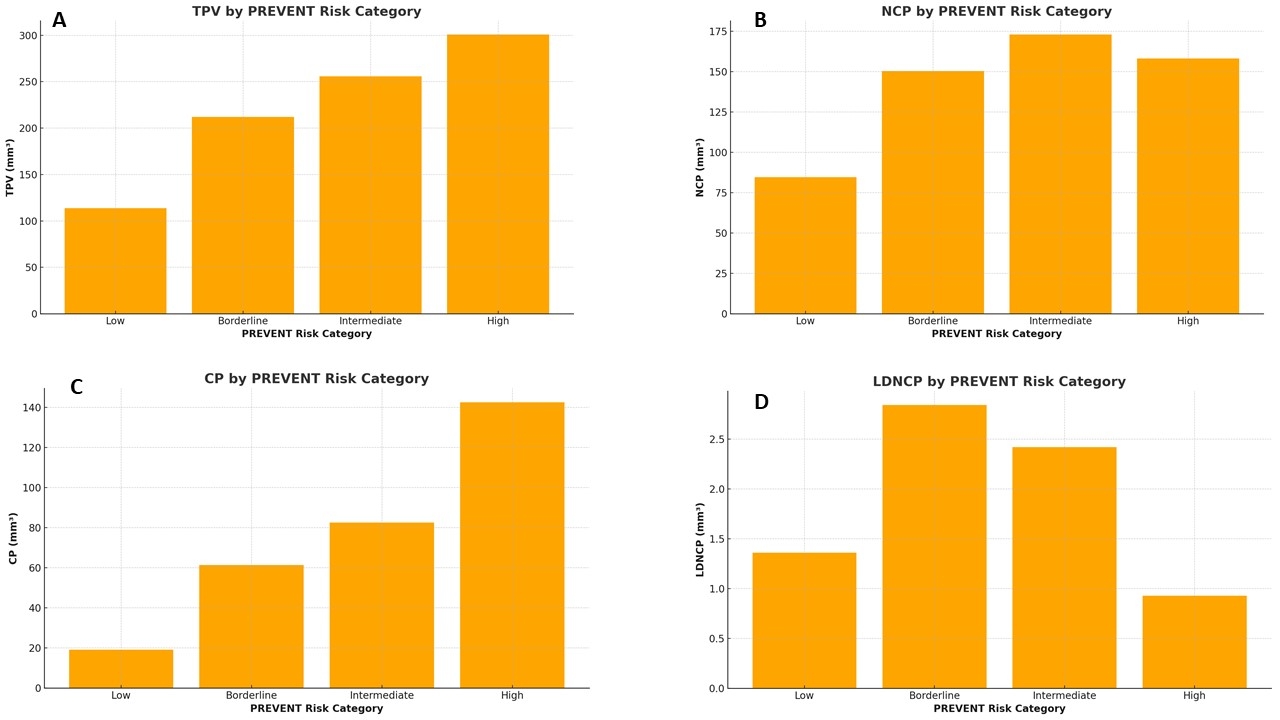
The cohort included 525 adults with a mean age of 55.8 years; 30% were female; and 51% were taking a statin. Total, calcified and non-calcified plaque burden, stenosis severity, and remodeling index increased across higher 10-year total CVD risk categories (p<0.001 for trend; Figure 1). LDNCP was not associated with 10-year total CVD risk. When analyzing the PREVENT score as a continuous variable, higher scores were associated with greater TPV, CP, and NCP (all p<0.001, Table 1), but not LDNCP (p=0.15). Higher Lp(a) was associated with TPV, CP, and NCP after adjustment for 10-year total CVD risk (Table 1).
Conclusion
The 10-year predicted total CVD risk estimated by the PREVENT equations was associated with coronary plaque burden, including calcified and non-calcified components. These results support estimating 10-year predicted total CVD risk using the PREVENT equations as a tool for subclinical atherosclerosis risk assessment and highlight the relevance of Lp(a) in identifying residual plaque risk.
  • Gurevitz, Chen  ( Mount Sinai Health , New York , New York , United States )
  • Fisher, Rebecca  ( Mount Sinai Health , New York , New York , United States )
  • Muntner, Paul  ( University of Alabama at Birmingham , Birmingham , Alabama , United States )
  • Fisher, Edward  ( Mount Sinai Health , New York , New York , United States )
  • Rosenson, Robert  ( Mount Sinai Health , New York , New York , United States )
  • Author Disclosures:
    Chen Gurevitz: DO NOT have relevant financial relationships | Rebecca Fisher: DO NOT have relevant financial relationships | Paul Muntner: DO have relevant financial relationships ; Consultant:Merck:Active (exists now) ; Consultant:Novartis:Active (exists now) ; Research Funding (PI or named investigator):Amgen Inc.:Active (exists now) | Edward Fisher: No Answer | Robert Rosenson: DO have relevant financial relationships ; Research Funding (PI or named investigator):Amgen:Active (exists now) ; Consultant:Intercept Pharmaceuticals:Past (completed) ; Consultant:Eli Lilly:Active (exists now) ; Consultant:Editas Medicine:Past (completed) ; Consultant:CRISPER Therapeutics:Past (completed) ; Consultant:Arrowhead:Active (exists now) ; Consultant:Amgen:Active (exists now) ; Research Funding (PI or named investigator):Shanghai Argo Biopharmaceutical Co.:Active (exists now) ; Research Funding (PI or named investigator):89Bio:Active (exists now) ; Research Funding (PI or named investigator):Novo Nordisk:Past (completed) ; Research Funding (PI or named investigator):Novartis:Active (exists now) ; Research Funding (PI or named investigator):NIH:Active (exists now) ; Research Funding (PI or named investigator):Merck:Active (exists now) ; Research Funding (PI or named investigator):Eli Lilly:Active (exists now) ; Research Funding (PI or named investigator):Arrowhead:Active (exists now)
Meeting Info:

Scientific Sessions 2025

2025

New Orleans, Louisiana

Session Info:

Charting the Future: Cardiovascular Disease Risk Prediction

Monday, 11/10/2025 , 10:45AM - 12:00PM

Moderated Digital Poster Session

More abstracts on this topic:
A Focus for Improvement - Factors for Lab Adherence in a Pediatric Preventive Cardiology Program

Holsinger Hunter, Porterfield Ronna, Taylor Makenna, Dresbach Bethany, Seipel Brittany, Igwe Chukwuemeka, Alvarado Chance, Tran Andrew

A Cross-scale Causal Machine Learning Framework Pinpoints Mgl2+ Macrophage Orchestrators of Balanced Arterial Growth

Han Jonghyeuk, Kong Dasom, Schwarz Erica, Takaesu Felipe, Humphrey Jay, Park Hyun-ji, Davis Michael E

More abstracts from these authors:
Lipoprotein(a) Selectively Associates with Vulnerable Coronary Plaque Phenotypes in Comparison with Other Established Risk Markers

Gurevitz Chen, Fisher Rebecca, Fisher Edward, Park Jisuk, Min James, Goonewardena Sascha, Rosenson Robert

Should Women Have Lower Blood pressure Goals Than Men? Sex Differences in Blood Pressure and Cardiovascular Disease in the UK Biobank

Kelly Rebecca K, Harris Katie, Carcel Cheryl, Muntner Paul, Woodward Mark

You have to be authorized to contact abstract author. Please, Login
Not Available