
Logo

American Heart Association

  19
  0


Final ID: MP1479

Re-Evaluating the Unassuming Assumption: Lessons from Hemodynamic Predictors in Heart Transplant Outcomes

Abstract Body (Do not enter title and authors here):
Background:
Cox proportional hazards models are common statistical methods widely used in cardiovascular research that depend on several key assumptions of the data to ensure validity of results. The assumption of linearity (that is, proportional), or the linear relationship between predictor variables and the log of the hazard, is rarely tested but recently observed in our group’s research to be unreliable. This discovery may prevent biased risk estimates if true relationships are nonlinear.

Research Question:
To interrogate the assumed linearity between key hemodynamic variables used in heart transplant risk stratification and patient outcomes, understanding the methodological reliance on standard Cox modeling in research design.

Methods:
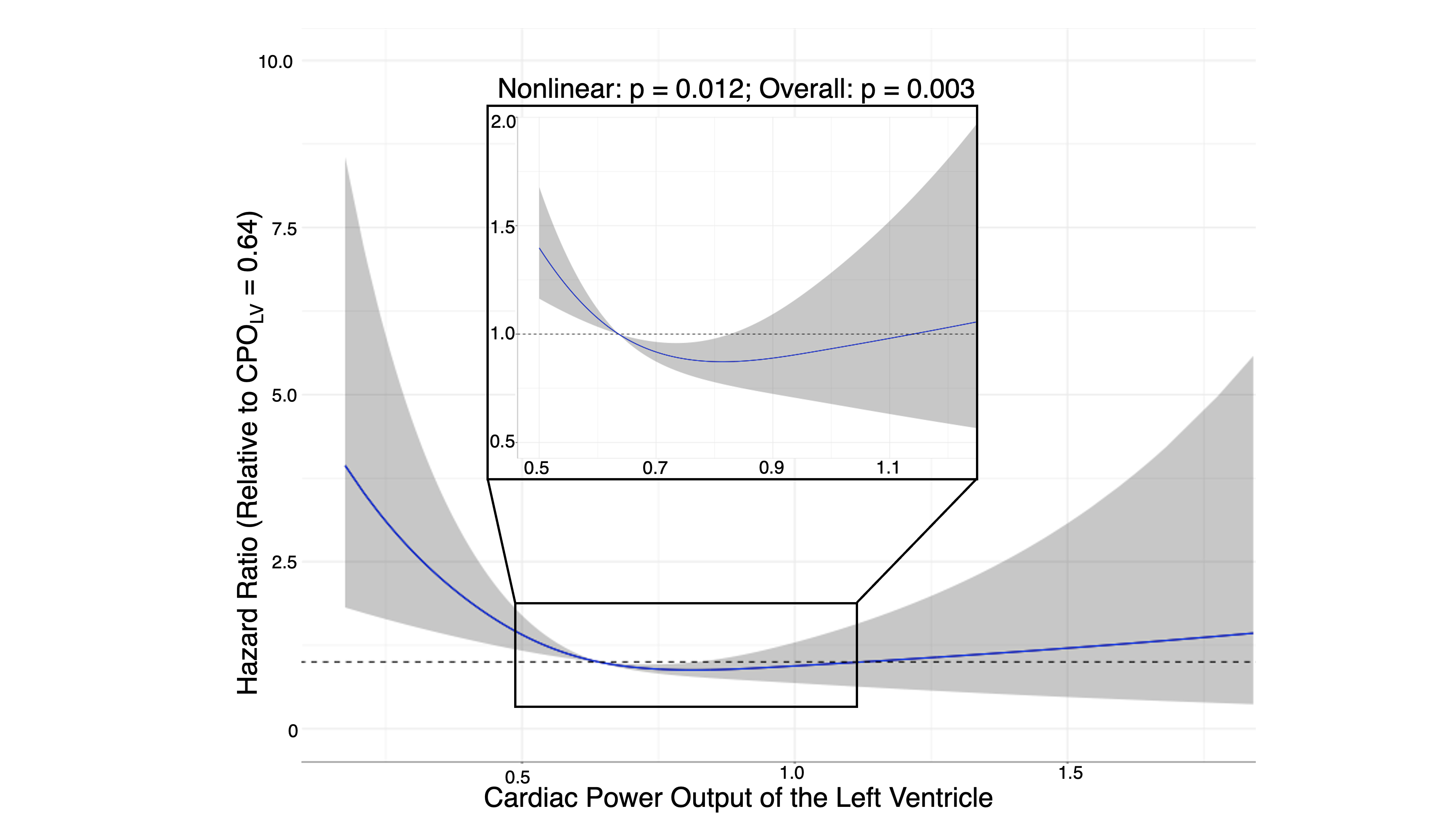
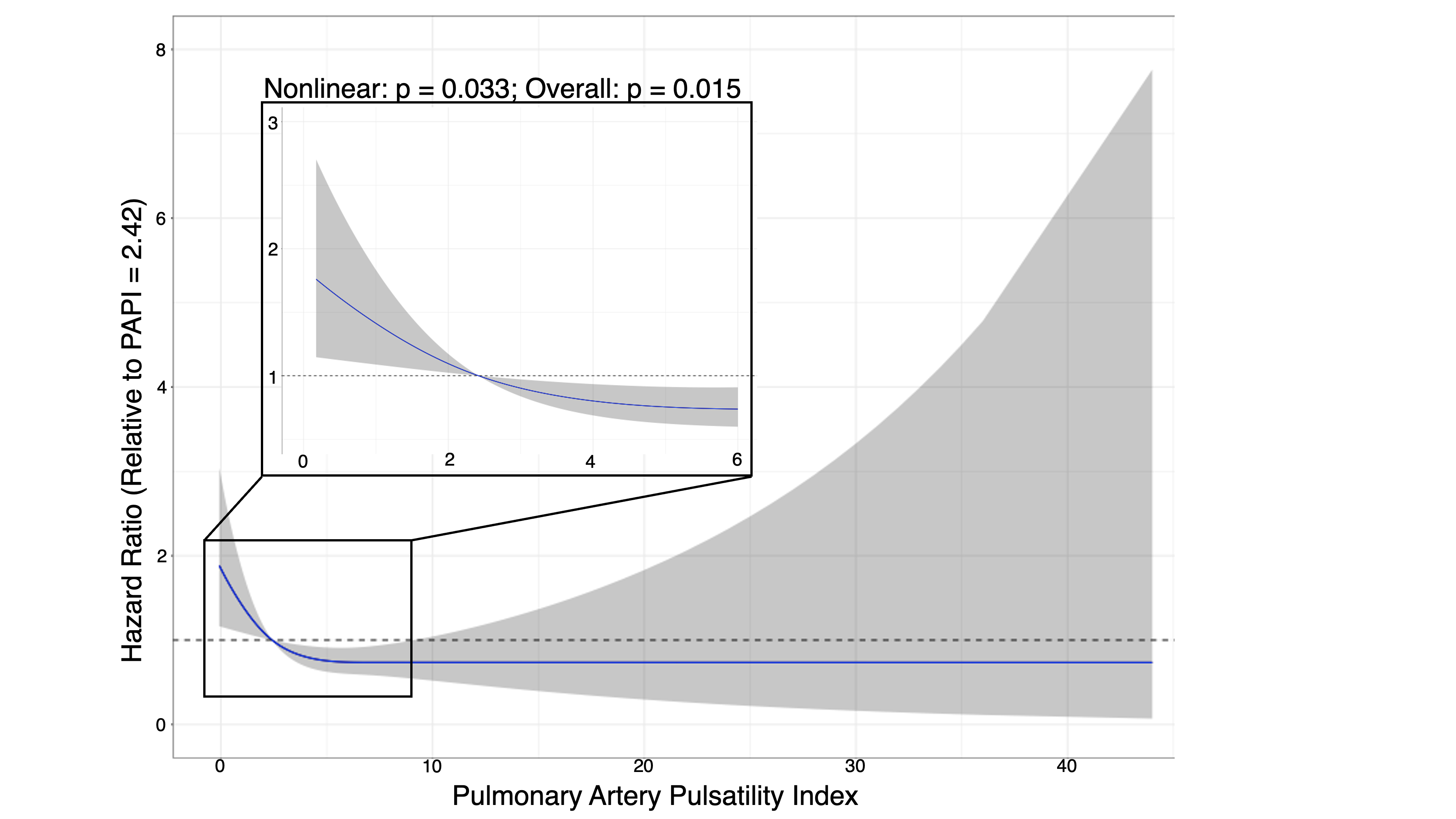
Using a population subgroup defined for another study of adult, heart-only transplant candidates (Status 1-3) without mechanical circulatory support (MCS) listed in the UNOS Registry from 10/18/2018 to 09/30/2024 with follow-up through 10/04/2024. Hemodynamic values at listing were assessed for association with the outcome of death/deterioration on the waitlist. To evaluate the potentially nonlinear relationship between hemodynamic variables and the log cause-specific hazard, we applied restricted cubic splines to the above hemodynamic variables prior to inclusion into the cause-specific Cox proportional hazards model.

Results:
In total, 2,718 non-MCS patients were included. There was a significant non-linear association between left ventricular cardiac power output (CPOLV) (p-nonlinear = 0.012) and pulmonary artery pulsatility index (PAPI) (p-nonlinear = 0.033) with the outcome of death/deterioration on the waitlist. Additionally, these findings display threshold effects, where these variables can be treated as continuous below certain cutoff values but plateau beyond them. For instance, risk of death/deterioration increased sharply below PAPI = 2.42 but plateaued beyond that, violating linearity assumptions.

Conclusion:
Our findings demonstrate that commonly used hemodynamic markers may not exhibit linear risk relationships. This implies that Cox regression may misestimate true risk at certain hemodynamic values when analyzing not only CPOLV and PAPI, but perhaps other physiologic estimates in cardiac research. Thus, our results highlight the need for more routine testing for nonlinearity in Cox models when employed in cardiovascular outcomes research.
  • Ferrall, Joel  ( University of Southern California , Los Angeles , California , United States )
  • Chen, Matthew  ( University of Southern California , Los Angeles , California , United States )
  • Nattiv, Jonathan  ( University of Southern California , Los Angeles , California , United States )
  • Pandya, Kruti  ( University of Southern California , Los Angeles , California , United States )
  • Stachel, Maxine  ( University of Southern California , Los Angeles , California , United States )
  • Kawaguchi, Eric  ( University of Southern California , Los Angeles , California , United States )
  • Lee, Raymond  ( University of Southern California , Los Angeles , California , United States )
  • Vaidya, Ajay  ( University of Southern California , Los Angeles , California , United States )
  • Wolfson, Aaron  ( University of Southern California , Los Angeles , California , United States )
  • Author Disclosures:
    Joel Ferrall: DO NOT have relevant financial relationships | Matthew Chen: DO NOT have relevant financial relationships | Jonathan Nattiv: No Answer | Kruti Pandya: No Answer | Maxine Stachel: No Answer | Eric Kawaguchi: No Answer | raymond lee: No Answer | Ajay Vaidya: DO NOT have relevant financial relationships | Aaron Wolfson: No Answer
Meeting Info:

Scientific Sessions 2025

2025

New Orleans, Louisiana

Session Info:

Under Pressure: Exercise, Risk, and Real-World Predictors in Cardiovascular Disease

Sunday, 11/09/2025 , 03:15PM - 04:15PM

Moderated Digital Poster Session

More abstracts on this topic:
A Polypill Strategy for Heart Failure with Reduced Ejection Fraction: The POLY-HF Trial

Pandey Ambarish, Wang Thomas, Keshvani Neil, Rizvi Syed Kazim, Jain Anand, Coellar Juan David, Drazner Mark, Gupta Deepak, Chandra Alvin, Zaha Vlad

A Simple One-Item Nursing Falls Assessment Predicts Outcomes For Patients With Stage D Heart Failure Undergoing Surgical Advanced Therapies

Salvador Vincent, Perez Jaime Abraham, Hudec Paige, Gorodeski Eiran, Oneill Thomas

More abstracts from these authors:
Waitlist Outcomes in Patients on VA-ECMO With and Without Left Ventricular Unloading as a Bridge to Heart Transplantation

Chen Matthew, Ferrall Joel, Jinno Stephanie, Burton John, Kawaguchi Eric, Praeger Jonathan, Lee Raymond, Vaidya Ajay, Wolfson Aaron

Time-Dependent Impact of the 2018 UNOS Heart Allocation Policy Revision on Transplantation and Waitlist Outcomes: A Landmark Competing Risks Analysis

Chen Matthew, Ferrall Joel, Fong Michael, Nattiv Jonathan, Pandya Kruti, Kawaguchi Eric, Vaidya Ajay, Wolfson Aaron

You have to be authorized to contact abstract author. Please, Login
Not Available