
Logo

American Heart Association

  17
  0


Final ID: MP1928

Narrow Margins: Pulse Pressure as a Window into Risk in Pulmonary Embolism

Abstract Body (Do not enter title and authors here):
Background
Pulmonary embolism (PE) is a potentially life-threatening condition. Early risk stratification is critical, but existing tools have limitations in predicting hemodynamic compromise. Pulse pressure (PP), the difference between systolic and diastolic blood pressure, has been shown to predict clinical outcomes in patients with heart failure and sepsis, but its prognostic value in acute PE is unclear.

Objective
The purpose of this study is to evaluate if PP predicts mortality in critically ill patients with acute PE.

Methods
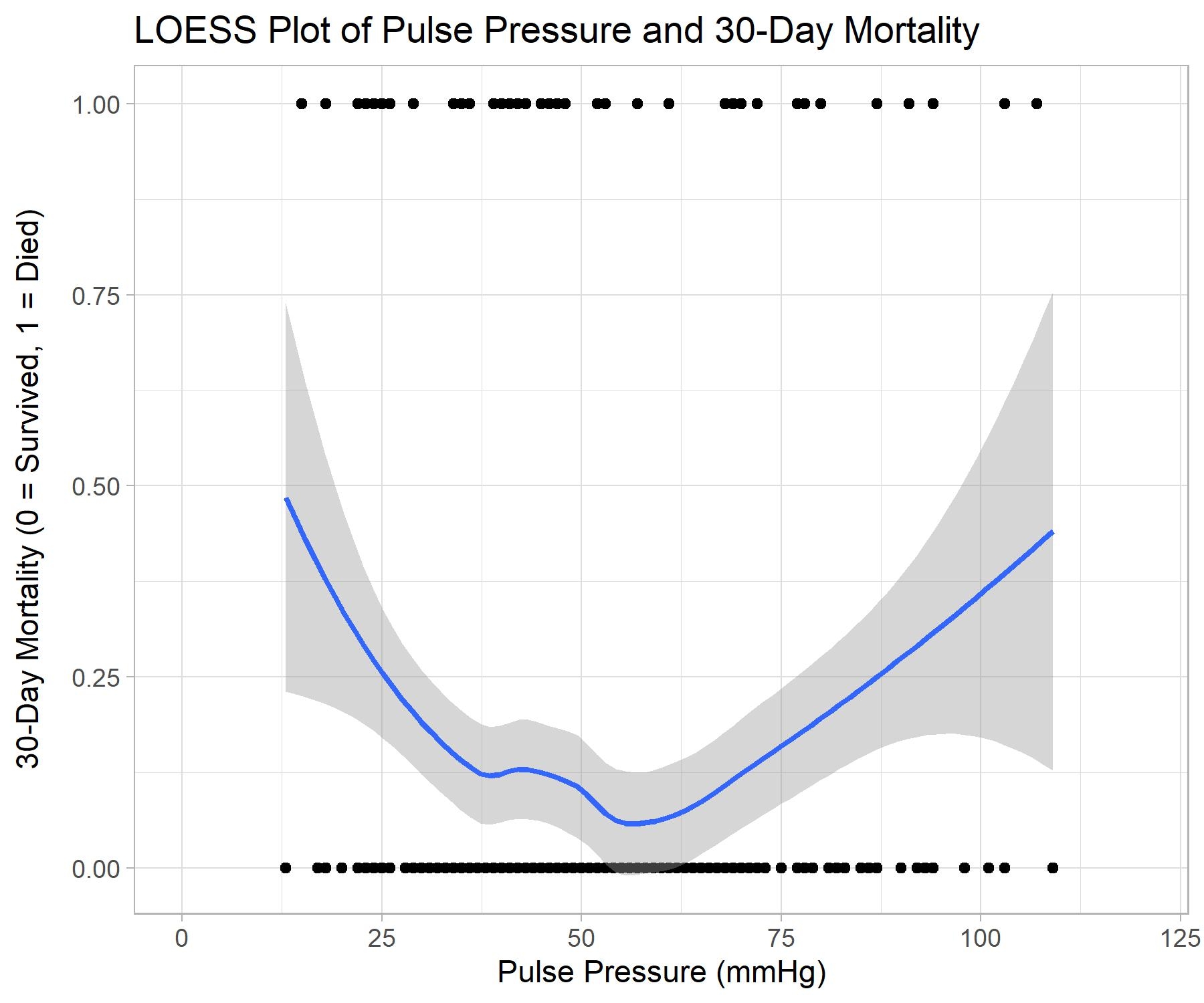
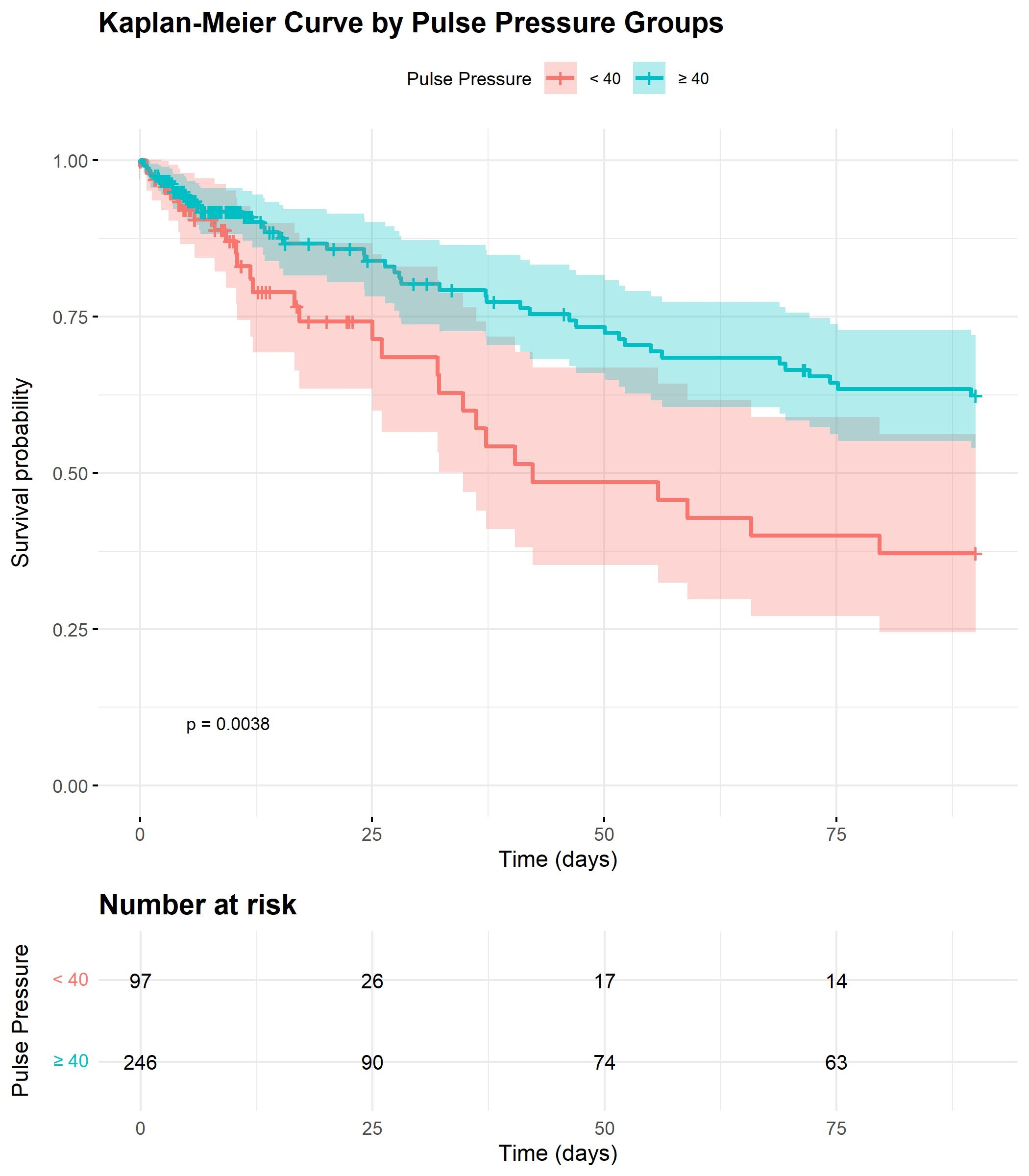
We conducted a retrospective cohort study using the Medical Information Mart for Intensive Care (MIMIC) - IV database. Our cohort included patients admitted to intensive care units (ICU) with an active diagnosis of acute PE within 24 hours of admission. Locally estimated scatterplot smoothing (LOESS) was utilized to visualize the relationship between PP and 30-day mortality. Multivariate logistic regression and Cox proportional hazard model assessed the association of PP with mortality outcomes, adjusting for age, gender, race, and insurance status. Kaplan-Meier curves were generated to compare time to death from ICU admission (censored at 90 days) between patients with PP < 40 mmHg and ≥ 40 mmHg.

Results
Our cohort consisted of 345 patients admitted to ICUs with acute PE. The mean age was 63.4, and 48.4% were male. LOESS curve revealed a nonlinear relationship between PP and 30-day mortality, with a decreasing risk observed for PP values between 0–40 mmHg, a relative plateau between 40–60 mmHg, and an increasing risk beyond 60 mmHg. In multivariate logistic regression, PP < 40 mmHg was significantly associated with higher 30-day mortality (OR 2.08, p = 0.039). Kaplan-Meier analysis demonstrated early and distinct separation in survival between the PP < 40 mmHg and PP ≥ 40 mmHg groups, with a log-rank test p-value of 0.004. In Cox proportional hazards modeling, PP < 40 mmHg was associated with a significantly higher hazard of death (HR 2.28, p = 0.001).

Conclusions
Lower PP at presentation is associated with increased short-term mortality in ICU patients with acute PE. Furthermore, a threshold of less than 40 mmHg effectively identified higher-risk patients. These previously unpublished findings suggest that PP, a readily available noninvasive bedside measurement, is an effective tool for early risk stratification in critically ill patients with acute PE.
  • Zhong, Yingchao  ( NYU Langone Health , New York , New York , United States )
  • Yuriditsky, Eugene  ( NYU Langone Health , New York , New York , United States )
  • Author Disclosures:
    Yingchao Zhong: DO NOT have relevant financial relationships | Eugene Yuriditsky: No Answer
Meeting Info:

Scientific Sessions 2025

2025

New Orleans, Louisiana

Session Info:

Pressure Points: PH, PE, and RV Failure After LVAD

Monday, 11/10/2025 , 09:15AM - 10:15AM

Moderated Digital Poster Session

More abstracts on this topic:
A Polypill Strategy for Heart Failure with Reduced Ejection Fraction: The POLY-HF Trial

Pandey Ambarish, Wang Thomas, Keshvani Neil, Rizvi Syed Kazim, Jain Anand, Coellar Juan David, Drazner Mark, Gupta Deepak, Chandra Alvin, Zaha Vlad

Artificial Intelligence-Enhanced Electrocardiographic Phenotyping Unveils Novel Lethal Cardiovascular & Sudden Death Risk Signatures in Traditionally Low Risk Populations

Barker Joseph, Syan Jasjit, Jenkins Alex, Ribeiro Antonio, Annis Jeffrey, Camelo Lidyane, Oliveira Clara, Paixao Gabriela, Brant Luisa, Ribeiro Antonio, Ge Junbo, Fathieh Sina, Kramer Daniel, Waks Jonathan, Brittain Evan, Peters Nicholas, Figtree Gemma, Khattak Gul Rukh, Sau Arunashis, Ng Fu Siong, Pastika Libor, Birdi Aidan, Zeidaabadi Boroumand, Patlatzoglou Konstantinos, Liang Yixiu, Aggour Hesham, El-medany Ahmed

More abstracts from these authors:
DSI-phering Signals: Unlocking Prognostic Clues in Cardiogenic Shock

Zhong Yingchao, Johnson Adam, Yuriditsky Eugene

Expert Faculty Pericardiocentesis

Il'giovine Zachary, O'brien Connor, Yuriditsky Eugene

You have to be authorized to contact abstract author. Please, Login
Not Available