DSI-phering Signals: Unlocking Prognostic Clues in Cardiogenic Shock
Abstract Body (Do not enter title and authors here): Background Vasoplegia presents as diastolic hypotension and tachycardia. Increasing values of the diastolic shock index (DSI), defined as the ratio between heart rate and diastolic arterial pressure, identify patients with septic shock at increased risk for death. However, its prognostic value in cardiogenic shock (CS) remains unclear.
Objective To determine whether the DSI predicts cardiac output (CO), systemic vascular resistance (SVR), and mortality in CS.
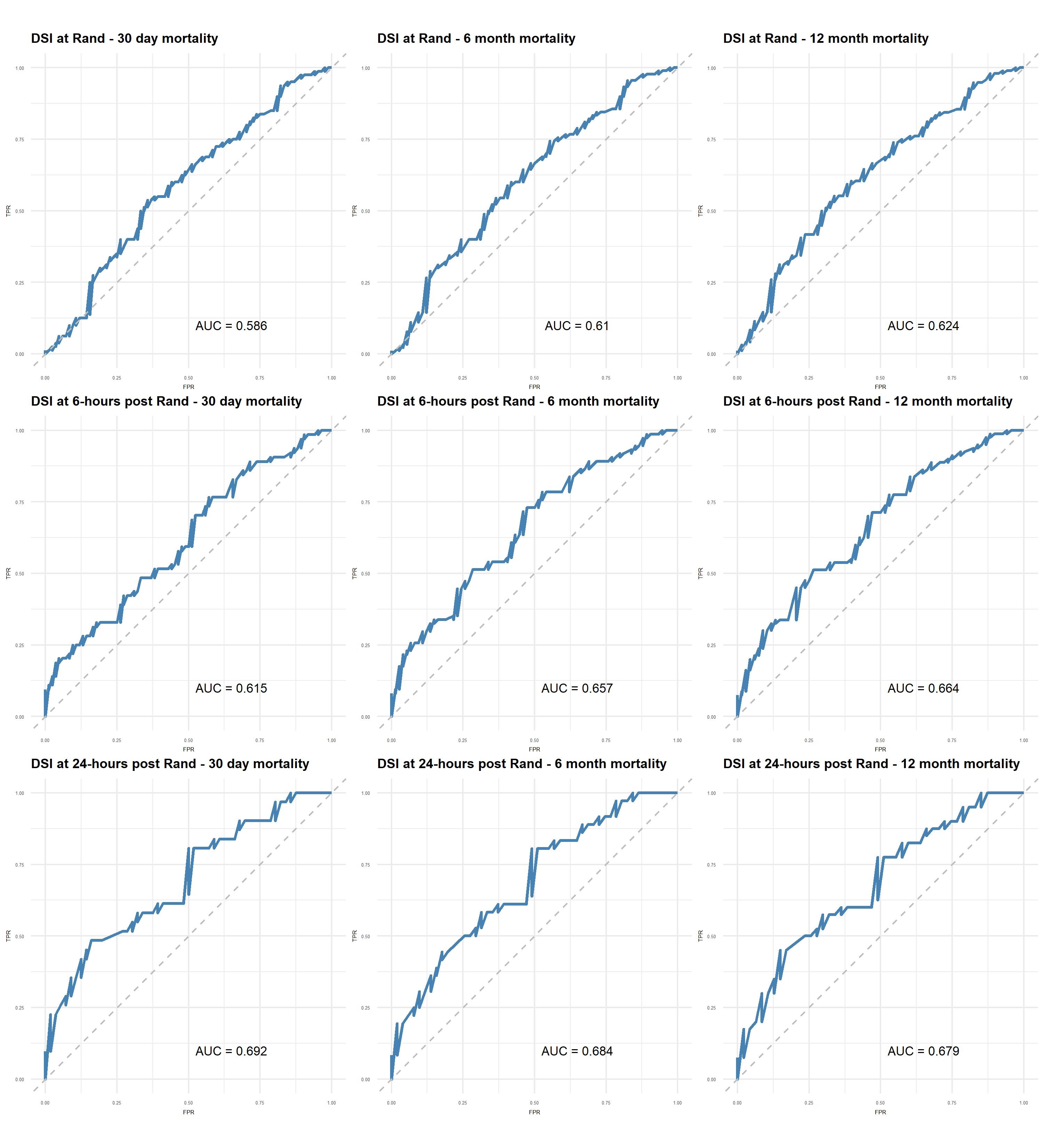
Methods This study utilized data from the SHOCK (Should We Emergently Revascularize Occluded Coronaries for Cardiogenic Shock) database. We excluded patients with septic shock. Receiver operating characteristic analysis evaluated DSI’s discriminatory ability at 30-day, 6-month, and 12-month mortality. Area under the curve (AUROC) values of DSI were calculated at randomization (rand), 6-hours post rand, and 24-hours post rand. Pearson’s correlation assessed relationships between DSI, CO, and SVR. Logistic regression evaluated DSI’s association with mortality outcomes.
Results The SHOCK database included 302 patients who presented with CS secondary to acute myocardial infarction; 58 had concomitant septic shock and were excluded leading to a final cohort of 244 patients. At the time of rand, AUROC for DSI are 0.59, 0.61, and 0.62 for 30-day, 6-month, and 12-month mortality, respectively. At 6-hours post rand, the AUROC for DSI are 0.62, 0.66, and 0.66, respectively. At 24-hours post rand, the AUROC for DSI are 0.69, 0.68, and 0.68, respectively. In multivariate logistic regression analysis, for each unit increase in DSI at 6-hours post rand, the odds ratio are 1.61 for 30-day mortality (p = 0.054), 2.00 for 6-month mortality (p = 0.022), and 1.90 for 12-month mortality (p = 0.035). Correlation analysis examining the association between DSI and invasive hemodynamic parameters identified significant negative correlations between DSI and CO at 6 hours (p = 0.01) and between DSI and SVR at 24 hours (p = 0.02).
Conclusions Our findings indicate that a higher DSI at 6-hours post rand is linked to increased 6-month and 12-month mortality in CS patients. We identified that a high DSI is associated with low cardiac output at 6 hours and low systemic vascular resistance at 24 hours. These findings suggest that high DSI values in CS may help identify a distinct mixed cardiogenic-vasoplegic phenotype and early identification could help tailor interventions in a timely manner.
Zhong, Yingchao
(
NYU Langone Health
, New York , New York , United States )
Johnson, Adam
(
NYU Langone Health
, New York , New York , United States )
Yuriditsky, Eugene
(
NYU Langone Health
, New York , New York , United States )
Author Disclosures:
Yingchao Zhong:DO NOT have relevant financial relationships
| Adam Johnson:No Answer
| Eugene Yuriditsky:No Answer