
Logo

American Heart Association

  46
  0


Final ID: Mo2035

Anxiety Disorder as an Independent Risk Factor for Coronary Heart Disease: A Systematic Review and Meta-Analysis

Abstract Body (Do not enter title and authors here): Background
Anxiety disorders are common, but their role in cardiovascular risk is underrecognized. Traditional risk factors for coronary heart disease (CHD), such as hypertension and diabetes, are well established, but anxiety may independently influence future heart disease. Emerging evidence suggests anxiety can predict events such as myocardial infarction. We aimed to quantify the association between anxiety disorders and the risk of developing CHD in adults without prior heart disease.

Hypothesis and Objectives
We hypothesized that anxiety disorders increase CHD incidence and aimed to determine whether anxiety is an independent risk factor for heart disease. We also examined anxiety subtypes such as generalized anxiety disorder (GAD) and post-traumatic stress disorder (PTSD) for differential associations with CHD.

Methods
We conducted a systematic review and meta-analysis. We searched MEDLINE, Scopus, Embase, and Google Scholar for English-language studies from 2010 to 2023. Eligible studies included adults with anxiety (diagnosed by standardized criteria) and measured incident CHD outcomes in individuals free of CHD at baseline. Two reviewers independently extracted data. A random-effects meta-analysis estimated pooled hazard ratios with 95% confidence intervals; heterogeneity was assessed by I2 statistic.

Results
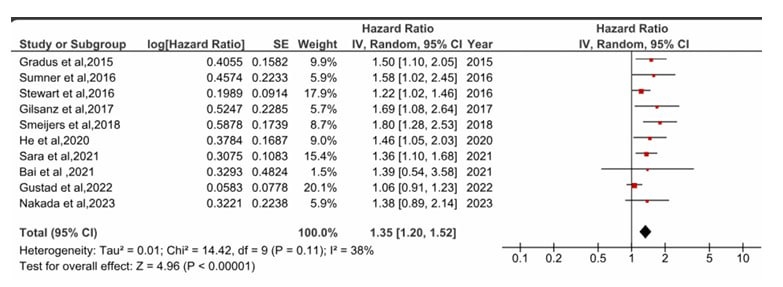
A total of ten studies (n=546,802) met inclusion criteria. The pooled hazard ratio for incident CHD (primarily myocardial infarction) in participants with anxiety versus without anxiety was 1.35 with a 95% confidence interval of 1.20–1.52 (p<0.001), indicating a significant association. Subgroup analysis identified generalized anxiety disorder and post-traumatic stress disorder as anxiety subtypes most strongly linked to higher CHD risk. Statistical heterogeneity was moderate (I2=39%, p=0.11). Most studies adjusted for traditional cardiovascular risk factors.

Conclusions
These findings provide strong evidence that anxiety disorders, particularly GAD and PTSD, are independently associated with higher CHD risk. Integrating mental health assessment with cardiovascular prevention could help identify modifiable risk factors. We conclude that addressing anxiety may be important in CHD prevention strategies.
  • Yadav, Sant  ( Corewell Health William Beaumont University Hospital , Royal Oak , Michigan , United States )
  • Yadav, Digraj  ( Maharajgunj Medical Campus , Lalitpur , Nepal )
  • Yadav, Manish  ( Maharajgunj Medical Campus , Lalitpur , Nepal )
  • Shah, Newton  ( Maharajgunj Medical Campus , Lalitpur , Nepal )
  • Bhandari, Kritick  ( KIST Medical College , Lalitpur , Nepal )
  • Joshi, Amir  ( SAINT VINCENT HOSPITAL , Worcester , Massachusetts , United States )
  • Verrill, Thomas  ( Corewell Health William Beaumont University Hospital , Royal Oak , Michigan , United States )
  • Author Disclosures:
    Sant Yadav: DO NOT have relevant financial relationships | Digraj Yadav: DO NOT have relevant financial relationships | Manish Yadav: No Answer | Newton Shah: DO NOT have relevant financial relationships | Kritick Bhandari: DO NOT have relevant financial relationships | Amir Joshi: DO NOT have relevant financial relationships | Thomas Verrill: No Answer
Meeting Info:

Scientific Sessions 2025

2025

New Orleans, Louisiana

Session Info:

A Potpourri of Cardiovascular Disease Prevention, Trends, and More

Monday, 11/10/2025 , 10:30AM - 11:30AM

Abstract Poster Board Session

More abstracts on this topic:
A novel reproducible low-cost model of acute myocardial infarction in swine

Li Yichen, Zheng Zilong, Tang Weijie, Chen Wangping, Yang Jinfu, Fan Chengming

A 50% or Greater Reduction in LDL-Cholesterol Is Associated with Improved Long-Term Outcomes and Lower Health Care Utilization After Myocardial Infarction - a SWEDEHEART study

Reitan Christian, Watanabe Alexandre, Bash Lori, Galvain Thibaut, Arnet Urs, Jernberg Tomas

More abstracts from these authors:
You have to be authorized to contact abstract author. Please, Login
Not Available