
Logo

American Heart Association

  14
  0


Final ID: MP672

Tissue-Transducer Contact Sensing Improves High-Intensity Ultrasound Catheter Ablation in Healthy Swine

Abstract Body (Do not enter title and authors here): Background:
High-intensity ultrasound (HIU) catheter ablation produces deeper lesions than radiofrequency and may serve as a new modality for interventricular septal (IVS) reduction in hypertrophic cardiomyopathy (HCM). A proprietary “contact sensing” algorithm was developed to confirm orientation of the side-facing transducer toward the IVS.

Hypothesis:
Contact sensing will improve HIU ablation efficacy, resulting in larger and more consistent IVS lesions.

Methods:
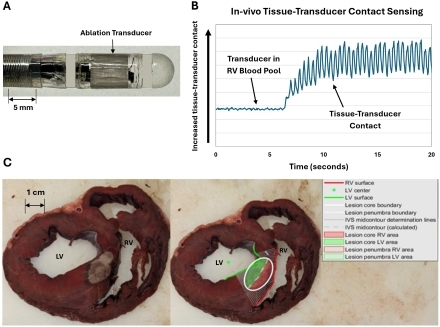
A total of 31 healthy swine underwent HIU catheter (Fig A) ablation via femoral venous access targeting the RV side of the IVS. In 13 of the 31 swine, continuous transducer-tissue contact was monitored to confirm tissue contact (Fig B) and optimize catheter positioning prior to ablation. Each swine underwent 8-16 HIU sonications. Animals were euthanized immediately post-ablation, and lesion presence, dimensions, volume, and location were assessed by gross pathology. Lesion metrics are reported as mean ± standard deviation. Group comparisons (with vs. without contact sensing) were performed using unpaired, two-tailed homoscedastic t-tests for continuous variables and chi-squared tests for categorical outcomes.

Results:
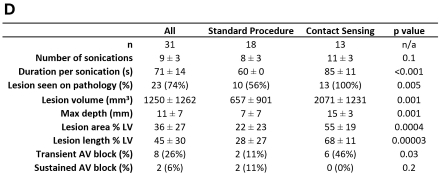
Contact sensing increased lesion volume from 657 ± 901 to 2071 ± 1230 mm3 (p=0.001) and lesion depth from 7 ± 7 mm to 15 ± 3 mm (p=0.001; Fig C,D). Spline analysis of gross pathology showed that the lesion area on the LV side of the IVS increased from 22 ± 23% without sensing to 55 ± 19% with sensing (p=0.0004; Fig C,D). Transient atrio-ventricular block occurred in both groups (Fig D) and resolved with catheter repositioning. Sustained AVB occurred in one swine without contact sensing.

Conclusion:
HIU transducer-tissue contact sensing significantly improved HIU ablation efficacy, producing larger, deeper, and more optimally located lesions for HCM septal reduction. Survival studies will confirm the degree of septal reduction.
  • Morris, Craig  ( University of Washington , Seattle , Washington , United States )
  • Arang, Naveed  ( University of Washington , Seattle , Washington , United States )
  • Dijour, Phoebe  ( Coridea , New York , New York , United States )
  • Thiel, Jeff  ( University of Washington , Seattle , Washington , United States )
  • Totten, Stephanie  ( University of Washington , Seattle , Washington , United States )
  • Wang, Yak-nam  ( University of Washington , Seattle , Washington , United States )
  • Giraud, David  ( University of Washington , Seattle , Washington , United States )
  • Nazer, Babak  ( University of Washington , Seattle , Washington , United States )
  • Author Disclosures:
    Craig Morris: DO NOT have relevant financial relationships | Naveed Arang: No Answer | Phoebe Dijour: No Answer | Jeff Thiel: DO have relevant financial relationships ; Consultant:Sonomotion :Active (exists now) | Stephanie Totten: DO NOT have relevant financial relationships | Yak-Nam Wang: No Answer | David Giraud: No Answer | Babak Nazer: DO NOT have relevant financial relationships
Meeting Info:

Scientific Sessions 2025

2025

New Orleans, Louisiana

Session Info:

The ECG and Beyond: The Expanding Role of Imaging in Electrophysiology

Saturday, 11/08/2025 , 12:15PM - 01:30PM

Moderated Digital Poster Session

More abstracts on this topic:
Catheter Ablation versus Antiarrhythmic Drugs for Ventricular Tachycardia: A Systematic Review and Meta-Analysis

Patel Palak, Shahid Sufyan, Tabassum Shehroze, Ali Muhammad Abdullah, Alam Umama, Ejaz Zoya, Iqbal Minahil, Jain Hritvik, Khalid Salman

Artificial Intelligence-based screening for Hypertrophic Cardiomyopathy from Single-lead Electrocardiograms: A Multinational Development and Validation Study

Croon Philip, Aminorroaya Arya, Pedroso Aline, Dhingra Lovedeep, Khera Rohan

More abstracts from these authors:
Multi-Modality Imaging in Giant Cell Myocarditis

Chiang Joey, Yadava Mrinal, Ferencik Maros, Nazer Babak

Clinical Features and Prognosis of FDG-avid Genetic Cardiomyopathies

Bevan Graham, Llamas Valle Yovani, Johnson Bryce, Cheng Richard, Nazer Babak

You have to be authorized to contact abstract author. Please, Login
Not Available