
Logo

American Heart Association

  21
  0


Final ID: MP767

Closing the Gap: Improved Survival with Early Catheter Ablation in Sustained VT – A Multicenter Real-World Study

Abstract Body (Do not enter title and authors here): Background:
Catheter ablation is guideline-recommended for sustained ventricular tachycardia (VT) in patients with structural heart disease, yet real-world utilization and effectiveness remain underexplored.

Objective:
To assess the utilization and clinical outcomes of VT ablation compared to conservative management among hospitalized patients with sustained VT and structural heart disease.

Methods:
Using the TriNetX Research Network, we identified adults hospitalized with sustained VT and underlying structural heart disease from 2019 to 2024. Of 15,808 eligible patients, 2,446 (15.5%) underwent VT ablation during the index hospitalization. An additional 10 patients received ablation within 90 days post-discharge but were included in the non-ablation cohort for analysis. After 1:1 propensity score matching based on demographics, comorbidities, and clinical variables, 2,417 well-balanced patients per group were analyzed. The primary outcome was 30-day hospital readmission. Secondary outcomes included all-cause mortality at 30, 90, and 180 days. Kaplan-Meier survival analysis and Cox proportional hazards models were used.

Results:
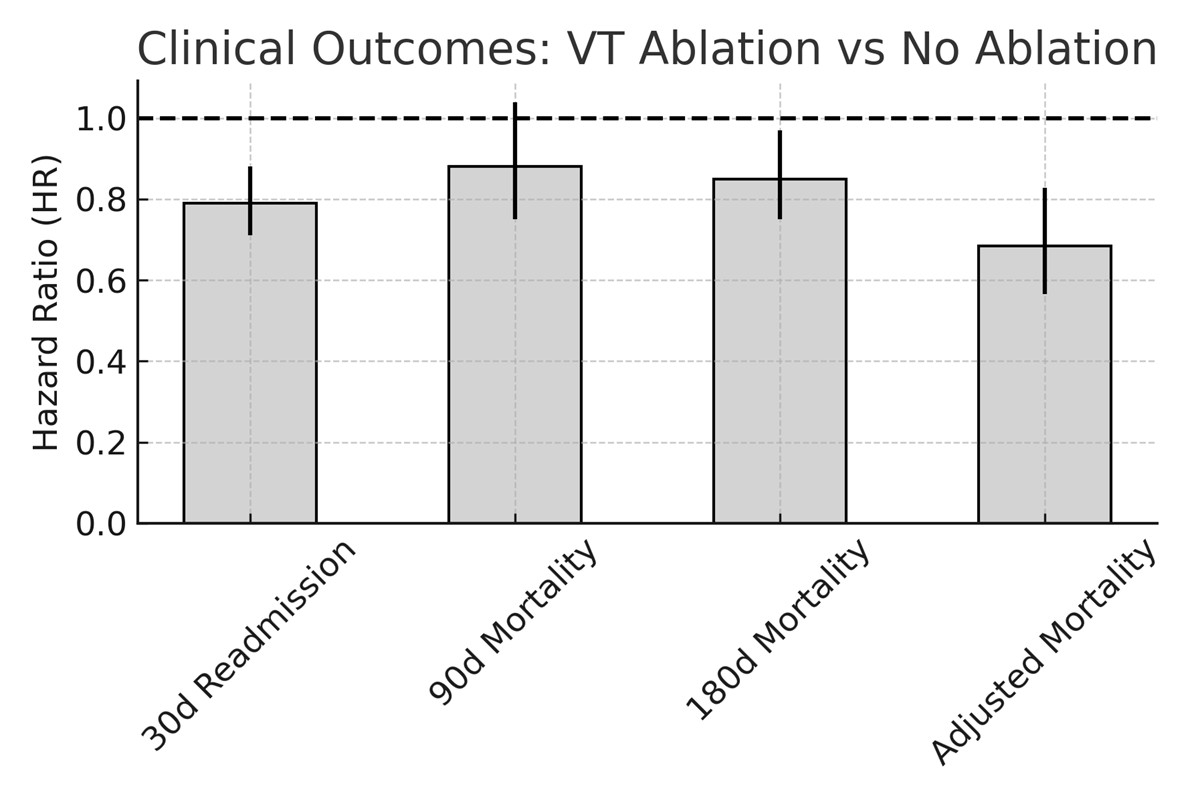
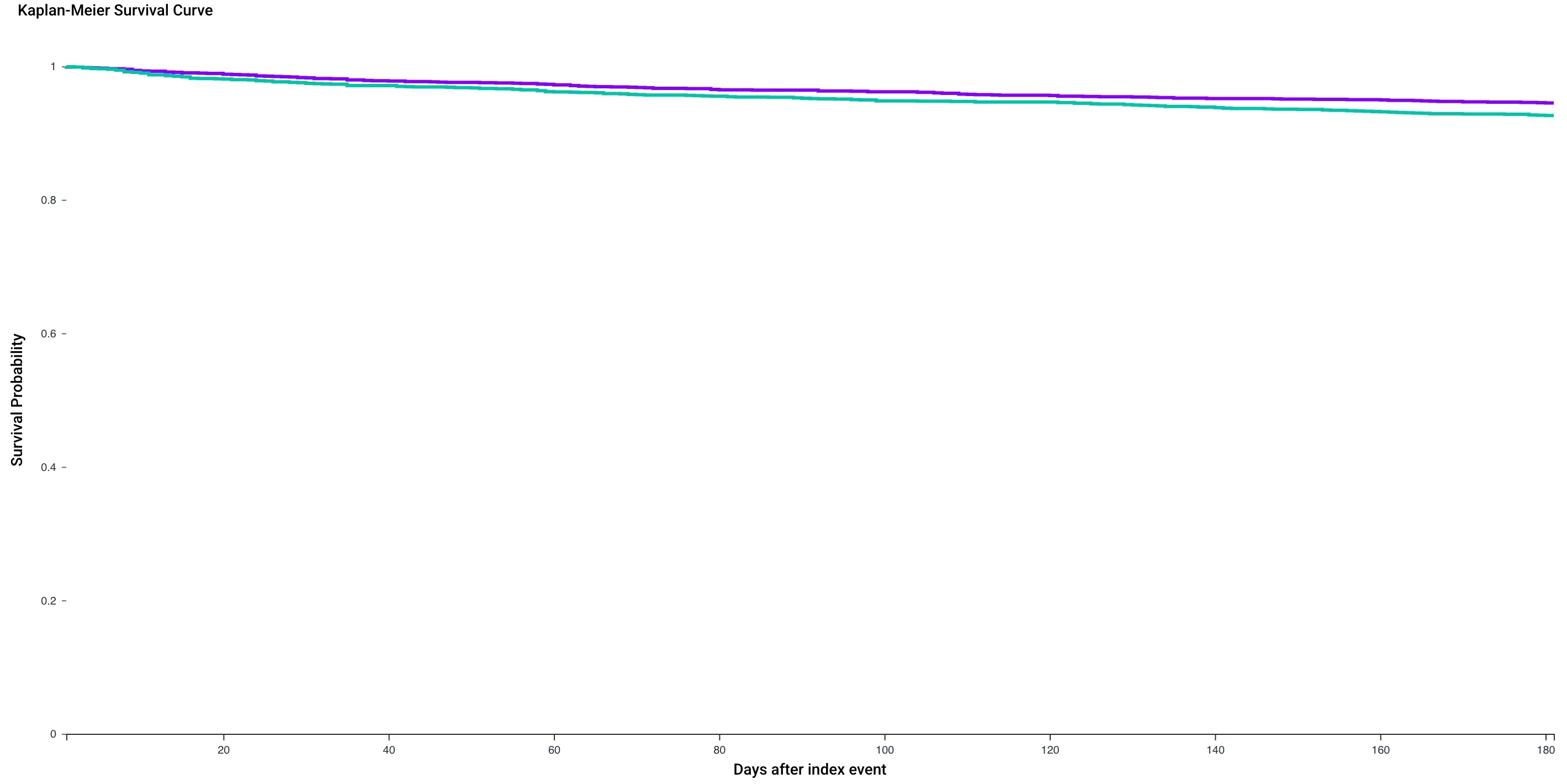
VT ablation was associated with a significantly lower risk of 30-day readmission (HR 0.79; 95% CI 0.71–0.88; p<0.001). No significant difference in 90-day mortality was observed (HR 0.88; 95% CI 0.75–1.04; p=0.13). However, at 180 days, ablation was linked to improved survival (HR 0.85; 95% CI 0.75–0.97; p=0.016). In a fully adjusted Cox regression model, ablation was independently associated with reduced overall mortality (HR 0.684; 95% CI 0.565–0.828; p<0.0001). Kaplan-Meier curves demonstrated a sustained survival advantage for the ablation group over 180 days.

Conclusion:
Despite strong guideline support, catheter ablation remains underutilized in hospitalized patients with sustained VT and structural heart disease. In this large, real-world cohort, VT ablation was independently associated with reduced readmissions and improved long-term survival. These findings support a broader adoption of ablation in appropriate patients.
  • Napon, Geoffroy  ( UnityPoint Health Des Moines , Des Moines , Iowa , United States )
  • Roy, Shubha Deep  ( The Iowa Clinic , Urbandale , Iowa , United States )
  • Jain, Varun  ( Trinity Health of New England , Avon , Connecticut , United States )
  • Huebner, Miranda  ( UnityPoint Health Des Moines , Des Moines , Iowa , United States )
  • Wolfe, Brandon  ( UnityPoint Health Des Moines , Des Moines , Iowa , United States )
  • Gupta, Tejasva  ( Armed Forces Medical College , Pune , India )
  • Aiyer, Aishwarya  ( Armed Forces Medical College , Pune , India )
  • Rayapureddi, Karthik  ( Armed Forces Medical College , Pune , India )
  • Author Disclosures:
    Geoffroy Napon: DO NOT have relevant financial relationships | SHUBHA DEEP ROY: DO NOT have relevant financial relationships | Varun Jain: No Answer | Miranda Huebner: No Answer | Brandon Wolfe: No Answer | Tejasva Gupta: No Answer | Aishwarya Aiyer: DO NOT have relevant financial relationships | Karthik Rayapureddi: DO NOT have relevant financial relationships
Meeting Info:

Scientific Sessions 2025

2025

New Orleans, Louisiana

Session Info:

Treatment of Arrhythmias: Ablation

Saturday, 11/08/2025 , 12:15PM - 01:10PM

Moderated Digital Poster Session

More abstracts on this topic:
You have to be authorized to contact abstract author. Please, Login
Not Available