
Logo

American Heart Association

  19
  0


Final ID: 4360601

Body Mass Index, Diastolic Blood Pressure, and Hypertrophic Cardiomyopathy Polygenic Background Differentially Modify Hypertrophic Cardiomyopathy Risk

Abstract Body (Do not enter title and authors here): Background: Hypertrophic cardiomyopathy (HCM) risk is incompletely explained by pathogenic variants and polygenic background. Mendelian randomization studies have implicated body mass index (BMI) as a modifiable risk factor for HCM in individuals with a pathogenic HCM variant (‘genotype-positive’; G+) and in those without (‘genotype-negative’; G-), and diastolic blood pressure (DBP) as a modifiable risk factor for genotype-negative HCM only.

Research Questions: How do BMI, DBP, and HCM polygenic risk influence HCM diagnoses and echocardiographic endophenotypes by genotype status?

Methods: Penn Medicine BioBank participants with and without HCM were identified using electronic health records. G+ participants carried pathogenic variants in definitive HCM genes. To avoid confounding, BMI and DBP were represented by polygenic scores (PGSs). PGSs for BMI, DBP, and common variant HCM risk were identified from the PGS Catalog (IDs PGS004150, PGS004604, PGS004910). Stratifying by pathogenic variant status (G+/G-), we tested PGS associations with HCM status with logistic regression. We evaluated their associations with interventricular septal thickness and left ventricular ejection fraction (EF) on echocardiogram using linear regression. Models included age and sex as covariates. Formal interaction testing between each PGS and monogenic variant status was performed.

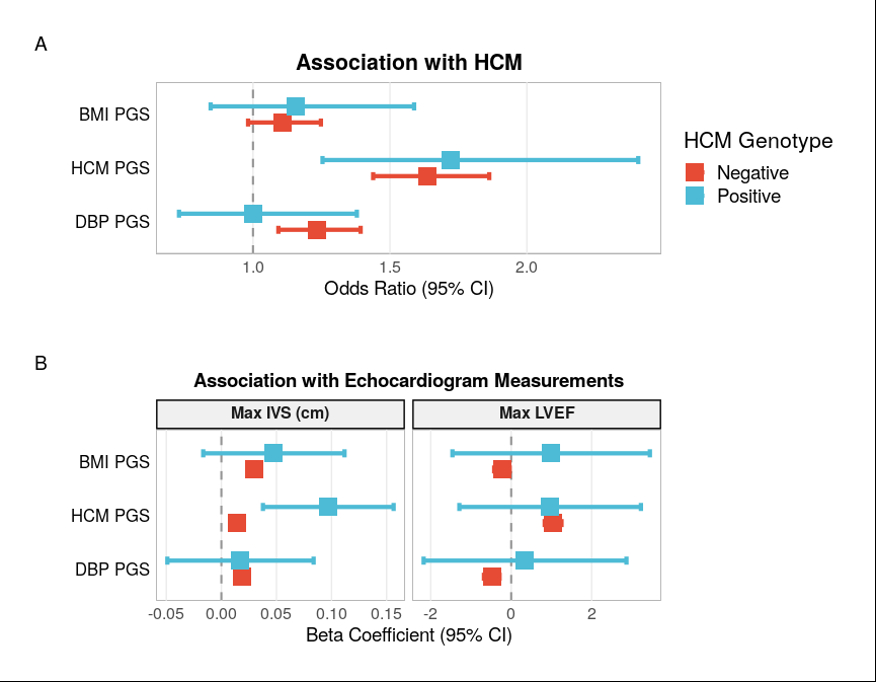
Results: Among 32,615 unrelated participants, 363 (1.1%) were diagnosed with HCM. G+ status conferred a 58-fold increased HCM risk (p=2.6x10-135). Estimated associations between BMI and HCM PGSs and HCM were positive regardless of pathogenic variant status (p<0.05 for HCM PGS only); DBP was associated with HCM only among G- individuals (OR 1.63; 95% CI 1.09 to 1.39; p=7.0x10⁻⁴; Figure 1A). All PGSs were positively associated with septal thickness, a defining feature of HCM (Figure 1B). A significant (p<0.05) interaction term was observed between monogenic and polygenic HCM risk. DBP and BMI PGSs were negatively associated with EF among G- individuals, discordant with the typical HCM phenotype (Figure 1B).

Conclusions: Increased polygenic BMI, DBP, and HCM risk may promote septal thickening. The interaction between HCM PGS and variant carrier status suggests a synergistic role of common- and rare-variation directly related to HCM. In contrast, DBP appears to modify the risk of genotype-negative disease only. These findings suggest distinct roles of modifiable risk factors in G- and G+ HCM.
  • Abramowitz, Sarah  ( University of Pennsylvania , Philadelphia , Pennsylvania , United States )
  • Levin, Michael  ( University of Pennsylvania , Philadelphia , Pennsylvania , United States )
  • Hoffman-andrews, Lily  ( University of Pennsylvania , Philadelphia , Pennsylvania , United States )
  • Zhang, David  ( Perelman School of Medicine , Philadelpha , Pennsylvania , United States )
  • Judy, Renae  ( University of Pennsylvania , Philadelphia , Pennsylvania , United States )
  • Cappola, Thomas  ( University of Pennsylvania , Philadelphia , Pennsylvania , United States )
  • Day, Sharlene  ( University of Pennsylvania , Philadelphia , Pennsylvania , United States )
  • Reza, Nosheen  ( University of Pennsylvania , Philadelphia , Pennsylvania , United States )
  • Owens, Anjali  ( University of Pennsylvania , Wallingford , Pennsylvania , United States )
  • Damrauer, Scott  ( University of Pennsylvania , Philadelphia , Pennsylvania , United States )
  • Author Disclosures:
    Sarah Abramowitz: DO NOT have relevant financial relationships | Michael Levin: DO have relevant financial relationships ; Research Funding (PI or named investigator):MyOme:Active (exists now) ; Consultant:BridgeBio:Active (exists now) | Lily Hoffman-Andrews: No Answer | David Zhang: DO NOT have relevant financial relationships | Renae Judy: No Answer | Thomas Cappola: DO NOT have relevant financial relationships | Sharlene Day: DO have relevant financial relationships ; Consultant:Lexicon Pharmaceuticals:Active (exists now) ; Research Funding (PI or named investigator):BMS:Active (exists now) ; Consultant:Solid Biosciences:Active (exists now) ; Advisor:Cytokinetics:Active (exists now) ; Research Funding (PI or named investigator):Lexicon Pharmaceuticals:Active (exists now) | Nosheen Reza: DO have relevant financial relationships ; Consultant:Zoll:Past (completed) ; Research Funding (PI or named investigator):Bristol Myers Squibb:Active (exists now) ; Advisor:Novo Nordisk:Past (completed) ; Advisor:Idorsia:Past (completed) ; Advisor:AstraZeneca:Past (completed) ; Advisor:Bristol Myers Squibb:Active (exists now) ; Advisor:American Regent:Past (completed) ; Advisor:Roche:Active (exists now) | Anjali Owens: DO have relevant financial relationships ; Consultant:Alexion:Active (exists now) ; Consultant:Stealth:Active (exists now) ; Consultant:Corvista:Active (exists now) ; Consultant:Tenaya:Active (exists now) ; Consultant:Lexeo:Active (exists now) ; Consultant:Imbria:Active (exists now) ; Consultant:Edgewise:Active (exists now) ; Consultant:Cytokinetics:Active (exists now) ; Consultant:Avidity:Active (exists now) ; Consultant:BMS:Active (exists now) ; Consultant:Biomarin:Active (exists now) ; Consultant:Bayer:Active (exists now) | Scott Damrauer: DO have relevant financial relationships ; Researcher:Amgen:Active (exists now) ; Consultant:Tourmaline:Past (completed) ; Researcher:Novo Nordisk:Active (exists now)
Meeting Info:

Scientific Sessions 2025

2025

New Orleans, Louisiana

Session Info:

Hypertrophic Cardiomyopathy Medical Society Oral Abstracts

Friday, 11/07/2025 , 02:30PM - 03:45PM

Abstract Oral Session

More abstracts on this topic:
Combining Monogenic and Polygenic Analysis Improves Sudden Cardiac Death Risk Prediction

Monroe Tanner, Pesce Lorenzo, Kearns Samuel, Dellefave-castillo Lisa, Webster Gregory, Puckelwartz Megan, Mcnally Elizabeth

4-Phenylbutyric Acid Reduces Endoplasmic Reticulum Retention and Partially Restores Function of LDLR p.D622N Mutation In Vitro: A Potential Therapy for Hypercholesterolemia

Wang Yongxiang, Zhang Piyi, Bai Ming, Zhang Zheng

More abstracts from these authors:
Genome-wide vQTL Analysis of Blood Lipid Traits

Mimouni Nour, Judy Renae, Levin Michael, Damrauer Scott

A Hypertrophic Cardiomyopathy Polygenic Score Modifies Penetrance of Pathogenic Hypertrophic and Dilated Cardiomyopathy Variants in Opposite Directions

Abramowitz Sarah, Hoffman-andrews Lily, Depaolo John, Judy Renae, Owens Anjali, Damrauer Scott, Levin Michael

You have to be authorized to contact abstract author. Please, Login
Not Available