
Logo

American Heart Association

  120
  0


Final ID: MDP49

A Hypertrophic Cardiomyopathy Polygenic Score Modifies Penetrance of Pathogenic Hypertrophic and Dilated Cardiomyopathy Variants in Opposite Directions

Abstract Body (Do not enter title and authors here): Background
Hypertrophic (HCM) and dilated (DCM) cardiomyopathy have been postulated to represent morphologically opposing cardiac disease traits, with genetic pathways implicated in HCM demonstrating inverse relationships with DCM. The degree to which polygenic risk for HCM protects from DCM in individuals at genetic risk of DCM remains unexplored.
Research Question
Is polygenic risk for HCM protective against developing DCM in carriers of titin truncating variants?
Methods
Associations between polygenic risk for HCM, monogenic variants, and cardiomyopathy outcomes were modeled among Penn Medicine BioBank (PMBB) participants genetically similar to European reference populations using logistic regression. Polygenic risk for HCM was determined using a previously published HCM polygenic score (PGS; PGS Catalog PGS000739; Harper et al. 2021); scores were PCA adjusted, and the mean and variance were normalized using pgsc_calc. Pathogenic variants in definitive HCM genes were identified using ACMG criteria. Titin truncating variants in high percentage spliced in exons (TTNtv) were considered pathogenic. HCM and DCM outcomes were assigned based on diagnosis codes +/- clinical notes in the electronic health record.
Results
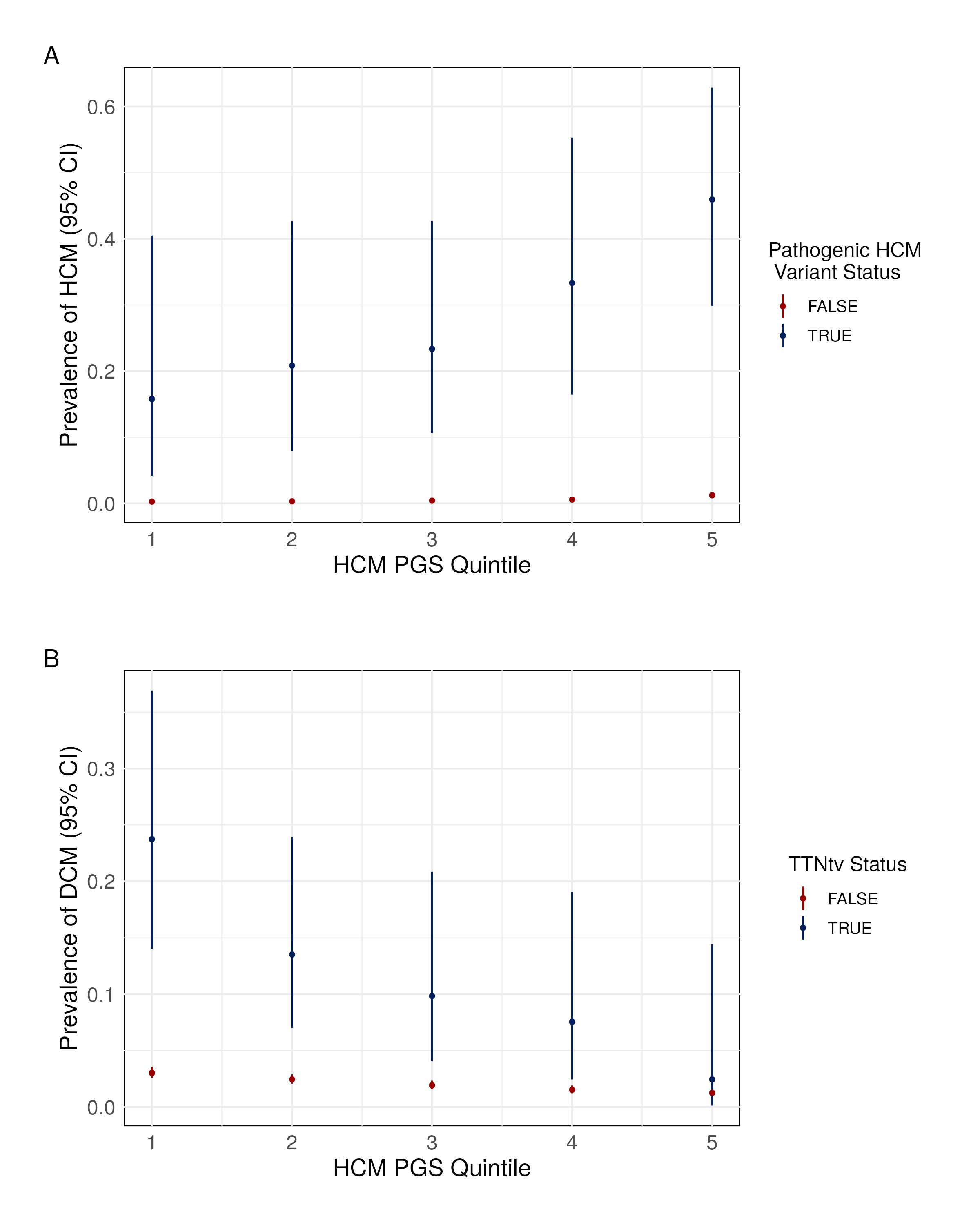
Of 26,728 PMBB participants, 205 (0.77%) had HCM and 589 (2.2%) had DCM. 289 had a TTNtv, and 144 had a pathogenic HCM variant. Pathogenic HCM variant status (n=144) conferred a 76-fold increase in HCM risk (p=1.8 e-87). A one standard deviation change in HCM PGS had a significant positive association with HCM (OR 1.6; p=1.5e-9) and negative association with DCM (OR 0.72; p=1.e-12). TTNtv status (n=289) was associated with an increased risk of DCM (OR 5.0; p=1.4e-12). An interaction term between TTNtv status and HCM PGS had a negative association with DCM (OR 0.61; p=4.5e-2). Among the top HCM PGS quintile, there was no statistically significant difference in DCM risk between those with and without TTNtv (Figure 1).
Conclusions
These results provide additional evidence that HCM and DCM are influenced by polygenic background. We observe that polygenic risk of HCM additively increases risk of HCM among pathogenic HCM variant carriers and may synergistically protect from DCM among TTNtv carriers.
  • Abramowitz, Sarah  ( University of Pennsylvania , Philadelphia , Pennsylvania , United States )
  • Hoffman-andrews, Lily  ( University of Pennsylvania , Philadelphia , Pennsylvania , United States )
  • Depaolo, John  ( University of Pennsylvania , Philadelphia , Pennsylvania , United States )
  • Judy, Renae  ( University of Pennsylvania , Philadelphia , Pennsylvania , United States )
  • Owens, Anjali  ( University of Pennsylvania , Philadelphia , Pennsylvania , United States )
  • Damrauer, Scott  ( University of Pennsylvania , Philadelphia , Pennsylvania , United States )
  • Levin, Michael  ( University of Pennsylvania , Philadelphia , Pennsylvania , United States )
  • Author Disclosures:
    Sarah Abramowitz: DO NOT have relevant financial relationships | Lily Hoffman-Andrews: No Answer | John Depaolo: DO NOT have relevant financial relationships | Renae Judy: No Answer | Anjali Owens: DO have relevant financial relationships ; Consultant:BMS:Active (exists now) ; Consultant:corvista:Active (exists now) ; Consultant:stealth:Active (exists now) ; Consultant:Edgewise:Active (exists now) ; Consultant:Alexion:Active (exists now) ; Consultant:Lexicon:Active (exists now) ; Consultant:Lexeo:Active (exists now) ; Consultant:Tenaya:Active (exists now) ; Consultant:biomarin:Active (exists now) ; Consultant:Cytokinetics:Active (exists now) | Scott Damrauer: DO have relevant financial relationships ; Researcher:Amgen:Active (exists now) ; Consultant:Tourmaline:Past (completed) ; Researcher:Novo Nordisk:Active (exists now) | Michael Levin: DO have relevant financial relationships ; Research Funding (PI or named investigator):MyOme:Active (exists now) ; Consultant:BridgeBio:Active (exists now)
Meeting Info:

Scientific Sessions 2024

2024

Chicago, Illinois

Session Info:

Latest Advances in Human Genetics and Genomics

Saturday, 11/16/2024 , 12:50PM - 02:15PM

Moderated Digital Poster Session

More abstracts on this topic:
A functional survey of postnatal heart maturation with in vivo Perturb-seq in spatial and temporal resolution

Wang Haofei, Liu Jiandong, Dong Yanhan, Shi Huitong, Colon Marazzano, Liu Xingyan, Farber Gregory, Qian Yunzhe, Anthony Nicholas, Qian Li

Shared Genetic Burden of Ischemic and Non-Ischemic Dilated Cardiomyopathy

Cao Louie, Rushakoff Joshua, Zhang Zijun, Williamson Ian, Karlstaedt Anja, Kittleson Michelle, Czer Lawrence, Kransdorf Evan

More abstracts from these authors:
Body Mass Index, Diastolic Blood Pressure, and Hypertrophic Cardiomyopathy Polygenic Background Differentially Modify Hypertrophic Cardiomyopathy Risk

Abramowitz Sarah, Levin Michael, Hoffman-andrews Lily, Zhang David, Judy Renae, Cappola Thomas, Day Sharlene, Reza Nosheen, Owens Anjali, Damrauer Scott

Genome-wide vQTL Analysis of Blood Lipid Traits

Mimouni Nour, Judy Renae, Levin Michael, Damrauer Scott

You have to be authorized to contact abstract author. Please, Login
Not Available