Agbaje’s Waist-to-Height Ratio Estimated Fat Mass Pediatric Cutoff Predicts Elevated Blood Pressure Risk in Multi-racial US Children and Adolescents
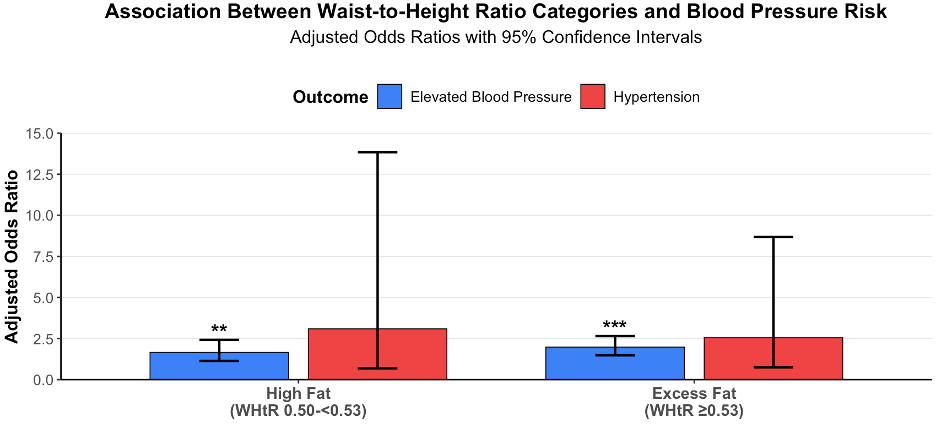
Abstract Body (Do not enter title and authors here): Background: Body mass index (BMI) masks physiologic lean mass versus pathologic fat mass effects on blood pressure (BP) in youth. Elevated BP in adolescents predicts premature cardiac damage. While dual-energy X-ray absorptiometry (DXA) is the gold standard for fat mass assessment, it is costly and inaccessible. BMI has 65% agreement with DXA-measured fat mass, while waist-to-height ratio (WHtR) demonstrates 89% agreement with DXA-measured total and trunk fat. New WHtR cutoffs predicting normal, high, and excess fat have been proposed in pediatrics (https://urfit-child.com/waist-height-calculator/). Whether these WHtR cutoffs predict elevated BP and hypertension risk in youth remains unclear. Methods: We included 1,886 multi-racial US participants (mean age 14.7±4.5 years) from NHANES 2021-2023 with complete data for three BP measurements, waist circumference, and height. WHtR categories: normal fat (0.40-<0.50 males, 0.40-<0.51 females), high fat (0.50-<0.53 males, 0.51-<0.54 females), excess fat (≥0.53 males, ≥0.54 females). Elevated BP (≥120/70 mmHg) and hypertension (≥140/90 mmHg) risk assessed using logistic regression, adjusted for age, sex, education, smoking, race, sedentary time, moderate physical activity, fasting total cholesterol, and high-sensitivity C-reactive protein. Results: Among 1,886 participants (47.9% non-Hispanic White, 17.0% other/multi-racial, 13.3% non-Hispanic Black, 12.0% Mexican American, 9.8% other Hispanic), mean WHtR was 0.51±0.1. Distribution: 607 (32.2%) excess fat, 184 (9.8%) high fat, 1,095 (58.1%) normal fat. Unadjusted analyses showed high fat and excess fat WHtR categories associated with higher SBP versus normal fat (high fat: 1.70 mmHg [95% CI 0.65-2.75], p=0.043; excess fat: 1.27 mmHg [0.22-2.32], p=0.02), attenuated after adjustment. Elevated BP prevalence was 27%; hypertension 1%. Relative to normal fat, high-fat WHtR predicted elevated BP risk (adjusted OR 1.66 [1.14-2.42], p=0.009); excess fat showed a stronger association (adjusted OR 1.98 [1.48-2.65], p<0.001). Hypertension associations attenuated after adjustment due to low prevalence. Conclusions: New WHtR pediatric adiposity cutoffs effectively identified youth at increased risk of elevated BP who are likely to progress to hypertension. These findings support the utility of WHtR as a universal, cheap, and easily accessible preventive and clinical tool for cardiovascular risk stratification in youth.
Corsi, Douglas
(
Rugters Robert Wood Johnson
, New Brunswick , New Jersey , United States )
Agbaje, Andrew
(
University of Eastern Finland
, Kuopio , Finland )
Author Disclosures:
Douglas Corsi:DO NOT have relevant financial relationships
| Andrew Agbaje:DO have relevant financial relationships
;
Research Funding (PI or named investigator):Novo Nordisk Foundation:Active (exists now)