Cardiovascular Health and Cardiovascular Disease Risk: Trends and Projections to 2040
Abstract Body (Do not enter title and authors here): Background: Along with the advent of the second century of the American Heart Association, two novel metrics have emerged to advance cardiovascular health: Life’s Essential 8 (LE8) and the Predicting Risk of CVD EVENTs (PREVENT) calculator. LE8 characterizes cardiovascular health over four health behaviors (diet, physical activity, sleep and nicotine exposure) and four health factors (weight, blood lipids, blood glucose, and blood pressure). The PREVENT calculator predicts 10-year risk of cardiovascular disease using updated cardio-kidney-metabolic health variables. Both metrics hold promise for improving health in the United States; however, current and future trends of these metric are unclear.
Purpose: We aimed to evaluate recent trends and estimate future projections in LE8 and PREVENT.
Approach: We used data from the National Health and Nutrition Examination Survey (NHANES) study from 2009-2018. Participants ≥20 years with no prior atherosclerotic cardiovascular disease were eligible. PREVENT 10-year risk and LE8 scores were calculated according to AHA guidelines and analyzed as continuous measures. PREVENT scores were also grouped into low (<7.5%) or high (>7.5%) risk. Variance-weighted linear regression was implemented to evaluate trends in the continuous scores. To estimate outcomes through 2040, projections assumed that trends would continue at the same rate. For PREVENT categories, logistic models were used with category prevalence as the outcome and survey year, age, sex and race/ethnicity as the predictors. Future prevalences were estimated from the model and combined with projected population counts estimated by the U.S. Census Bureau.
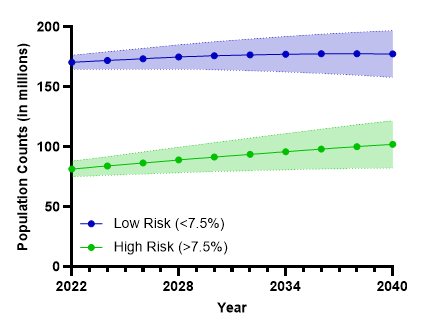
Results: A total of 20101 participants were included (46.0±16.3 years, 52.1% women, 66.9% Caucasian). PREVENT increased (β 0.28, 95%CI:0.15-0.41, p<0.001) and LE8 scores decreased (β -0.21, 95%CI:-0.35- -0.07, p=0.002) with time. This resulted in a projected 30.4% increase in PREVENT (95%CI: 17.2-42.8) and a 3.3% decrease (95%CI: 1.2-5.5) in LE8 scores from 2018 to 2040. An estimated 102.2 million U.S. adults (95%CI: 82.4-122.0) will have high PREVENT risk in 2040, or 36.5% (95%CI: 34.3-38.2) of the adult population (Figure).
Conclusions: Projected trends indicates that more than 1 in 3 U.S. adults will have high cardiovascular risk by 2040, accompanied by declining overall cardiovascular health. These present results suggest a dire need for improvements in promotion, monitoring and management strategies.
Scheuermann, Britton
( Kansas State University
, Manhattan
, Kansas
, United States
)
Fenn, Sarah
( Kansas State University
, Manhattan
, Kansas
, United States
)
Morrison, Kristina
( Kansas State University
, Manhattan
, Kansas
, United States
)
Ade, Carl
( KANSAS STATE UNIVERSITY
, Manhattan
, Kansas
, United States
)
Author Disclosures:
Britton Scheuermann:DO NOT have relevant financial relationships
| Sarah Fenn:DO NOT have relevant financial relationships
| Kristina Morrison:DO NOT have relevant financial relationships
| Carl Ade:DO NOT have relevant financial relationships