Logo

American Heart Association

  18
  0


Final ID: Sa4036

The Effects of Autoimmune Rheumatic Diseases on the Development of Clonal Hematopoiesis

Abstract Body (Do not enter title and authors here): Background: Observational studies have proposed that genetic susceptibility to autoimmune rheumatic disease predisposes to the development of clonal hematopoiesis of indeterminate potential (CHIP), which may exacerbate cardiovascular risk associated with both conditions. However, it remains unknown if these two distinct conditions are causally related or stem from risk factors common to both etiologies.

Purpose: We aimed to determine the causal association between three rheumatic diseases – rheumatoid arthritis (RA), systemic lupus erythematosus (SLE), and ankylosing spondylitis (AS) - and CHIP.

Approach: Two-sample Mendelian randomization using publicly available summary statistics from genome-wide association studies allows for the investigation of causal relationships between variables, if all assumptions are sufficiently met. We selected 3 rheumatic disease exposures – RA (5427 cases; 479171 controls), SLE (647 cases; 482264 controls), and AS (1296 cases; 461637 controls). Our primary outcome was overall CHIP (10203 cases; 173918 controls). We additionally assessed CHIP gene subtypes, namely DNMT3A (5185 cases; 173918 controls) and TET2 (2042 cases; 173918 controls). Analyses were conducted with inverse-weighted variance methods. Additional sensitivity analyses used weighted median and Mendelian Randomization Pleiotropy RESidual Sum and Outlier (MR-PRESSO) methods. Results are presented as odds ratios (OR) and 95% confidence intervals (95%CI).

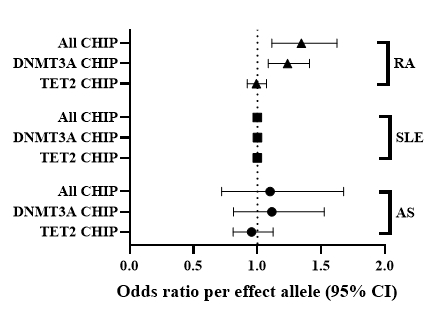
Results: Of the three selected rheumatic diseases, only RA was associated with a greater risk of overall CHIP (OR 1.34, 95%CI: 1.11-1.62, p=0.002). This finding was robustly supported by weighted median (p<0.001) and MR-PRESSO (p=0.013) results. Similar results were observed in analyses specific to DNMT3A CHIP (Figure). Only RA was significantly associated with an increased risk (OR 1.24, 95%CI: 1.09-1.41, p=0.001), again supported by weighted median (p=0.011) and MR-PRESSO analyses (p=0.011). Conversely, SLE was associated with a reduced risk of TET2 CHIP in inverse-variance weighted (p=0.028) and MR-PRESSO (p=0.015) models.

Conclusions: Our findings suggest that RA, one of the most common rheumatic diseases in the U.S., is associated with greater risk for overall CHIP and the DNMT3A CHIP subtype. The development of CHIP in the RA population may contribute to their greater cardiovascular disease risk. Further investigation is needed to understand the clinical implications of CHIP in rheumatic diseases.
  • Scheuermann, Britton  ( Kansas State University , Manhattan , Kansas , United States )
  • Morrison, Kristina  ( Kansas State University , Manhattan , Kansas , United States )
  • Fenn, Sarah  ( Kansas State University , Manhattan , Kansas , United States )
  • Ade, Carl  ( KANSAS STATE UNIVERSITY , Manhattan , Kansas , United States )
  • Author Disclosures:
    Britton Scheuermann: DO NOT have relevant financial relationships | Kristina Morrison: DO NOT have relevant financial relationships | Sarah Fenn: DO NOT have relevant financial relationships | Carl Ade: DO NOT have relevant financial relationships
Meeting Info:

Scientific Sessions 2025

2025

New Orleans, Louisiana

Session Info:

Genomic Insights into Cardiac Valve and Aortic Disease

Saturday, 11/08/2025 , 10:30AM - 11:30AM

Abstract Poster Board Session

More abstracts on this topic:
A Spatially Resolved Transcriptomic Signature of Atherosclerotic Plaque Stabilization and Regression

Persaud Luis, Lin Li-hsien, Weiss Robert, Kutschke William, Streeter Jennifer

A CRISPR-Activation CROP-seq Screen Identifies HMGN1 as a Dosage-Sensitive Regulator of Heart Defects in Down Syndrome

Ranade Sanjeev, Mital Rahul, Boileau Ryan, Koback Frances, Padmanabhan Arun, Merriman Alexander, Wallace Langley, Nguyen Annie, Poulis Nikolaus, Gifford Casey, Pollard Katherine, Li Feiya, Srivastava Deepak, Whalen Sean, Angelo Pelonero, Ye Lin, Huang Yu, Brand Abigail, Nishino Tomohiro, Costa Mauro

More abstracts from these authors:
You have to be authorized to contact abstract author. Please, Login
Not Available