
Logo

American Heart Association

  20
  0


Final ID: MP653

Atrial Fibrillation Ablation Outcomes by Hospital Academic Status: A Nationwide Comparative Analysis using TriNetX Registry

Abstract Body (Do not enter title and authors here): Background:
Atrial fibrillation (Afib) is the most prevalent arrhythmia worldwide and catheter ablation has been established as an effective treatment modality. The outcomes can vary based on medical expertise and location of the procedure. This study evaluates the differences in outcomes of catheter ablation performed at non-academic compared to academic institutions.

Methods:
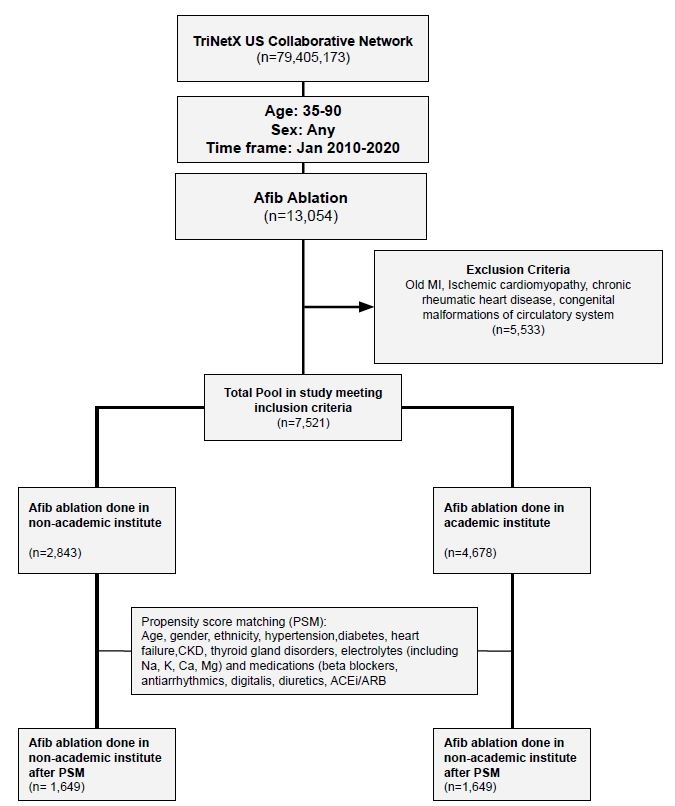
A retrospective cohort study was conducted using the TriNetX US Collaborative Network. Adults (35–90 years), who underwent Afib ablation between Jan 1, 2010 to Jan 1, 2020 were included. Those with congenital malformations of circulatory system, rheumatic heart disease, ischemic cardiomyopathy, or prior myocardial infarction (MI) were excluded. Groups were stratified by hospital academic status and balanced using 1:1 propensity score matching. Outcomes were assessed within 365 days post-ablation. Patients with outcome prior to the time window were excluded and odds ratio was used for statistical comparisons with significance set at p<0.05.

Results:
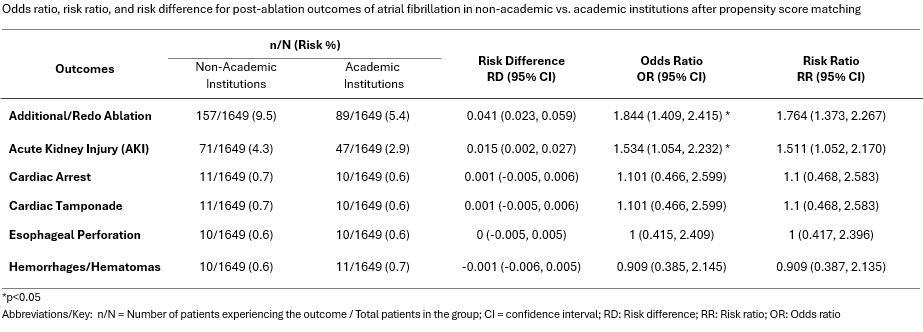
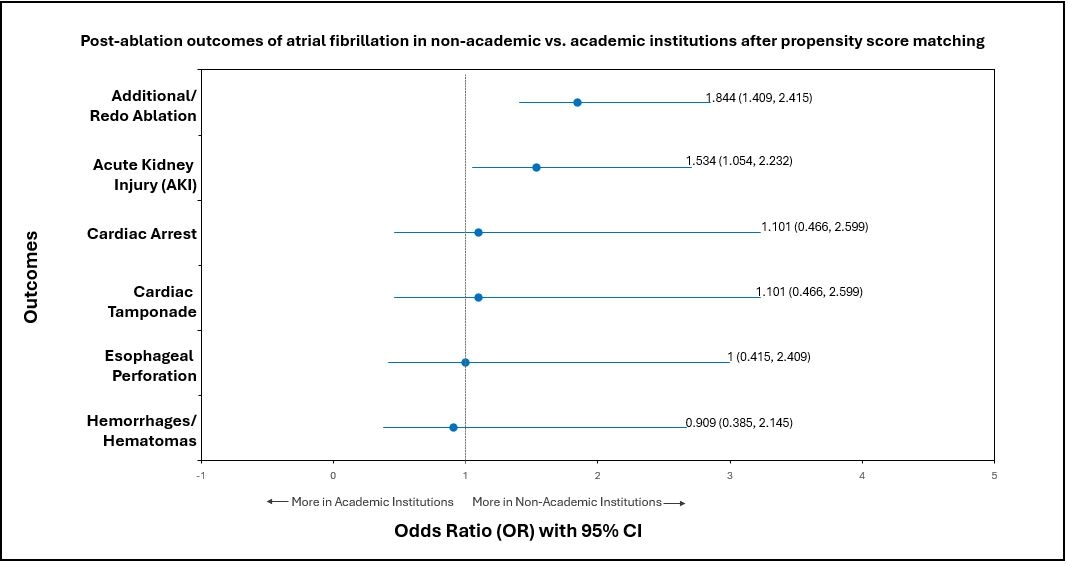
Following propensity score matching, the analysis revealed that patients undergoing atrial fibrillation ablation at non-academic institutions had significantly higher odds of requiring additional or redo ablation (OR: 1.844; 95% CI: 1.409–2.415) and developing acute kidney injury (OR: 1.534; 95% CI: 1.054–2.232) compared to those treated at academic institutions. Other post-ablation complications, including cardiac arrest (OR: 1.101; 95% CI: 0.466–2.599), cardiac tamponade (OR: 1.101; 95% CI: 0.466–2.599), esophageal perforation (OR: 1.000; 95% CI: 0.415–2.409), and hemorrhages or hematomas (OR: 0.909; 95% CI: 0.385–2.145), did not differ significantly between the two groups.

Conclusion:
Catheter ablation of atrial fibrillation performed at academic hospitals resulted in better outcomes, specifically lower rates in redo-ablation and acute kidney injury than non-academic institutions, potentially reflecting advanced technical expertise, post-op care and better institutional resources. These results highlight the importance of standardization of care and the need for increased access of high-standard care across healthcare settings.Future studies should investigate modifiable institutional factors and patient level variables driving this disparity.
  • Osama, Muhammad  ( Mass General Brigham , Boston , Massachusetts , United States )
  • Shabbir, Muhammad Raffey  ( Marshfield Clinic Health System , Marshfield , Wisconsin , United States )
  • Baig, Ahmad Ullah  ( Allama Iqbal Medical College , Lahore , Pakistan )
  • Ahsan, Waseh  ( Health Education Services , Dothan , Alabama , United States )
  • Imtiaz, Mahrukh  ( Allama Iqbal Medical College , Lahore , Pakistan )
  • Author Disclosures:
    Muhammad Osama: DO NOT have relevant financial relationships | Muhammad Raffey Shabbir: DO have relevant financial relationships ; Individual Stocks/Stock Options:NOVO NORDISK:Active (exists now) ; Individual Stocks/Stock Options:Eli Lilly:Active (exists now) ; Individual Stocks/Stock Options:BOSTON SCIENTIFIC:Expected (by end of conference) | Ahmad Ullah Baig: DO NOT have relevant financial relationships | Waseh Ahsan: No Answer | Mahrukh Imtiaz: DO NOT have relevant financial relationships
Meeting Info:

Scientific Sessions 2025

2025

New Orleans, Louisiana

Session Info:

What Drives Success? Trends and Predictive Factors in AF Ablation Outcomes

Saturday, 11/08/2025 , 09:15AM - 10:30AM

Moderated Digital Poster Session

More abstracts on this topic:
More abstracts from these authors:
You have to be authorized to contact abstract author. Please, Login
Not Available