A Comparison of Characteristics and Outcomes in Patients with and without Adult Congenital Heart Disease Undergoing Catheter Ablation for Ventricular Tachycardia
Abstract Body (Do not enter title and authors here): Background: Patients with adult congenital heart disease (ACHD) form a unique subset of patients with complex ventricular tachycardia (VT).
Objective: To evaluate the clinical and procedural characteristics and outcomes of patients with congenital heart disease who present for VT ablation.
Methods: A single-center, retrospective study of patients undergoing VT ablation was conducted. The primary composite outcome was recurrent monomorphic VT, and repeat ablation.
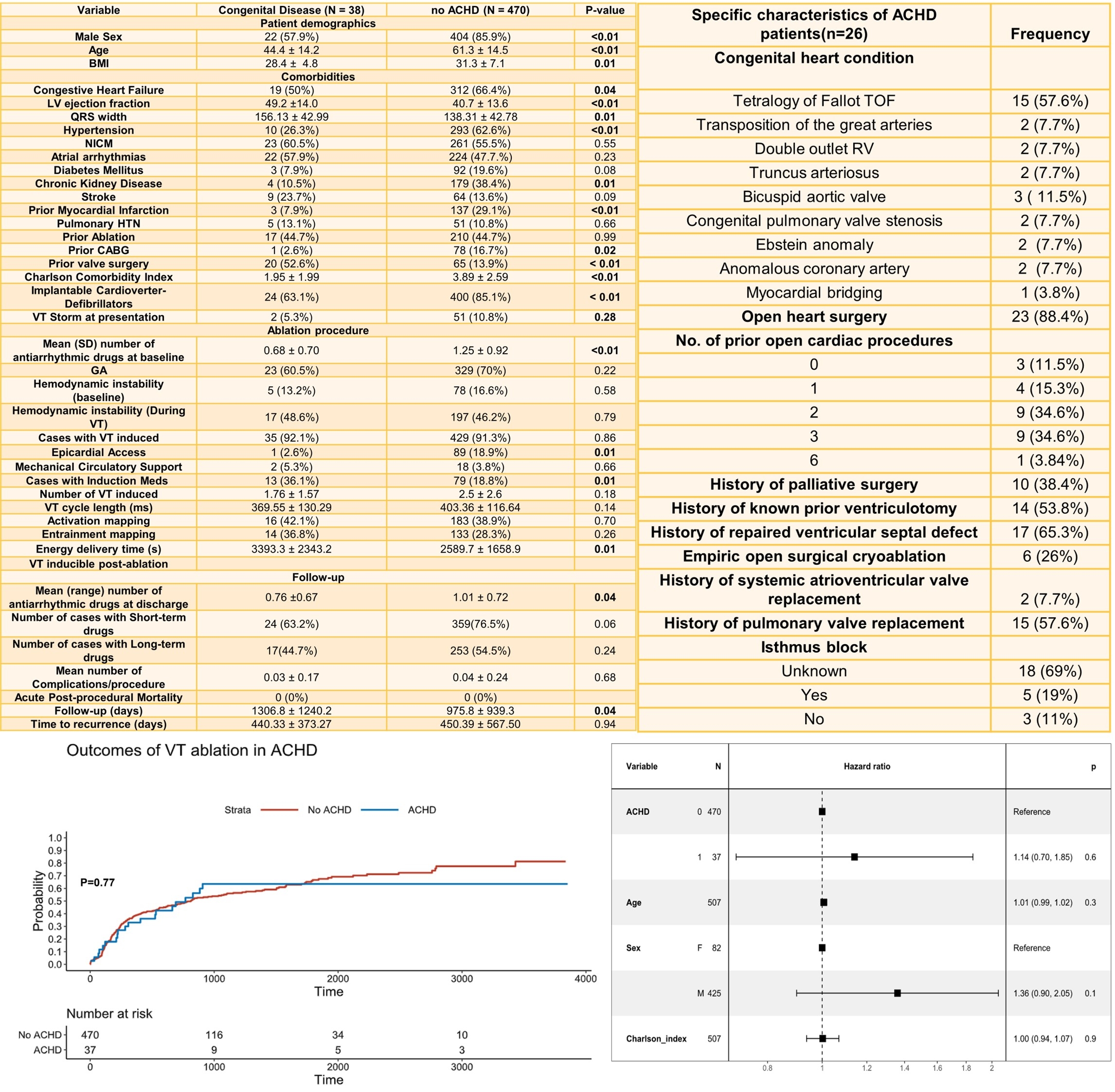
Results: Out of 508 procedures for ventricular tachycardia ablation, 37 were performed in ACHD patients. These patients were younger compared to the non-ACHD subtype.(Table 1). Out of 26 patients with congenital heart disease, a majority had a diagnosis of tetralogy of Fallot (57.6%) and 69% had 2-3 prior open-heart surgeries, including ventriculotomy (53.8%), ventricular septal defect repair (65.3%), and pulmonary valve replacement (57.6%) (Table2). They had a higher mean LVEF,and lower burden of comorbidities including hypertension, chronic kidney disease, and myocardial infarction compared to their non-ACHD counterparts and had been on fewer antiarrhythmics at baseline. ACHD patients were less likely to require epicardial access, but the requirement for induction meds was higher, and energy delivery times were longer. There were no significant differences in the VT characteristics and mapping techniques between the two groups. There were no significant differences in outcomes including complications, and time to recurrence, and a Kaplan-Meier analysis showed no significant difference in VT free survival when ACHD patients were compared to patients without ACHD (Figure 3). After adjusting for age, sex and comorbidities, ACHD was not a predictor of having VT recurrence or repeat ablation (aHR =1.1 (0.7-1.9), p=0.6)
Conclusion: VT ablation in patients with ACHD is safe, and as effective as ablation in non-ACHD patients. Procedure times tend to be longer owing to a more challenging substrate.
Futela, Pragyat
( MetroHealth Medical Center
, Cleveland
, Ohio
, United States
)
Poddar, Aastha
( Mayo Clinic
, Rochester
, Minnesota
, United States
)
Kowlgi, Gurukripa
( Mayo Clinic
, Rochester
, Minnesota
, United States
)
Author Disclosures:
Pragyat Futela:DO NOT have relevant financial relationships
| Aastha Poddar:DO NOT have relevant financial relationships
| Gurukripa Kowlgi:DO NOT have relevant financial relationships