
Logo

American Heart Association

  23
  0


Final ID: 4359746

Safety and Feasibility of Hyperkalemic Cardioplegia with Diazoxide in Cardiac Surgery: CPG-DZX Trial

Abstract Body (Do not enter title and authors here): Introduction
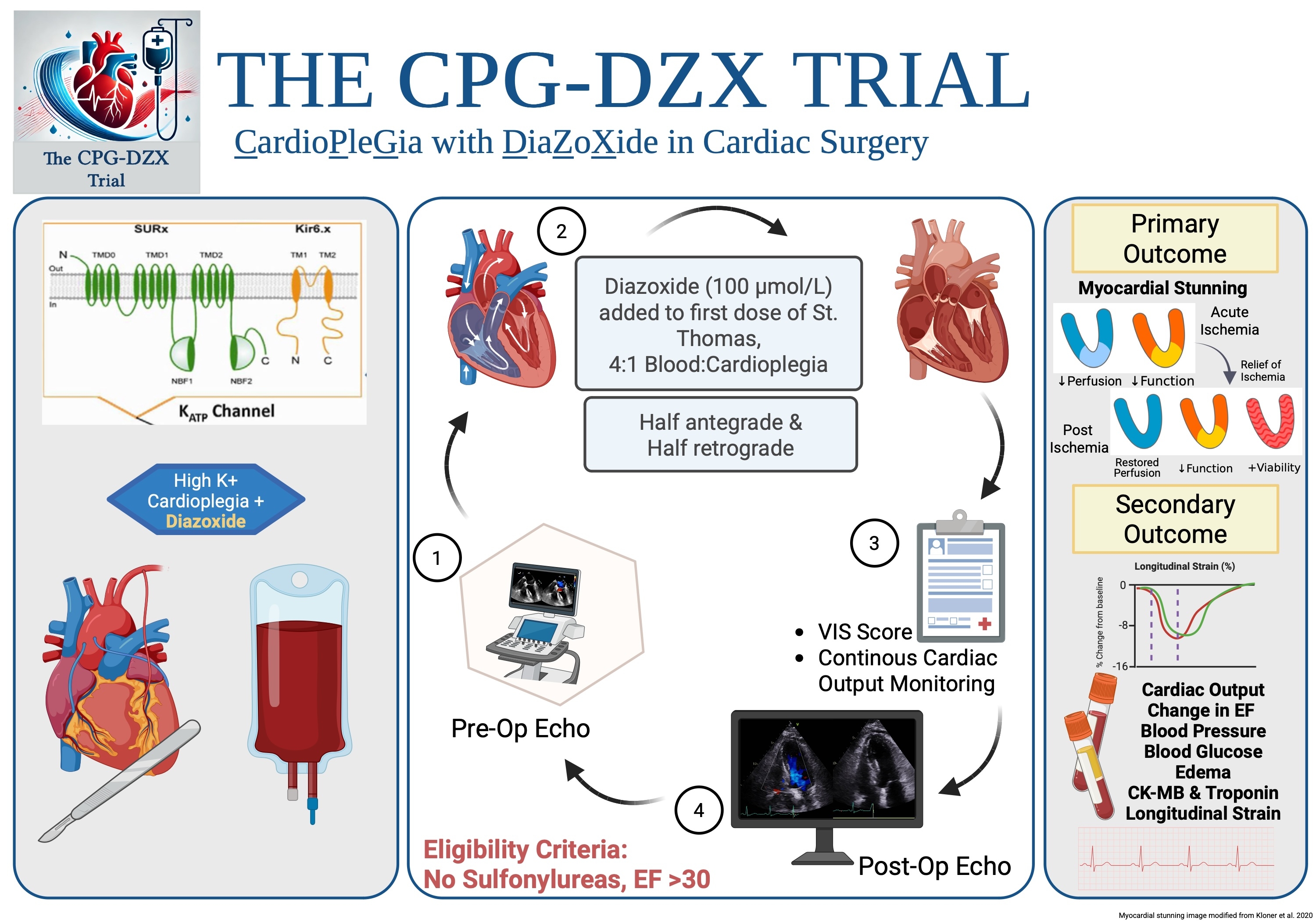
Adenosine triphosphate-sensitive potassium (KATP) channel opener diazoxide (DZX) is cardioprotective in multiple translational animal models. We report the first in human FDA approved Phase I safety and feasibility trial of diazoxide in hypothermic hyperkalemic cardioplegia in patients undergoing cardiac surgery. The aim of this study was to demonstrate the safety and feasibility of DZX in patients undergoing cardiac surgery. The results will support a future Phase III randomized controlled trial to evaluate stunning in patients after cardiac surgery with DZX.

Hypothesis
We hypothesize that DZX can be safely administered in hypothermic hyperkalemic cardioplegia in cardiac surgery.

Methods
Patients undergoing non-emergent cardiac surgery (coronary artery bypass, aortic, or valve) received 100 microM/L intracoronary DZX delivered in the first dose of hypothermic, hyperkalemic cardioplegia at the time of cross-clamp placement. Patients on KATP channel inhibitors or with left ventricular ejection fraction (LVEF) <30% were excluded. Primary safety endpoints were changes in blood glucose, mean arterial pressure (MAP), and weight gain. Additional data collected included the presence of myocardial stunning (using a novel definition of the need for mechanical and/or inotropic support >24 and <72 hours), the difference in pre- and postoperative LVEF, and time to wean from bypass.

Results
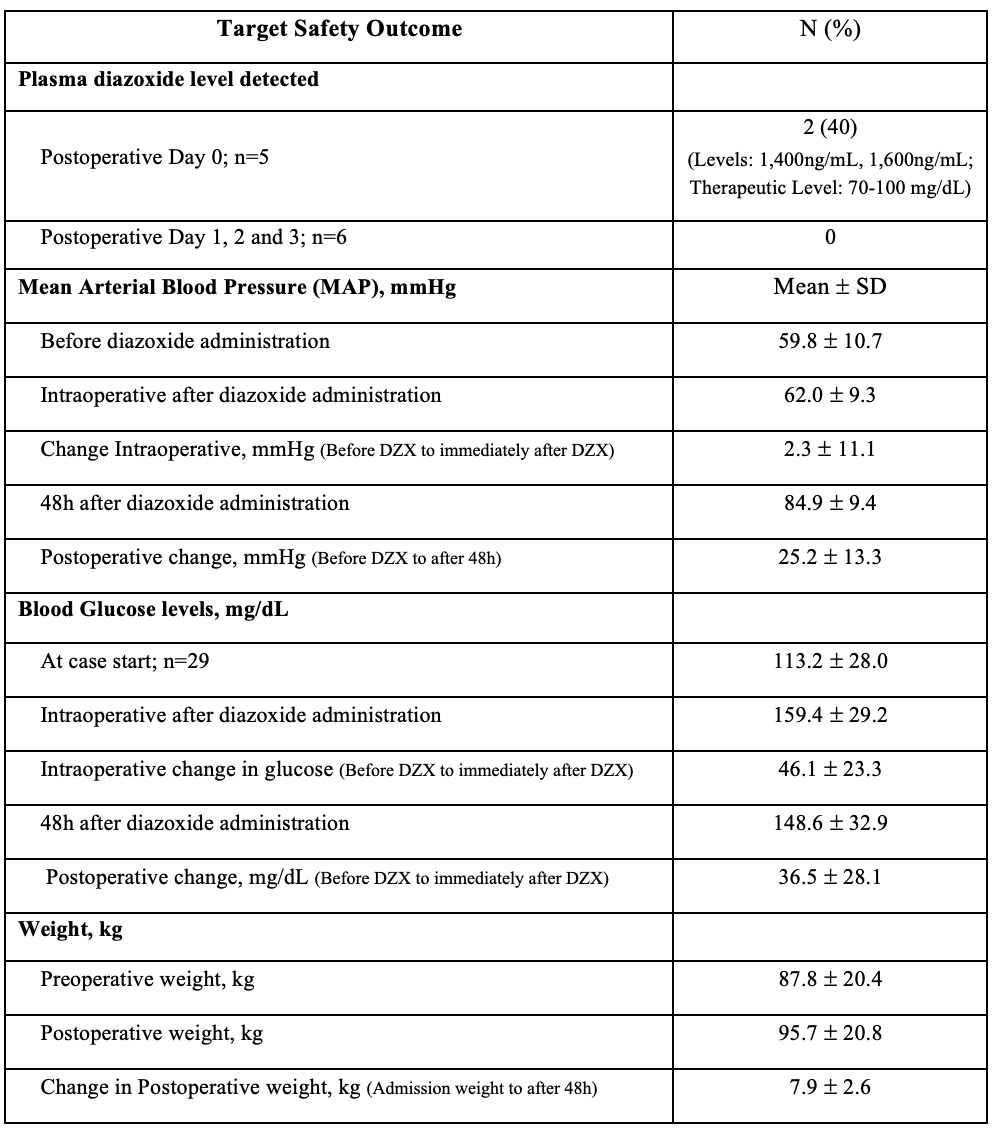
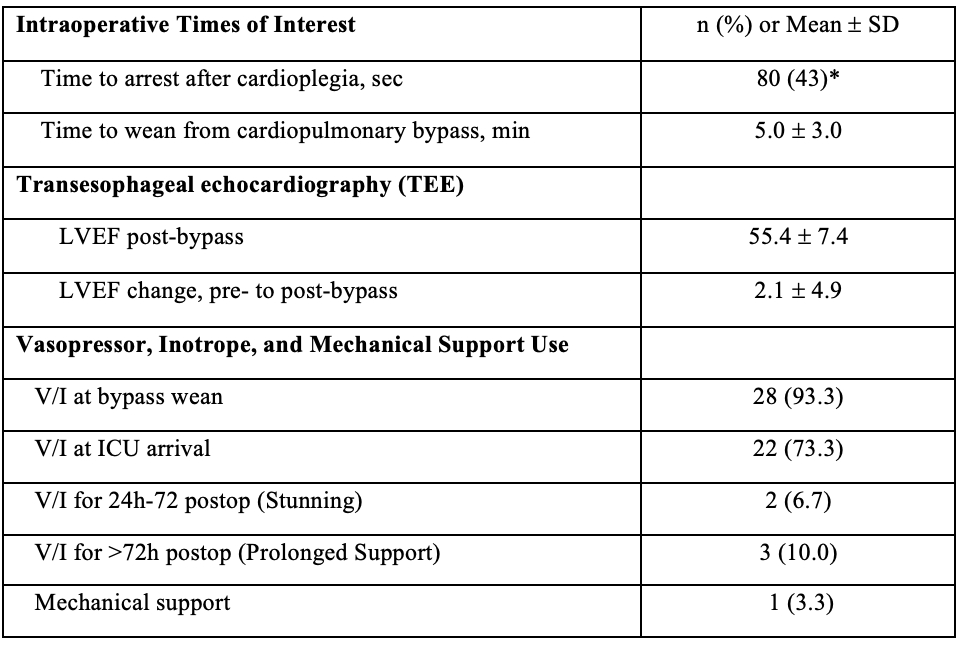
Thirty patients received intracoronary DZX. One serious adverse event occurred, unrelated to DZX. The mean MAPs before DZX were 59.8 mmHg (last intraoperative MAP before DZX) and 62.0 mmHg (lowest MAP within 5 min after DZX). Intraoperative glucose before DZX was a mean of 113 mg/dL (at case start) and a mean of 159 mg/dL after DZX (point-of-care, intraoperative). Patients gained a mean of 7.9 kg postoperatively (preoperative weight compared to 48-hr postoperative) (Table 1). In the first 12 hrs postoperatively, mean peak lactate was 5.6±5.1 and peak troponin was 12,531±18,615 ng/L. Two patients (6.7%) had stunning. Intraoperative transesophageal echocardiography (TEE) pre- and post-bypass showed that mean LVEF significantly increased from baseline (2.1±4.9%, p=0.024). Mean time to cardiac arrest was 80±44 seconds, and time to wean from bypass was 5±3 min (Table 2).

Conclusion
Intracoronary DZX can be safely administered in hypothermic hyperkalemic cardioplegia in cardiac surgery.
  • Briscoe, Jessica  ( Johns Hopkins University , Baltimore , Maryland , United States )
  • Bradshaw, Alleabelle  ( Johns Hopkins University , Baltimore , Maryland , United States )
  • Robinson, Zyriah  ( Johns Hopkins University , Baltimore , Maryland , United States )
  • Fornaresio, Lisa  ( Johns Hopkins University , Baltimore , Maryland , United States )
  • Aziz, Hamza  ( Johns Hopkins University , Baltimore , Maryland , United States )
  • Lawton, Jennifer  ( Johns Hopkins University , Baltimore , Maryland , United States )
  • Author Disclosures:
    Jessica Briscoe: DO NOT have relevant financial relationships | AlleaBelle Bradshaw: DO NOT have relevant financial relationships | Zyriah Robinson: DO NOT have relevant financial relationships | Lisa Fornaresio: No Answer | Hamza Aziz: No Answer | Jennifer Lawton: DO NOT have relevant financial relationships
Meeting Info:

Scientific Sessions 2025

2025

New Orleans, Louisiana

Session Info:

William W. L. Glenn Lecture

Sunday, 11/09/2025 , 08:00AM - 09:15AM

Abstract Oral Session

More abstracts on this topic:
More abstracts from these authors:
Myocardial Protection by Adenosine Triphosphate-Sensitive Potassium Channel Opener Diazoxide Involves Sulfonylurea Receptor (SUR) 2 Subunit

Wang Jie, Bradshaw Alleabelle, Tryon Robert, Pan Rachel, Holmes Sari, Nichols Colin, Lawton Jennifer

Challenging Case: Acute Type A Aortic Dissection with Multi-Organ Malperfusion

Agarwal Rishab, Bradshaw Alleabelle, Lawton Jennifer

You have to be authorized to contact abstract author. Please, Login
Not Available